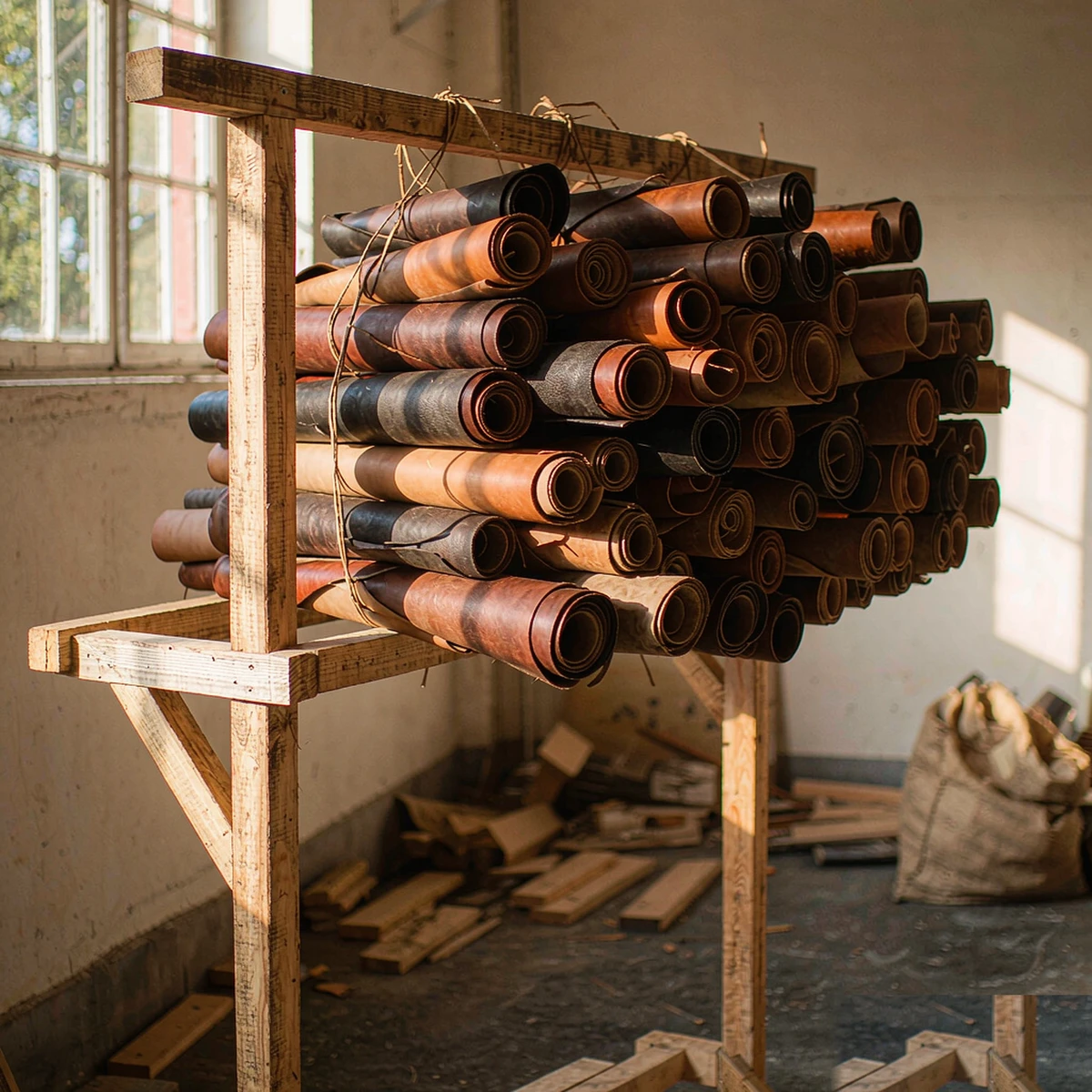
A bag factory's quality problem often begins before the first stitch. Leather arrives with scars, growth marks, tick bites, healed wounds and colour variation; fabric arrives with slubs, bowing, oil spots and shade bands. If those defects are discovered at final inspection, the material has already been cut, stitched and packed, and the argument is about who pays for the scrap.
Incoming material inspection exists to move that discovery earlier. The four-point system is the most widely used scoring method in the trade because it produces a single number per unit of material, which can be compared against an agreed acceptance level and used to reject a delivery rather than absorb it.
How the Four-Point System Scores
The system assigns penalty points to each defect according to its length, over a defined area of material. The classic application is to woven fabric, where a linear yard or metre across the full width is the inspection unit, and the score is normalised to points per hundred square yards or per hundred square metres.
| Defect length | Penalty points |
|---|---|
| Up to 3 inches (75 mm) | 1 |
| Over 3 inches up to 6 inches (75–150 mm) | 2 |
| Over 6 inches up to 9 inches (150–230 mm) | 3 |
| Over 9 inches (230 mm) | 4 |
| Any hole or opening regardless of size | 4 |
Four points is the maximum for any single defect in one inspection unit, whatever its length. That rule is what stops one long running defect from swamping the score and hiding the rest of the roll's condition.
Applying It to Leather
Leather does not come in a continuous roll, so the method is adapted. Each hide is inspected on the flesh side and the grain side, and defects are scored within a defined usable area — normally excluding a border of several centimetres around the edge, where natural stretch and thinning are expected.
The practical difference is that leather defects are not random in the way fabric defects are. They cluster: the belly and shoulder areas are looser and mark more readily than the backbone. A hide that scores badly on the whole area may still yield a clean cutting plan if the cutting is nested around the defect map. This is why leather inspection is normally paired with a defect map and a nesting decision rather than a simple accept or reject on a single score.
Defect mapping pays for itself
Marking each defect on the hide with a chalk circle and photographing the marked hide turns the inspection into a cutting tool. The clicker can then nest around the marks instead of discovering them under the knife.
Programme parameters at a glance
| Parameter | Commitment |
|---|---|
| Minimum order quantity | 500 pieces per style / colourway |
| Sampling lead time | 6–10 working days (12–15 days for complex constructions) |
| Bulk production lead time | 35–50 days after sample approval |
| Inspection standard | AQL 2.5 (ISO 2859-1), single sampling, general level II |
| Incoterms | FOB Xiamen — EXW, CIF and DDP available on request |
| Payment terms | T/T 30% deposit / 70% before shipment; L/C at sight for container loads |
| Verified production floor space | 4,950 m² (SGS-verified) |
| Team | 137 staff across 7 production lines |
| Equipment | 149 machines including computerised saddle-stitch and edge-painting units |
| Monthly capacity | 200,000 pieces |
| Entity | Founded 2014; principal has worked in bag development since 2004 |
What Counts as a Defect
Scoring is only as consistent as the defect list. Agreeing the list before the first delivery is the single most useful hour in an incoming inspection programme.
- **Holes, cuts and tears** — any breach, scored at four points regardless of size.
- **Growth marks and healed scars** — visible on the grain; scored by length, and separately noted if the grain is affected structurally.
- **Tick and insect damage** — small but numerous; normally scored individually, which is why a badly affected hide can accumulate a high total quickly.
- **Colour variation and shade bands** — not always a four-point item; usually handled as a separate shade assessment against the approved standard.
- **Finish defects** — coating skips, orange peel, scratching in the finish, and uneven gloss. These matter most on finished and corrected-grain leathers.
- **Loose or spongy areas** — a structural rather than a cosmetic defect; scored by area and critical on any panel that will carry load.
- **Slubs, bowing, skew and oil spots** on woven fabric — bowing and skew are normally measured separately, because they affect cutting yield rather than appearance.
Sampling: How Much to Inspect
Inspecting every metre of every roll is uneconomic, and inspecting one roll out of fifty is theatre. The workable middle ground is an AQL-based sample on the delivery, with the acceptance level agreed in advance. Textile practice commonly uses an inspection level that samples a percentage of rolls plus a percentage of each selected roll.
For leather, the usual approach is to inspect a defined proportion of hides per lot — ten to twenty percent is common for a first delivery — and to treat the sample as representative only if the lot came from a single tannery batch. Mixed batches should be sampled per batch, not per delivery, because the variation between them is exactly what the inspection is looking for.
Setting the Acceptable Score
The four-point system is normally paired with an acceptance threshold expressed as points per hundred square units. Twenty points per hundred square yards is a widely used benchmark for apparel fabric; heavier bag materials and leather often justify a different figure, and the number should be set against the cutting yield the programme can tolerate.
| Material | Indicative acceptance | Rationale |
|---|---|---|
| Coated fabric, body panels | ≤ 20 points per 100 yd² | Large flat panels tolerate some marking but visible defects concentrate on the face |
| Lining fabric | ≤ 25 points per 100 yd² | Interior panels are largely hidden; cost pressure is higher |
| Full-grain leather, visible panels | ≤ 12 points per hide in the usable area | Grain defects are visible and cannot be corrected |
| Corrected-grain or finished leather | ≤ 18 points per hide | Finishing hides some natural marks |
| Structural webbing and strapping | Zero critical defects | Any defect is at a load path |
Whatever figure is agreed, write the formula down: the unit of measure, the inspection area, the defect list, the sampling plan and the threshold. A threshold without a formula is a negotiation, not a specification.
Where the Method Breaks Down
Four-point scoring has three well-known weaknesses worth stating plainly. It does not weight defects by their position, so a four-point defect in a dead-centre front panel counts the same as one on a panel that will be cut away. It does not capture defects that only appear after processing — shrinking, heat sensitivity, poor adhesion and colour migration all show up later. And it is an inspection of the material, not of the material's behaviour on the line.
The practical response is to add what the score cannot carry: a defect map for leather, a small trial cut or bonding test for any new material, and a wash or heat test where the construction involves fusing. Incoming inspection catches what is visible; a trial run catches what is latent.
Recording and Using the Data
Inspection data earns its keep when it is aggregated over time. Per-lot scores plotted by supplier and by material reference show whether a supplier is stable, drifting, or shipping a bad batch and hoping. A supplier whose scores are consistently just inside the threshold is a different risk from one whose scores are usually excellent with occasional spikes.
Keep the photographs. A scored hide with visible chalk marks and a lot number is the only evidence that will survive a commercial argument six weeks later, when the material has been cut and the balance of the delivery returned.
Fitting It Into a 500-Piece Programme
For a 500-piece run the material volume is modest, and the cost of a formal incoming inspection is a few hours of one inspector's time. Spread against the cost of remaking panels cut from a defective hide, it is close to free.
QUANZHOU JUNYUAN BAGS inspects incoming leather and fabric against an agreed four-point threshold before cutting is released, and pairs the score with a defect map so nesting can work around marked areas. The same data feeds the AQL 2.5 final inspection, which is where workmanship is judged — the two checks answer different questions.
Score the material before it is cut
Send the material list and the panels that show. The programme team will propose a defect list, a sampling plan and an acceptance threshold that fits the cutting plan.
Frequently Asked Questions
What is the four-point system?
A defect scoring method that assigns one to four penalty points to each defect according to its length, with any hole scored at four, normalised to points per hundred square yards or metres of material and compared against an agreed acceptance threshold.
What is an acceptable four-point score?
Twenty points per hundred square yards is a common benchmark for apparel fabric. For bag materials the figure is usually set against cutting yield, and for full-grain leather a hide-based threshold in the low teens is more typical because grain defects cannot be corrected.
Does the four-point system work for leather?
It works as a scoring framework but needs adaptation. Leather is inspected per hide within a defined usable area, and the score is normally combined with a defect map because leather defects cluster and can often be nested around.
Should I inspect every roll and every hide?
No. Use an AQL-based sample of the delivery, commonly a percentage of rolls plus a percentage of each selected roll, and ten to twenty percent of hides on a first leather delivery. Sample per production batch rather than per delivery when a lot mixes batches.
What defects should be excluded from scoring?
Natural characteristics that match the approved standard — grain variation on aniline leather, growth marks within the accepted character, and colour variation within the agreed shade range. Scoring these as defects means the specification and the inspection disagree.
How do I handle colour variation separately?
Use a shade assessment against the approved standard under a controlled light source, normally a light box at a specified colour temperature. Shade variation is a different question from physical defect and is usually judged against a range rather than scored in points.
What happens to a lot that fails the threshold?
The usual options are rejection, acceptance with a negotiated allowance, or acceptance with the defective units replaced. The important thing is that the consequence is written into the purchase order before the delivery arrives, so the conversation is about applying a rule rather than inventing one.
Can incoming inspection catch latent defects?
Not reliably. Shrinkage, heat sensitivity, poor adhesion and colour migration appear after processing. For any new material, add a small trial cut, bond or heat test alongside the visual inspection.
Who should do the inspection?
Either a trained in-house inspector or a third-party inspection company, provided the defect list and the acceptance formula are the same for both. A third party scoring against a different list produces numbers that cannot be compared with your own.
Does four-point inspection replace final AQL inspection?
No. Incoming inspection judges the material; AQL 2.5 final inspection judges workmanship in the finished bag. They catch different problems at different points in the flow, and both are needed.