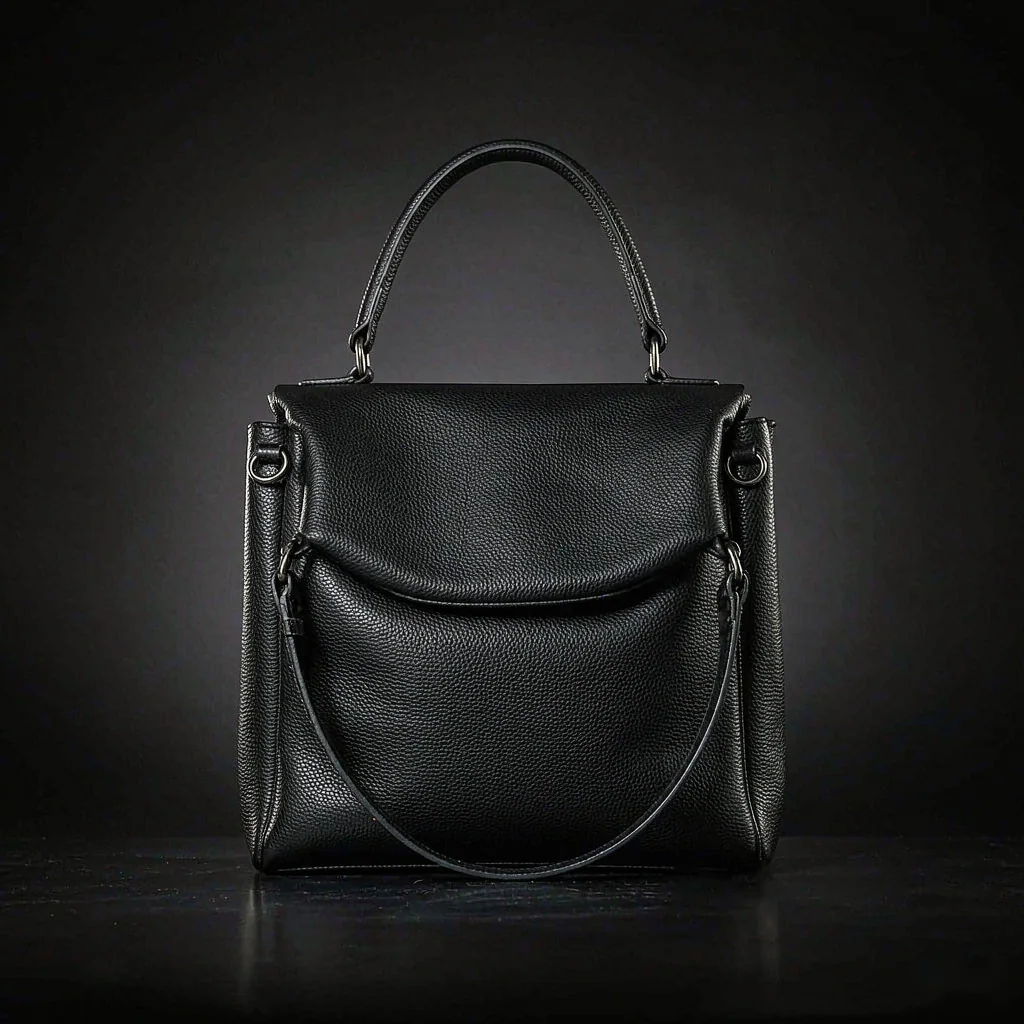
Custom Handbags Engineered for Everyday Carry
A practical development guide for branded handbags whose handles, opening, gusset and base must remain balanced through daily use.
A custom handbag is an everyday hand- or shoulder-carried bag built to a buyer-defined silhouette, material and interior. MOQ is 500 pieces per style and colourway; samples take 6–10 working days, complex builds 12–15, and bulk 35–50 days after approval. Inspection uses AQL 2.5, ISO 2859-1, general level II.
Programme parameters at a glance
| Parameter | Commitment |
|---|---|
| Minimum order quantity | 500 pieces per style / colourway |
| Sampling lead time | 6–10 working days (12–15 days for complex constructions) |
| Bulk production lead time | 35–50 days after sample approval |
| Inspection standard | AQL 2.5 (ISO 2859-1), single sampling, general level II |
| Incoterms | FOB Xiamen — EXW, CIF and DDP available on request |
| Payment terms | T/T 30% deposit / 70% before shipment; L/C at sight for container loads |
| Verified production floor space | 4,950 m² (SGS-verified) |
| Team | 137 staff across 7 production lines |
| Equipment | 149 machines including computerised saddle-stitch and edge-painting units |
| Monthly capacity | 200,000 pieces |
| Entity | Founded 2014; principal has worked in bag development since 2004 |
The everyday handbag begins with the hand
A handbag succeeds when its opening, handle and centre of gravity work together. The user should be able to set it down without the body rolling, reach the main compartment without fighting the handle roots, and lift a normal payload without the top line bowing. Those behaviours are designed into the pattern. Styling alone cannot correct an anchor positioned too close to a gusset fold or a base that is too narrow for the intended load.
The first brief should identify how the piece is carried, what it normally holds and whether it must stand when empty. A 28 cm office top-handle carrying a tablet needs a different base and handle pitch from a 34 cm soft day bag carrying a scarf and cosmetics. QUANZHOU JUNYUAN BAGS translates that use case into a pattern, component schedule and measurable approval sheet rather than treating every handbag as the same scaled shell.
Choose the silhouette by access pattern, not by sketch alone
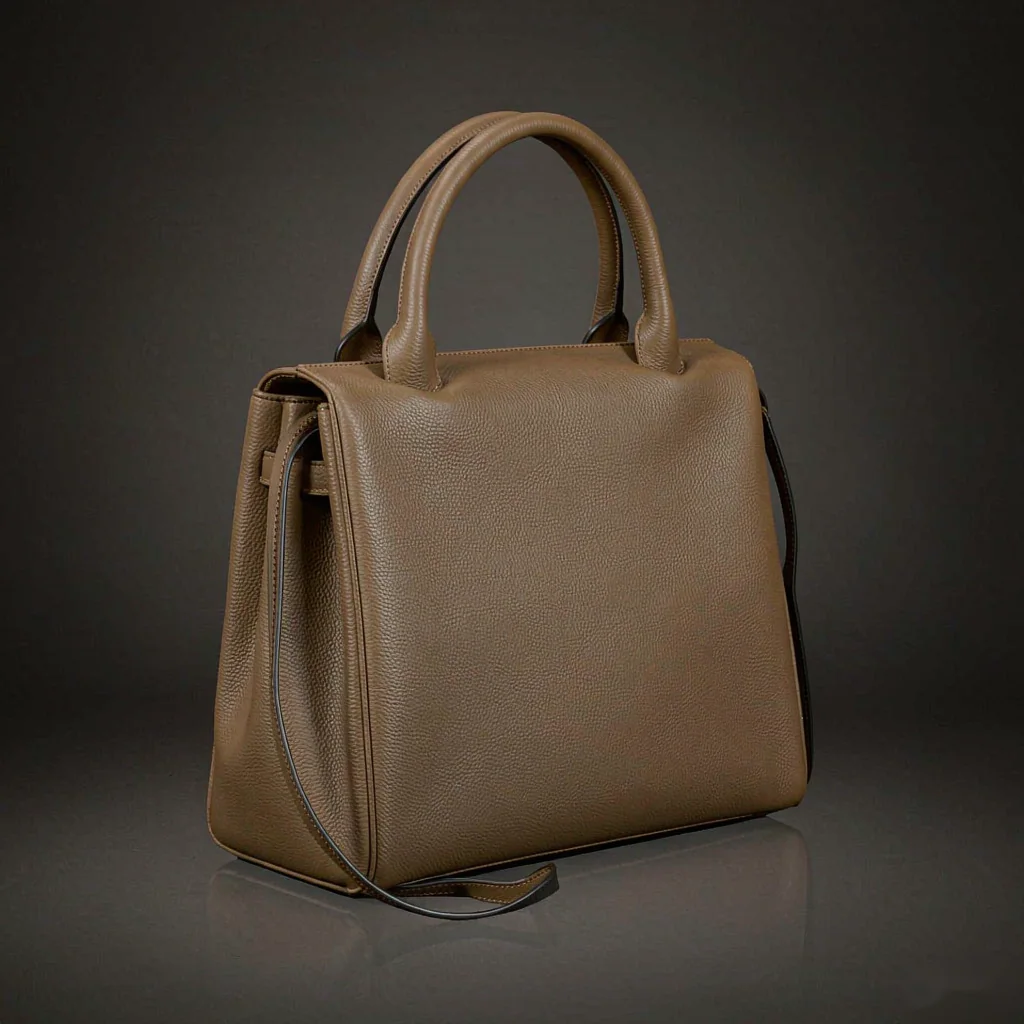
Top-handle, shoulder, doctor, bucket and frame styles can share a visual language while demanding different engineering. A rigid top-handle concentrates load at two small attachment zones. A bucket distributes load around a drawcord channel but risks mouth distortion. A shoulder bag places the strap pull on one side of the body and needs the gusset to resist twist. The useful question is not which outline looks attractive; it is where the user applies force every time the bag opens, closes or lifts.
| Handbag architecture | Nominal body | Material callout | Critical attachment | Release limit |
|---|---|---|---|---|
| Compact top-handle | 26 × 19 × 9 cm | 1.25 mm firm grain | Handle tabs over 0.70 mm backing | Left/right tab offset ≤ 1.5 mm |
| Soft shoulder form | 33 × 24 × 11 cm | 0.95 mm milled hide | Strap end buried 35 mm into seam | Top-line wave ≤ 3 mm |
| Double-gusset day bag | 31 × 23 × 13 cm | 1.20 mm pebble grain | Gusset return and base corner | Paired gussets within 2 mm |
| Drawcord bucket | 24 × 28 × 14 cm | 1.05 mm pliable leather | Eyelet band with continuous doubler | Cord path runs freely at 12 points |
| Frame-opening handbag | 29 × 21 × 10 cm | 1.30 mm smooth leather | Frame channel and hinge ends | Closed frame gap ≤ 0.7 mm |
| Convertible day style | 30 × 22 × 10 cm | 1.15 mm semi-firm hide | Top handle plus two strap rings | Detachable hooks face outward |
Follow the force from handle core to base board
The handle is only as reliable as the layers below its visible tab. For a medium top-handle, a practical stack is body leather, a 0.70 mm non-woven or microfibre reinforcement, a second leather doubler around the fastener, and the lining carried clear of the post. The reinforcement extends at least 18 mm beyond the stitch or washer in every direction. A decorative rivet should never be the only load-bearing element; the tab needs a stitched perimeter or buried tail that transfers force into the body panel.
At the bottom, a 1.0–1.4 mm board can keep a structured handbag level, while a soft model may use a removable 0.8 mm insert so the drape is not lost. Corners receive skived doublers rather than full-thickness stacks, which create hard ridges visible through smooth leather. If feet are fitted, their washers sit above the base reinforcement and below the lining. The assembly order belongs in the specification because the same components arranged differently do not deliver the same service life.
- Mark every handle centreline and require the pair to sit within 1.5 mm of the approved position.
- Use a 20 mm minimum inside width for rings carrying a 16 mm leather tab, leaving movement without edge cutting.
- Specify a 4.0–4.5 mm post where a screw-back fitting passes through a reinforced handle tab.
- Keep magnetic catches at least 12 mm from the folded panel edge to avoid a visible sink mark.
- Turn zip ends into covered garages so the slider does not strike exposed lining or scratch hardware.
- Skive layered leather gradually over 15–20 mm; abrupt thickness changes telegraph through the face.
Run the prototype as a sequence of decisions
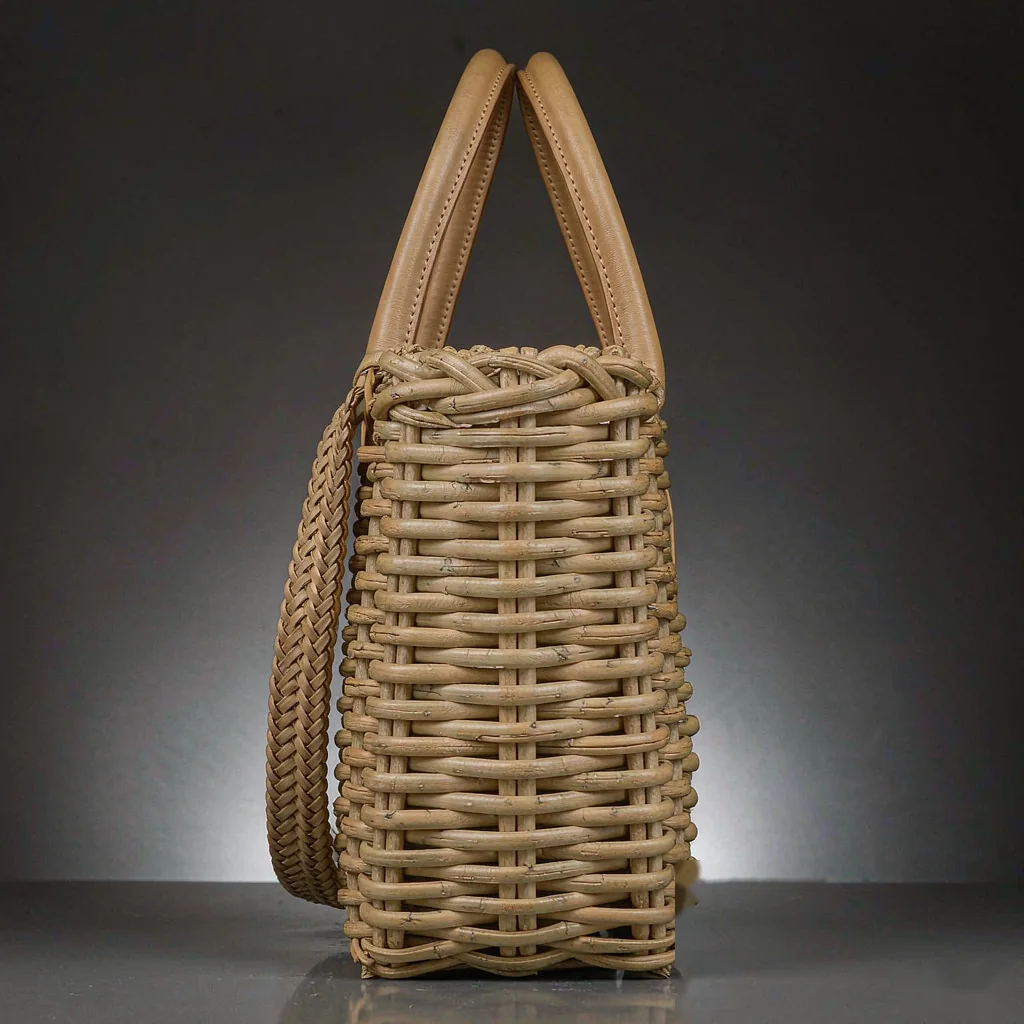
Sampling is most efficient when each review answers a defined question. A first prototype should not be judged as if it were finished stock; it establishes volume, posture, reach and attachment geometry. Colour and final plating can follow once the shape works. Standard samples take 6–10 working days. A handbag needing a new frame, cast closure or moulded handle moves to the 12–15 working-day window because a component first article must be checked with the bag, not in isolation.
- List the carried objects and set the target payload before agreeing the outside dimensions.
- Review a paper or low-cost pattern mock-up for opening width, hand clearance and pocket reach.
- Build the first sewn prototype and assess it empty, loaded, held in the hand and worn with any detachable strap.
- Record corrections as measurements: move a tab 4 mm, widen the zip opening 12 mm, or lower a pocket 8 mm.
- Approve leather, lining, thread, edge paint and hardware against physical swatches rather than screen images.
- Seal the pre-production sample made with intended bulk components and sign its measurement report.
- Release bulk only after the approval record, 30% T/T deposit and pack-out instructions are complete.
Grade failures by what the customer experiences
Common failures are not equally serious. A loose handle post, an exposed sharp edge or a closure that opens under normal load affects safety or function. A 4 mm logo shift may be visually unacceptable but does not disable the bag. Minor natural grain variation may be permitted if the hide map defines where it can appear. The defect library should therefore show physical examples and classify them before inspection starts; arguing about descriptions beside packed cartons is too late.
Five handbag faults that reveal an incomplete specification
- Top-line smile: the opening dips between handle roots because reinforcement stops too early or the load path is too narrow.
- Rotating tab: a single fastener allows the handle base to pivot; a stitched outline or second locating point is required.
- Base hammock: the centre sags below the feet because the board is undersized, unsupported or cut against the pattern grain.
- Edge-paint fracture: coating is too rigid for the fold radius, or thick layers were not dried between applications.
- Closure drift: the lock aligns while empty but misses when loaded because the flap and front panel stretch differently.
Acceptance checks should recreate those risks. Load the handbag to 6.0 kg for 30 minutes, then compare handle spacing, base deflection and lock alignment with the sealed sample. Open and close the primary hardware repeatedly, inspect edge paint under raking light, measure paired features from fixed datum points and verify the intended phone or tablet actually fits. ASTM D2209 can inform leather elongation conversations, while chemical requirements for the destination market can be specified with reference to REACH (EC) 1907/2006. The applicable test plan must be agreed for the actual material set.
Move from signed sample to a controlled Quanzhou run
Bulk scheduling begins after sample approval and normally occupies 35–50 days. Leather is shade-sorted before cutting; paired handles, gussets and highly visible panels should come from compatible zones. Top-of-run pieces establish stitch tension and edge colour before volume continues. Mid-run pulls then expose drift in skiving, handle pitch or hardware position while correction is still possible. The SGS-verified production floor in Quanzhou, Fujian covers 4,950 m² with 137 staff, seven lines and 149 machines; stated monthly capacity is 200,000 pieces across programmes.
Final inspection follows ISO 2859-1 single sampling at general level II with AQL 2.5. The checklist should combine measurements, function, workmanship, shade grouping, barcode and pack-out. Standard commercial terms are T/T, 30% deposit and 70% before shipment after release. Freight is quoted FOB Xiamen; CIF or DDP can be coordinated on request. Structured small-batch pilots may be available for a qualifying launch, but the normal order floor remains 500 pieces for each style and colourway.
Plan the interior before the exterior is frozen
The interior decides whether a handbag is used daily or abandoned after a week. Briefs usually describe the outside in detail and the inside in a sentence, and the result is a phone slip buried under the handle root, keys abrading the lining, or a device bay a few millimetres too narrow once lining, foam and seam allowance are counted. Interior planning should run alongside the shell, not after it. Each pocket receives three recorded numbers: position from a fixed datum, usable opening and finished internal depth.
| Interior zone | Typical specification | Position datum | Fault it prevents | Bulk check |
|---|---|---|---|---|
| Phone slip | 90 × 160 mm internal clear, reinforced mouth | 70 mm below top line, 25 mm off the gusset seam | Pocket folding inward under load | Gauge card enters without forcing |
| Zip security pocket | No. 3 coil, 150 mm opening, garage at both ends | Centred on back panel, 40 mm above base | Slider catching the lining return | Fifty cycles with no snag |
| Device bay | Clear opening 8 mm over the device diagonal | Against the back panel over 3 mm foam | Corner crush at a tight radius | Test block passes at both corners |
| Key leash | 12 mm webbing, 150 mm travel, swivel hook | Anchored on the side seam facing the gusset | Hook twisting under the lining | Hook lies flat when empty |
| Card stack | Four to six slots, 2 mm growth per filled slot | Front facing, clear of the closure path | Full stack blocking the lock | Lock closes with a full stack |
| Removable base | 0.8–1.2 mm board in a lined sleeve | Base area inset by 6 mm | Insert rattling or telegraphing | Insert seats flat and lifts free |
Lining selection belongs to the same decision. A 210D polyester lining adds almost no weight and lets contents slide out; a suedeed microfibre lining raises perceived value but holds dust and thickens corners. Whichever is chosen, the specification should state the internal clear dimension rather than the panel cut size, because the internal figure is what the customer's hand and device actually meet.
Specify hardware by mass, plating and cycle life
Hardware is where a handbag is judged first and returned last. A light-feeling closure, a dragging slider or plating that marks clothing reads as a quality failure even when the leather is excellent. The brief should therefore name the base metal, the plating type and its thickness in microns, the finish and the expected cycle life, because a fitting selected from a photograph can look correct on the sample and dull by the second shipment.
Colour-matched or custom-plated fittings are a separate purchase with their own lead time and, for some finishes, a component-level minimum. They belong in the first brief rather than a late revision. Where a lock carries load, the post and washer are specified together with the handle stack so the fastener and the reinforcement are approved as one assembly rather than as two independent parts.
Select leather for temper, then control shade across the run
Temper, not colour, is the first leather decision. The same hide in a firm and a milled finish produces two different handbags from one pattern: the firm version holds a crisp top line and needs a slightly wider opening to reach into, while the milled version drapes, forgives a tight gusset and shows handle-root movement sooner. Once temper is agreed, thickness, finish and grain character follow, and the hide map defines which panels may carry natural marks. The luxury leather materials library sets out these choices in more depth.
| Leather direction | Typical substance | Best use | Watch for | Approval record |
|---|---|---|---|---|
| Firm full-grain bovine | 1.20–1.35 mm | Structured top-handle and frame bodies | Stiff corners if skiving is skipped | Temper and shade swatch signed |
| Semi-milled hide | 1.05–1.20 mm | Day bags needing body with softness | Top-line wave when hung loaded | Loaded posture photograph |
| Pebbled grain | 1.10–1.30 mm | High-touch daily handbags | Grain depth varying between lots | Grain reference retained |
| Soft nappa | 0.90–1.10 mm | Relaxed and slouch silhouettes | Handle-root elongation | Local backing specified |
| Suede or split | 0.90–1.20 mm | Accent panels and gussets | Pile shading and soiling | Direction of pile fixed |
| Microfibre alternative | 0.80–1.00 mm | Programmes with a non-animal brief | Different edge-finish behaviour | Edge finish approved separately |
Shade control is a planning task rather than a finishing one. Hides are shade-sorted before cutting, pair parts such as handles, gussets and flaps are cut from compatible zones, and cutting direction is fixed so panels on the same bag reflect light identically. Because dye lots differ, a repeat order should reference the retained shade standard instead of a new photograph, and any acceptable tolerance is written as a physical range.
Read the cost drivers, pack-out and the second season together
A handbag quotation is driven by four things beyond size: hide yield, hardware tooling, hand-finishing minutes and edge treatment. A pattern that nests poorly across a hide costs more per piece than a slightly larger bag that cuts cleanly. A custom cast lock carries a tooling charge and a component minimum. Hand-applied edge paint on a curved flap adds minutes that no machine recovers. Naming which of these the buyer wants to protect turns costing into a trade-off instead of a negotiation.
- Confirm whether the target price covers the bag alone or the bag, dust bag, carton and labelling together.
- Agree tooling ownership for custom locks, feet and logo plates before the first sample is cut.
- Fix carton quantity, inner packing and barcode placement at costing so pack-out is specified rather than improvised.
- Decide whether retail-ready presentation — tissue, dust bag, hangtag, barcode label — is applied on the production floor or at the destination.
- Record the second-season plan: retained patterns, tooling and shade standards make a repeat run a confirmation rather than a redevelopment.
- Where the destination market requires it, gather REACH (EC) 1907/2006 or CPSIA material documentation against the order reference before shipment.
Standard commercial terms are T/T with a 30% deposit and 70% before shipment, quoted FOB Xiamen; CIF or DDP can be coordinated where a wider logistics scope is wanted. The minimum remains 500 pieces per style and colourway, with structured small-batch pilots considered for a qualifying launch. Send the brief to service@junyuanbags.com or reach the programme team on WhatsApp at 0086 17750020688, or start from the contact page.
Start with the carried objects and handle geometry
Share the target dimensions, payload, reference images and preferred leather. We will develop a measurable handbag brief covering structure, attachments, sample gates and final inspection.
Frequently Asked Questions
Which briefing details prevent a handbag handle revision?
State whether the bag is hand-held, elbow-carried or shoulder-carried; give the handle drop, intended payload, tab width and preferred construction. Also note whether it must clear a coat sleeve. These details determine pitch, core diameter and reinforcement. A reference measurement taken from a bag your customer already likes is particularly useful.
How is a handbag gusset kept symmetrical in bulk?
The approved pattern uses notches and fixed datum points rather than relying on the operator to judge the curve. Paired gussets are checked for length before closing, then the completed bag is measured at matching points. For the double-gusset example on this page, a difference greater than 2 mm would be held for review.
What daily payload should a medium handbag prototype carry?
The value should come from the intended contents, not a category assumption. For a medium day handbag, 6.0 kg is a useful static development load, followed by checks for handle-root movement, base sag and closure alignment. A smaller fashion piece may need less; a tablet-carrying style may need more and a longer-duration trial.
Does the 500-piece handbag MOQ apply to every colour?
Yes. The standard minimum is 500 pieces for each style and colourway, because each colour creates its own leather, lining, edge-paint and production-control commitment. A structured pilot below that level may be discussed where stock components and the programme economics allow it, but it is not the standard bulk basis.
Why seal a pre-production handbag instead of approving photographs?
A photograph cannot record handle feel, opening resistance, leather temper, loaded posture or the exact depth of an emboss. The sealed sample gives the production and inspection teams a physical benchmark. Its signed measurement sheet and approved material swatches remove ambiguity when the first line pieces are compared with what the buyer accepted.
How are edge-paint limits written for a curved handbag panel?
The specification names the colour, number of coats, sheen and acceptable coverage, then identifies the tightest fold radius. Review looks for pinholes, overflow, ridges and fracture after flexing. Curves are judged against the sealed sample under consistent light; the team does not rely on a vague instruction such as clean edge.
What evidence accompanies release of a handbag shipment?
The release file can include the signed pre-production record, material approvals, measurement results, applicable test reports, AQL inspection outcome and final packing data. Destination-specific chemical documentation should be agreed in the brief. The lot is inspected at AQL 2.5 under ISO 2859-1, single sampling, general level II before shipment.
How should FOB Xiamen timing be planned after handbag approval?
Allow 35–50 days for bulk after the sample is approved, then include inspection, booking and port cut-off in the launch calendar. Standard payment is 30% T/T deposit and 70% before shipment. FOB Xiamen is the default shipment basis, while CIF or DDP can be requested when the buyer wants a different logistics scope.
Can the interior be changed after the shell sample is approved?
Interior pockets can be revised after the shell sample, but the cost is a new lining pattern and a further prototype. Listing the phone, card, key and device positions in the first brief avoids that round. Where a change is unavoidable, expect the pocket datum to move with the seam allowance rather than staying where the sketch placed it.
What should a handbag hardware brief state about plating?
Name the base metal, the plating type and its thickness in microns, the finish and the expected cycle life, then approve a physical fitting rather than an image. Custom finishes outside the stock range carry extra lead time and sometimes a component minimum, so they belong in the first brief.
How is leather shade matched on a repeat handbag order?
The retained shade standard and swatch set from the first run are the reference. Hides are shade-sorted before cutting, pair parts come from compatible zones and cutting direction is fixed. A repeat order should quote the original standard; a new photograph is not a specification.
Which decisions move unit cost the most on a custom handbag?
Hide yield, hardware tooling, hand-finishing minutes and edge treatment. A pattern that nests poorly costs more than a slightly larger bag that cuts cleanly; a custom cast lock adds tooling and a component minimum; hand-applied edge paint on curves adds minutes. Agree which of these to protect before costing.
Can handbags be delivered retail-ready with dust bags and barcodes?
Yes, when it is specified at costing. Tissue, dust bag, hangtag, barcode label and carton quantity can be packed on the production floor or left for the destination. Pack-out, labelling and carton quantity are written into the order so the line follows one instruction.