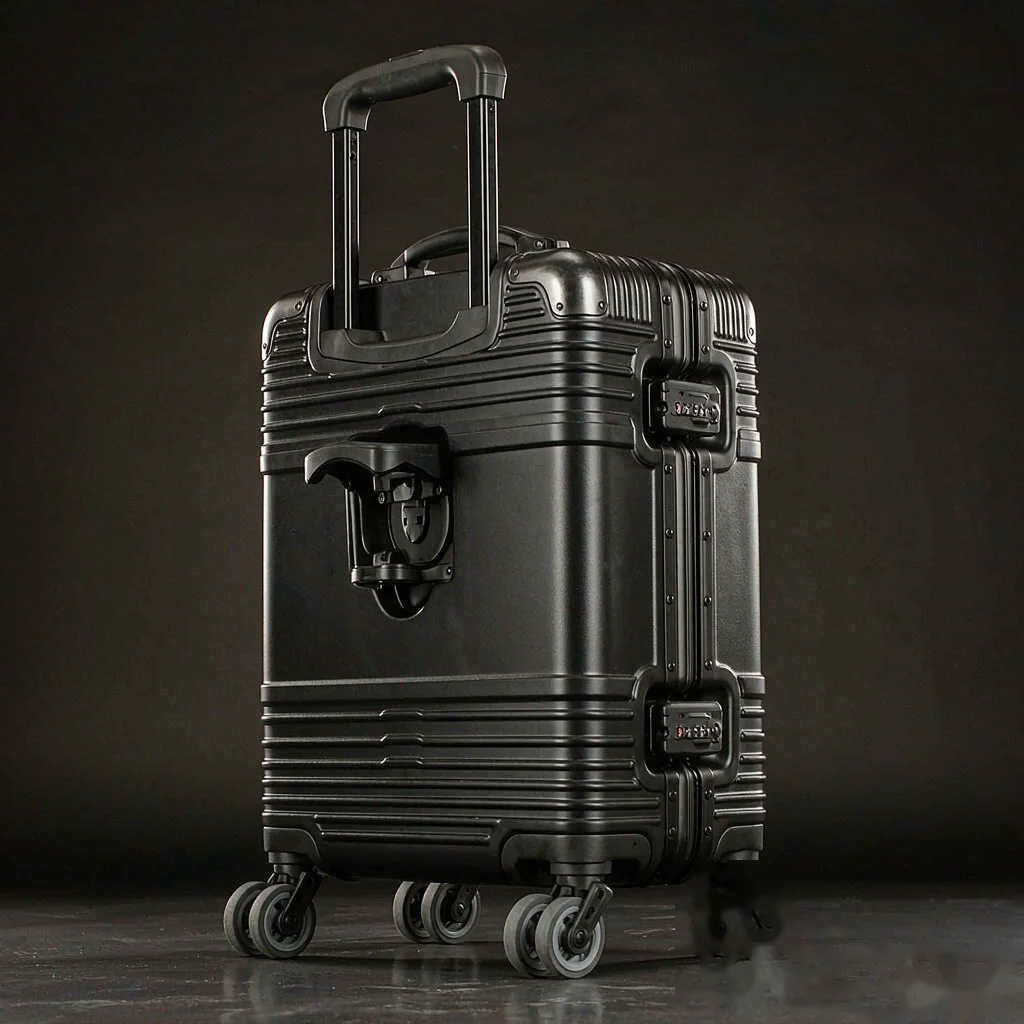
Bespoke Travel & Luggage
Cases specified as a platform rather than as single sizes — shell thickness, wheel set, handle stage and test regime fixed once and shared across the range.
Bespoke travel luggage covers the wheeled pieces of a travel range: cabin trolleys, medium and large check-in cases, wheeled hybrids and the frames, wheels and handles that make them work. Shell, chassis, closure, lock and interior are set by you and locked in a sealed pre-production sample. Runs start at 500 pieces per style and colourway; sampling takes 6–10 working days, extending to 12–15 where a new shell or custom hardware is developed; bulk runs 35–50 days after approval, inspected to AQL 2.5 under ISO 2859-1 and shipped FOB Xiamen.
Programme parameters at a glance
| Parameter | Commitment |
|---|---|
| Minimum order quantity | 500 pieces per style / colourway |
| Sampling lead time | 6–10 working days (12–15 days for complex constructions) |
| Bulk production lead time | 35–50 days after sample approval |
| Inspection standard | AQL 2.5 (ISO 2859-1), single sampling, general level II |
| Incoterms | FOB Xiamen — EXW, CIF and DDP available on request |
| Payment terms | T/T 30% deposit / 70% before shipment; L/C at sight for container loads |
| Verified production floor space | 4,950 m² (SGS-verified) |
| Team | 137 staff across 7 production lines |
| Equipment | 149 machines including computerised saddle-stitch and edge-painting units |
| Monthly capacity | 200,000 pieces |
| Entity | Founded 2014; principal has worked in bag development since 2004 |
Shell Platforms: Hard, Soft and Hybrid
The shell decision is made once and then lives with the range for years, because it sets the weight floor, the impact behaviour and the tooling. It is also the decision that determines what the case can be branded with and how it can be repaired, both of which matter long after the first shipment.
Thickness, weight and impact behaviour
Polycarbonate flexes and springs back, which suits cabin cases that get thrown into bins; ABS and ABS-polycarbonate blends are stiffer and cheaper but mark more; polypropylene is lightest and takes a hard knock cold; aluminium-framed constructions are the heaviest and the most repairable. Thickness is specified per face, and it is never uniform: corners and the wheel-box area carry more material than the lid.
| Size | Body H × W × D (cm) | Volume (L) | Target empty weight (kg) | Wheel count |
|---|---|---|---|---|
| Cabin | 55 × 40 × 20 | 36–42 | 2.6–3.2 in polycarbonate | Four double spinners |
| Compact check-in | 61 × 42 × 24 | 52–58 | 3.2–3.8 | Four double spinners |
| Medium | 66 × 45 × 27 | 65–75 | 3.8–4.4 | Four double spinners |
| Large | 76 × 50 × 30 | 95–110 | 4.4–5.0 | Four, larger diameter |
| Wheeled hybrid | 68 × 38 × 32 | 70–80 | 3.0–3.6 | Two inline wheels |
Weight appears in every retail comparison and every airline allowance, so the target is set in grams at costing and audited on the sealed sample. A cabin case that arrives 400 g over target is a different product from the one that was signed off.
Wheel Sets, Bearings and Housings
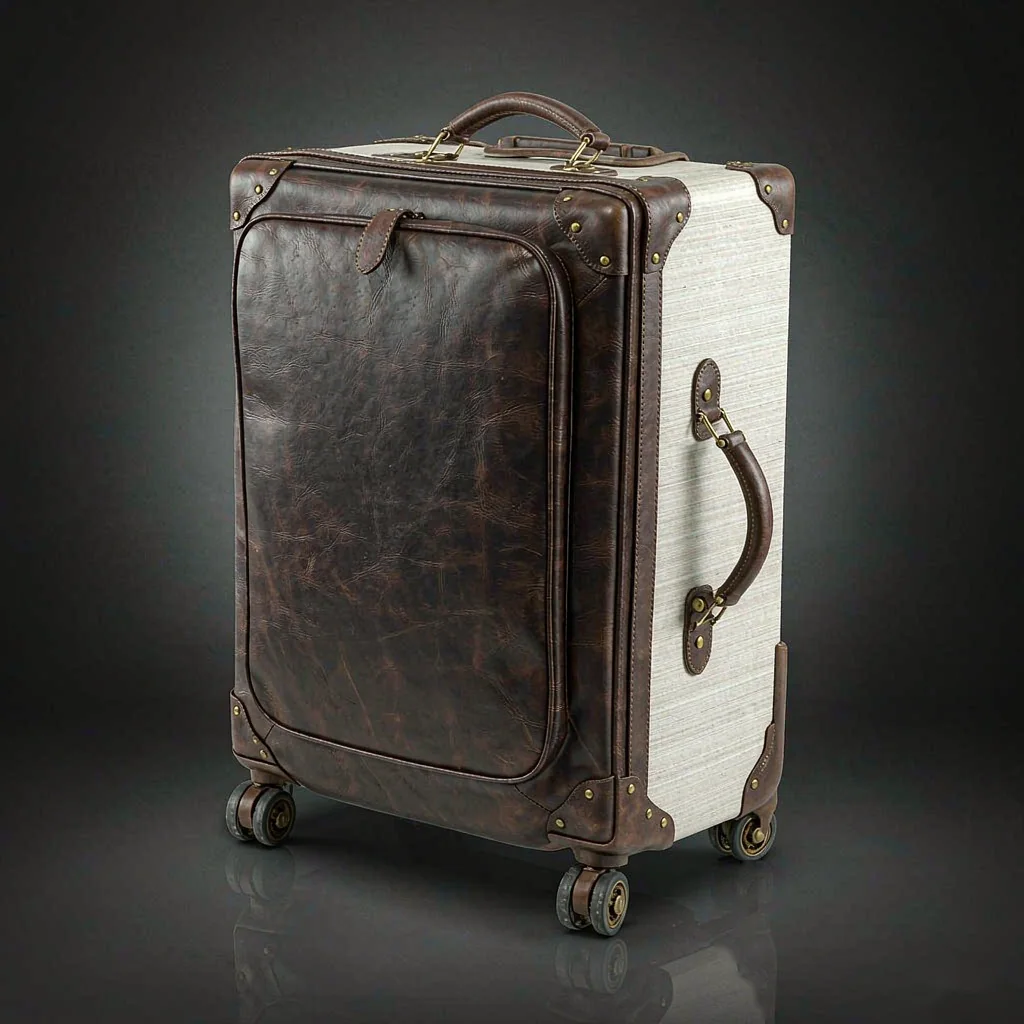
Wheels are the most replaced component in luggage and the cheapest to specify properly. Diameter, tyre material, bearing type and how the housing is fixed to the shell together decide whether a case is quiet after six months or rattling after six flights.
- Recessed versus surface-mounted — recessed wheels protect the housing and lower the centre of gravity; surface-mounted plates are easier to replace and add 12–15 mm of height.
- Tyre compound — softer compounds run quieter on terminal floors and wear faster on rough pavement; 82 Shore A is the usual compromise.
- Housing reinforcement — the wheel box is the thickest area of the shell, and on soft builds it sits on a moulded cup bonded to a board.
- Noise and floor marking — light-coloured tyres are specified for hospitality and cruise programmes where floor marking is inspected.
- Inline sets — two larger wheels suit hybrids pulled over kerbs and gravel, and they cost less than four spinners.
A walking test is the only honest way to compare wheel sets. Cases are run loaded on a treadmill or a drum with an obstacle strip, and the comparison is made on tyre wear, housing temperature and noise after distance rather than on how the wheel feels in the hand.
Telescopic Handle Systems
Handle specification reads simply — stages, tube section, release mechanism — and performs differently depending on tolerance. Play at full extension is the complaint users notice first, and it comes from tube wall thickness, bushing quality and how the stage locks, not from the number of stages.
Two-stage handles suit cabin cases and keep weight down; three-stage handles suit taller check-in sizes, where a short handle forces the user to walk with the case angled. Oval tube at roughly 20 × 15 mm with a 1.2 mm wall in aluminium is the common specification; steel costs more and suits crew programmes.
Closures, Locks and Frame Choices
Closure follows the shell. Zipped cases take a heavy anti-burst chain with two sliders; framed cases take latches set into an aluminium section. The lock then follows the closure, and it has to be decided at costing because the housing is built into the shell or the frame.
| Test | Load or condition | Duration | Acceptance |
|---|---|---|---|
| Wheel running | 25 kg in the case, obstacle strip every 12 m | 12 km at 4 km/h | Tyre wear under 1 mm, no housing crack |
| Handle cycling | 15 kg in the case, full extension each cycle | 5,000 cycles | No jamming, lateral play under 2.5 mm |
| Loaded drop | 15 kg cabin, 20 kg check-in, six faces | One drop per face at 0.9 m | Shell closes and rolls; no split at the wheel box |
| Cold impact | Cabin case conditioned to minus 10 °C | Three drops at 0.9 m | No cracking at corners or the shell lip |
| Tumbling | 18 kg load, rotating drum | 50 revolutions | No latch opening, no wheel loss |
| Closure endurance | Chain or latches, loaded | 3,000 cycles | No tooth separation, no latch misalignment |
Cold-impact testing is the one most often skipped and the one that catches polypropylene and thin ABS. A case that survives a warm drop can crack at the lip in a winter arrival hall, and the fix is material thickness at the corners rather than a different polymer.
Component Traceability and Spares Planning
- Every wheel, handle, lock and latch is listed by supplier and part number on the specification, not by description.
- Incoming component lots are checked for concentricity, handle play and lock function before they reach the line.
- The sealed sample is retained with its component list, so a re-order two seasons later matches what shipped.
- Spare wheel sets, handle units and lock bezels are ordered with the first run, typically 2–3 per cent of units.
- Replacement parts are packed separately and marked, so a warehouse can find them without opening a case.
- Repair instructions and a component diagram are issued with the programme where the brand services its own cases.
Spares bought at the time of the first order cost a fraction of the same parts bought later, because the tooling is still set and the component order is already placed. It is the cheapest decision in the whole programme and the one most often deferred.
Planning a Size Platform
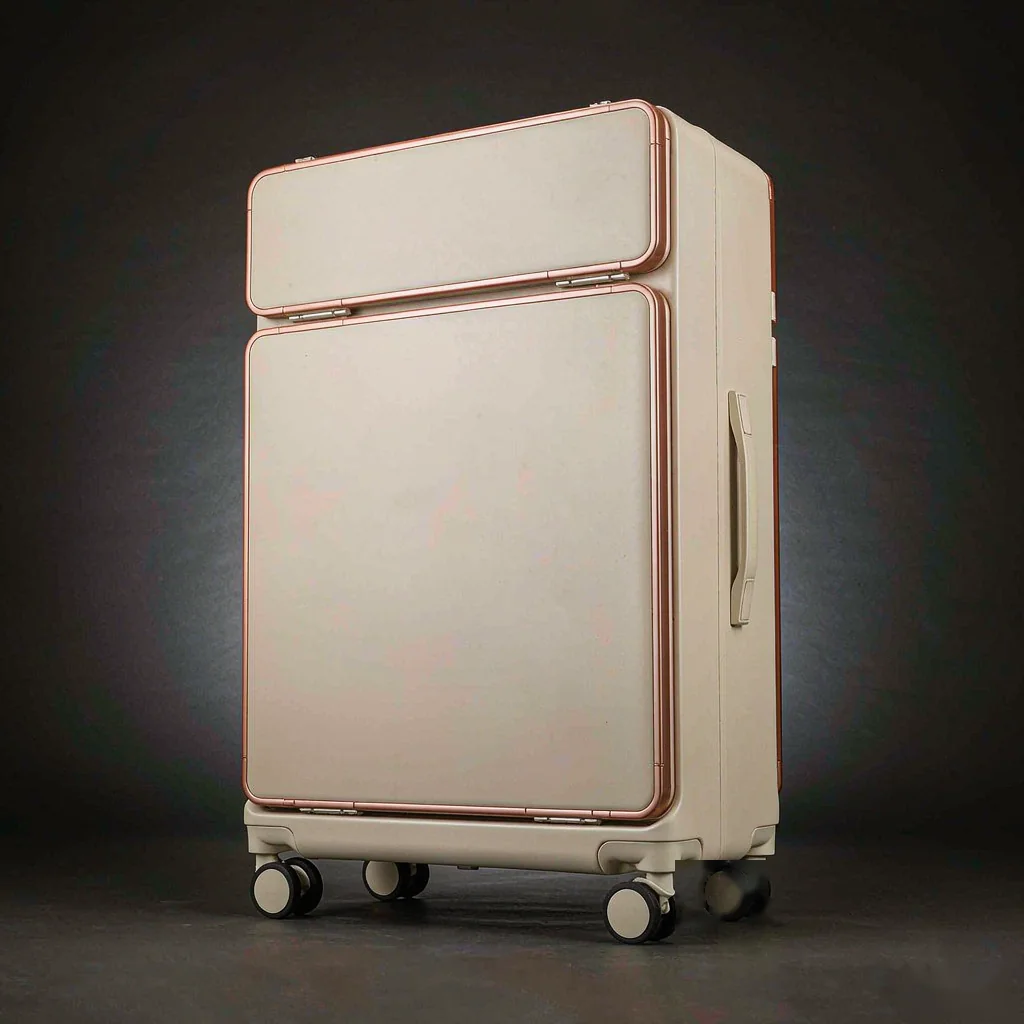
Luggage is almost never developed as one size. A platform of two or three cases shares a shell family, a wheel set, a handle and a lock, which spreads tooling across the range and keeps re-orders consistent. The platform also decides how the range nests for freight, which is where a surprising amount of landed cost sits.
- Nesting — cabin into medium into large, with a nesting allowance of 25–30 mm per step, cutting shipping cube by roughly a third.
- Tooling spread — one wheel set and one handle across three sizes, with the shell as the only new tool per size.
- Shared trim — one lining, one webbing, one puller and one plating reference across the platform, approved in a single lab-dip pass.
- Lot sampling — AQL 2.5 under ISO 2859-1, single sampling, general level II, defects graded critical, major and minor.
- Compliance — REACH and CPSIA declarations with the programme; OEKO-TEX Standard 100 linings and LWG-sourced leather trim on request.
Programmes are coordinated from Quanzhou, Fujian, on an SGS-verified 4,950 m² floor with 137 staff, 7 lines and 149 machines, with documented quality and environmental procedures aligned with ISO 9001 / ISO 14001 principles. Cast hardware, shell tooling and component intake run in parallel with sampling, so the 35–50 day bulk window starts from a specification that is already complete.
Interior Architecture: Linings, Dividers and Compression
The interior is where a luggage platform stops being a commodity shell and starts behaving like a branded product. Users touch the lining, the divider and the compression system on every trip, and those are also the cheapest parts of the specification to differentiate. Interior decisions belong alongside the shell decision, because lining attachment and divider anchoring points are fixed into the shell tool.
| Interior element | Specification options | What it changes |
|---|---|---|
| Lining fabric | Recycled polyester at 150-210 g/m², OEKO-TEX Standard 100 certified on request | Hand-feel, unit cost and whether a fibre claim can be printed |
| Divider | Full-height zipped panel, half-height mesh, or removable folio | Whether the case packs well for two travellers or one long trip |
| Compression | Webbing straps with cam buckles, or elastic cross-straps | Load stability and how much the case rattles when moved |
| Pocket layout | Zipped mesh on the lid, slip pockets on the body, wet pocket at the base | Whether small items stay findable mid-trip |
| Attachment | Turned and stitched panels, or bonded panels on a moulded board | Whether a lining can be replaced in service |
| Trim references | One webbing, one puller and one plating reference across the platform | Colour consistency between the cabin and the large case |
Lining attachment is the decision with the longest tail. A bonded lining is cheaper and gives a cleaner interior line, but it cannot be replaced without destroying the panel. A turned and stitched lining costs more in labour and can be unpicked at a service point, which matters for programmes where the brand services its own cases under warranty.
- Specify lining weight in grams per square metre rather than by description, so repeat orders match the original hand-feel.
- Keep lining, webbing and puller inside a single lab-dip pass across every size in the platform.
- Anchor the divider to a reinforced point in the shell instead of to the lining alone.
- Place the wet pocket at the base on travel ranges, where bottles and toiletries are most likely to leak.
- Print the brand story on the lid lining rather than the body, since the lid is the first surface a user sees.
Interior volume should be quoted as a packed figure rather than a mathematical one. A 42-litre shell holds noticeably less than 42 litres of clothing once wheel boxes, handle tubes and the divider are accounted for, and publishing the smaller honest number prevents the fitting complaints that follow a launch. Agree the measurement method at costing so the specification sheet and the marketing copy say the same thing.
Interior components are also the easiest place to introduce a compliance gap. Linings, foams, webbing, elastics and the coatings on a wet pocket each carry their own restricted-substance exposure, and a recycled-content claim made on the lining needs the same evidence trail as any claim printed on the carton. Programmes that name interior suppliers and part numbers at costing can answer a retailer's questionnaire in days rather than reopening the specification after the first shipment has already sailed.
Cabin Compliance and Airline Allowance Planning
Cabin cases are bought against a rule the buyer does not control. Allowances differ by carrier, by fare class and by region, and a case that clears one gauge will be gate-checked on another. Programmes sold into more than one region need a stated allowance target and a stated tolerance before the shell tool is cut.
The practical approach is to design the cabin case to the smallest gauge in the target market and then decide deliberately whether to offer an expander. An expander is a genuine selling point on a check-in size and a liability on a cabin size, because the customer will use it and then hold the case responsible when it fails the sizer.
- State the allowance target on the specification sheet including wheels and handle, not the body alone.
- Publish packed volume and empty weight together, since many long-haul routes are weight-limited.
- Keep the cabin case on the platform's shared wheel and handle set so the gauge is not lost to a taller housing.
- Confirm printed allowance wording with the brand's own reviewer for each sales region.
- Retain the signed-off gauge drawing with the sealed sample so a re-order matches what shipped.
Weight is usually the tighter constraint on long-haul routes. A cabin case at 3.2 kg leaves a traveller far less usable allowance than one at 2.6 kg, and the difference is typically a thinner lid panel or a two-stage handle rather than a different polymer. Setting the empty-weight target in grams at costing is what keeps that trade-off visible while it can still be changed.
Retail channels add a second layer of rules on top of the airline gauge. Marketplaces and department-store retailers each publish their own luggage dimension and weight fields, and a listing that disagrees with the printed specification generates returns that are logged against the brand rather than against the carrier. Publishing one verified set of figures, taken from the sealed sample rather than from the drawing, and reusing that same set across the product page, the carton and the marketplace feed removes most of that exposure before the first unit ships.
Branding and Decoration Routes on Hard and Soft Shells
Decoration is chosen against the shell, and a poor pairing fails in the field rather than in the sample room. A badge that sits well on a flat polycarbonate lid will lift at the corners on a textured shell within a season, and a print that survives the showroom will abrade at the wheel-box contact points. Decide the decoration with the shell surface and then approve it on the sealed sample.
| Method | Suits | Durability | Watch point |
|---|---|---|---|
| Moulded-in logo | Any moulded shell | Permanent | Tooling cost and a longer lead time before the first shot |
| Metal badge | Flat areas on hard shells | High | Adhesion on textured surfaces; needs a recessed seat |
| Screen print | Smooth hard shells and coated fabrics | Moderate | Abrasion at contact points; specify a rub-fastness target |
| Heat transfer | Lining and webbing | Moderate | Colour match under retail lighting |
| Emboss or deboss | Leather trim, patches and soft panels | High | Depth limited by substrate thickness |
| Laser etch | Aluminium frames and hardware | High | Contrast varies with anodising colour |
Placement matters as much as method. The lid edge, the wheel-box side and the handle grip are the three areas a user touches most, and decoration there takes the most abrasion. The upper lid face and the lid lining are the two surfaces that stay clean longest, which is why brand marks usually end up there regardless of how the exterior looks in a studio photograph.
- Approve decoration on the actual shell surface rather than on a flat sample panel.
- Set a rub-fastness or adhesion target for printed marks on the specification sheet.
- Keep the badge plating reference shared with hardware so both age at the same rate.
- Recess badges on textured shells so the edge is not the first point of failure.
- Check artwork placement against the nested orientation, since a mark can be hidden once cases are stacked.
Branding also drives the re-order logic. A moulded-in logo is permanent and ties the programme to a tool, while a badge or a print can change between seasons without new tooling. Brands running seasonal capsules usually take the printed or badged route for exactly that reason, and keep the moulded route for a core platform expected to run unchanged for several years.
Decoration materials need the same documentation discipline as the shell. Inks, adhesives and plating all sit inside the restricted-substance declaration for the programme, and a badge adhesive chosen only for bond strength can introduce a substance the brand's compliance file does not cover. Listing the decoration consumables by supplier and part number alongside the hardware keeps the REACH and CPSIA declarations complete at the point they are requested.
Landed Cost Modelling for a Luggage Platform
Unit price is the number everyone negotiates and the number that matters least on its own. Freight cube, duty classification and the spare-parts holding shape the landed figure just as much, and all three are decided before the first shipment rather than at booking. Modelling them at costing is what stops a competitive unit price turning into an uncompetitive landed one.
| Cost driver | Typical effect | Control lever |
|---|---|---|
| Shell polymer and thickness | Largest single material line | Specify thickness per face rather than uniformly |
| Wheel set and bearings | Second-largest component line | One wheel set shared across the platform |
| Handle stages and tube wall | Weight and cost move together | Two-stage on cabin, three-stage on check-in only |
| Nesting cube | Freight cost per unit | 25-30 mm nesting allowance per size step |
| Carton specification | Damage rate and freight cube | Right-sized export carton with corner protection |
| Duty classification | Varies by market and construction | Confirmed with the importer before the first booking |
Freight is where the platform approach pays back most visibly. Three nested sizes move in roughly two-thirds of the cube of three individually cartoned cases, and on a container out of Xiamen that difference is often larger than any saving available from trimming the wheel specification. Nesting has to be designed into the shell profile at tooling, so it must be raised at costing rather than at booking.
- Model landed cost per size rather than per range, because the cabin case and the large case behave differently in a container.
- Include the spare-parts holding in the first-season budget instead of treating it as a warranty afterthought.
- Confirm duty classification with the importer before the first booking; construction changes the answer.
- Re-cost the platform annually against polymer and freight indices, since both move more than labour does.
- Hold the sealed sample and its component list so a re-order is re-costed from the same baseline.
Payment structure belongs in the same model. Standard terms are T/T with a 30% deposit and the 70% balance before shipment, FOB Xiamen, which means the freight and duty leg sits with the brand's own forwarder and should be costed on the brand's own rates rather than estimated at the factory gate.
Volume planning is the last input. Runs start at 500 pieces per style and colourway, and that threshold is what sets the unit cost for tooling, component intake and line setup. A platform of three sizes sharing one shell family, wheel set and handle spreads those fixed costs three ways, which is usually the difference between a capsule that clears the target margin and one that only works at a single size.
Brief a luggage platform
Send the size platform, shell preference and volume plan. We will return a component specification and a test schedule.
Frequently Asked Questions
How is shell thickness chosen for a hard case?
Thickness follows the polymer and the size: polycarbonate around 1.4–2.0 mm, ABS and ABS-polycarbonate blends around 2.0–2.4 mm, polypropylene around 2.2–2.8 mm. Corners and the wheel box carry more material than the lid, and cold-impact testing at minus 10 °C is what confirms the choice.
What decides between a zipped case and an aluminium-framed case?
Weight, repairability and price. Zipped cases are lighter and cheaper and take a heavy anti-burst chain with two sliders; framed cases cost more, weigh more and can be re-latched and re-cornered. Crew and airline programmes tend to take frames for serviceability; retail capsules tend to take zips for weight.
How are wheel housings specified so wheels can be replaced?
As bolt-through assemblies with M5 fixings into a reinforced wheel box, so a wheel comes off without opening the lining. Housings are recessed on upright spinner cases and surface-mounted on hybrids. Intake checks cover concentricity within 0.5 mm and bearing condition on every lot.
What does a walking test actually measure?
Tyre wear, housing integrity and noise after distance: 12 km at 4 km/h with 25 kg in the case over an obstacle strip every 12 metres, with acceptance at under 1 mm of tyre wear and no housing cracking. It is a comparison tool between wheel sets rather than a pass-or-fail gate on its own.
How is handle play checked before bulk release?
Handles are cycled 5,000 times with 15 kg in the case, extending and retracting fully each time, and lateral play is measured at full extension with an acceptance limit of 2.5 mm. Play comes from tube wall thickness and bushing quality, so both are stated on the specification rather than left to the component supplier.
Can cases be nested for freight to reduce cube?
Yes. A cabin, medium and large platform nests with a 25–30 mm allowance per step, cutting shipping cube by roughly a third compared with individual cartons. Nesting is designed into the shell profile, so it has to be decided before tooling rather than at booking.
How are shells protected in transit packaging?
Corner protectors, a sleeve or bag over the shell and a carton with enough clearance to stop the case drumming. Printed shells get a tissue or film interleaf. Pack-out is agreed at costing and confirmed on the pre-production sample, because a shell that arrives scuffed is a rejected unit regardless of inspection.
What spare-part ratio should be ordered with the first run?
Two to three per cent of units for wheel sets, handle units and lock bezels is typical for a first season. Parts bought with the original order cost far less than the same parts bought later, and they turn a warranty claim into a five-minute repair rather than a replacement case.
Can a size platform be extended later without retooling?
Sometimes. Adding a size inside an existing shell family usually needs a new shell tool but no new wheel, handle or lock tooling, which is the expensive part. Extending outside the family — a larger check-in or a hybrid — starts a new platform and is costed as one.
How are locks and zips verified against tampering?
Locks are cycled and checked for smooth action and for resistance to being forced open at the bezel, while zip chains are tested for slider separation under a pulling load. TSA-accepted combination locks and zip-to-lock sliders are the usual specification, and the housing is built into the shell or frame at costing.
How is the packed volume of a case quoted for a size platform?
Quote a packed figure measured with wheel boxes, handle tubes and the divider in place, not the mathematical volume of the shell. A 42-litre shell holds noticeably less than 42 litres of clothing once those parts are counted. Agree the measurement method at costing so the specification sheet and the retail copy publish the same number.
Can a cabin case be developed to a specific airline gauge?
Yes. Design to the smallest gauge in the target market, including wheels and handle, and treat the IATA 55 × 40 × 20 cm recommendation as a target rather than a guarantee. Avoid an expander on a cabin size, because customers use it and then hold the case responsible when it fails the sizer.
Which decoration methods survive on a textured polycarbonate shell?
Moulded-in logos are permanent but need tooling; recessed metal badges work well on flat areas; screen prints need a stated rub-fastness target and should avoid wheel-box contact points. Approve the mark on the actual shell surface and on the sealed sample rather than on a flat sample panel.
How is landed cost modelled before the shell tool is cut?
Model it per size rather than per range. Shell polymer, wheel set, handle stages, nesting cube, carton specification and duty classification are all fixed at costing, and standard terms are T/T with a 30% deposit and the 70% balance before shipment, FOB Xiamen. Freight cube is usually where the platform approach saves the most.