
Behind every luxury leather bag sitting on a retail shelf is a production chain that most buyers never see. The distance between a brand owner's design concept and a finished, boxed product ready for shipment is measured in dozens of discrete operations, hundreds of hours of skilled labor, and a series of quality gates that determine whether a bag ships or gets scrapped. Understanding how leather bags are made at the factory level is not just an academic exercise — it directly affects your ability to set realistic timelines, negotiate accurate pricing, and identify the differences between a factory that will protect your brand reputation and one that will undermine it.
This guide walks through the complete luxury bag manufacturing process step by step: design development, pattern making, leather cutting, stitching, assembly, edge finishing, hardware installation, quality control, and packaging. For each stage, we cover the time required, the cost implications, and the specific quality benchmarks that separate premium manufacturing from cost-cutting alternatives. Whether you are evaluating your first OEM partner or auditing an existing supply chain, this is the operational knowledge you need.
The Complete Leather Bag Manufacturing Process: 7 Stages Overview
A luxury leather bag moves through seven major stages in a professional OEM factory. Each stage has its own specialized team, equipment, and quality checkpoints. The total timeline from design approval to finished goods ready for shipment typically ranges from 45 to 90 days, depending on design complexity, order quantity, and whether all materials are in stock.
Stage 1: Design & Development (5–15 Days)
The manufacturing process begins well before any leather is cut. During design development, the brand's tech pack — or in some cases, a rough sketch, reference photo, or physical sample — is analyzed by the factory's product development team. This stage involves translating the design intent into precise manufacturing specifications: exact dimensions (to the millimeter), leather type and thickness, hardware list with finishes, lining material, stitch density requirements, edge treatment method, and branding placement.
A professional OEM factory will flag potential manufacturing issues at this stage — for example, a strap attachment point that lacks adequate reinforcement, or a panel geometry that would waste more than 20% of the hide during cutting. These pre-production corrections prevent costly rework later. At Bespoke Bags, our design team provides a full manufacturability review with written feedback before any sample is produced. This step is included in our custom design service.
Material sourcing runs in parallel. The factory contacts tanneries for leather swatches matching the specified grade, color, and finish. Hardware samples (zippers, buckles, D-rings, magnetic clasps) are sourced or custom-produced. Lining material is selected. All material approvals must be signed off before production begins.
Stage 2: Pattern Making & Sampling (7–21 Days)
Pattern making is the bridge between a 2D design and a 3D product. A senior pattern maker creates the template for every panel, pocket, gusset, strap, and flap in the bag — typically 15 to 40 individual pattern pieces for a medium-complexity handbag. Each piece must account for seam allowances, skiving zones (where leather is thinned at edges for folding), and the natural stretch characteristics of the specific leather being used.
The first sample — called the proto sample — is hand-constructed by a senior artisan using the approved materials. This sample serves multiple purposes: it validates the pattern, tests the assembly sequence, and provides a physical reference for the brand to evaluate proportions, functionality, and aesthetic details. For a luxury bag, expect the first sample to require 15–30 hours of hand labor from a single experienced artisan.
Most new designs require 2–3 sampling rounds before approval. Each revision cycle takes 5–10 days, depending on the scope of changes. A factory that delivers a perfect first sample on complex designs is rare — the sampling iteration process is how quality is engineered into the product, not a sign of factory incompetence. At Bespoke Bags, we typically deliver the first sample within 7–14 days of material readiness and support revision cycles until the client provides written approval.

Pattern making requires both precision and experience — a single handbag design can require 15–40 individual pattern pieces, each accounting for seam allowances and leather behavior.
Stage 3: Leather Cutting (1–3 Days per Batch)
Cutting is where material cost is either controlled or wasted. A skilled cutting master begins by inspecting each hide for defects — scars, insect bites, discoloration, and thickness variations. Hides are graded and sorted: the best sections (called "bends," from the back area of the hide) are reserved for visible panels; sections with minor defects are assigned to non-visible components like pocket interiors.
Cutting Methods: Manual vs. CNC
For luxury bag production, manual cutting remains the standard. An experienced cutting master uses a head knife (a specialized curved blade) or a clicker press with steel-rule dies to cut each panel. Manual cutting allows the operator to navigate around natural hide defects, maximize yield from each hide, and adjust for subtle variations in leather thickness and stretch.
CNC (computer numerical control) leather cutting machines are used in factories producing high volumes of simpler designs. CNC cutting delivers consistent precision at speed — a CNC machine can cut a full set of bag panels in 2–5 minutes, compared to 30–60 minutes for a manual cutting master. However, CNC cutting is less effective at navigating natural defects and typically achieves lower hide utilization on complex hides with significant variation.
Cutting Precision Standards
Professional luxury bag factories hold cutting tolerances to ±0.5 mm on panel dimensions. A deviation of even 1 mm can cause misalignment during assembly, visible gaps at seams, or structural weakness at stress points. Each cut panel is inspected for dimension accuracy, edge cleanliness, and grain direction consistency before being released to the sewing line.
Stage 4: Stitching & Assembly (3–8 Hours per Bag)
This is the longest and most labor-intensive stage of the entire manufacturing process. The stitching and assembly phase transforms flat leather panels into a three-dimensional, structurally sound product. The work is organized into sub-assemblies that are later joined together.
Sub-Assembly Sequence
Assembly typically follows an inside-out logic:
- Interior preparation: Card slots, zip pockets, and lining panels are sewn together. Interior components are assembled first because they need to be enclosed within the outer shell later.
- Panel preparation: Outer leather panels receive any embossing, foil stamping, or decorative stitching before assembly. Strap and handle components are built and fitted with hardware attachment points.
- Joining main panels: Side seams, base seams, and gusset panels are sewn. Corners are clipped or folded to achieve the bag's three-dimensional volume.
- Structural reinforcement: EVA boards, cardboard stiffeners, or PP board inserts are added to the base and side panels for structure. Handle and strap attachment points receive extra stitching layers or bar tack reinforcement.
- Lining integration: The interior lining is fitted and attached to the outer shell, typically with adhesive bonding at key contact points plus stitching at the top edge.
- Closure and final seams: Zippers, magnetic clasps, flap closures, and top edges are finished last.
Stitching Quality Standards
Stitch density is one of the most objective quality indicators in leather bag manufacturing. Here are the industry benchmarks:
At stress concentration points — handle bases, strap anchors, and D-ring attachments — professional factories specify a minimum of 10 SPI with bar tack reinforcement (a dense cluster of zigzag stitches 1 to 1.5 inches wide). Thread must be bonded nylon or polyester, Tex 70–90 weight for leather bags. If a factory uses the same thread weight for every seam regardless of leather thickness, that is a cost-cutting signal.
Hand Stitching vs. Machine Stitching
Most luxury bag brands use high-quality machine stitching for the majority of construction, supplemented by hand stitching at decorative or visible stress points. Fully hand-stitched bags — where every seam uses saddle stitch — are reserved for ultra-luxury brands and command a 3–5× labor premium over machine-stitched equivalents.
Stage 5: Edge Finishing & Detailing (1–3 Hours per Bag)
Edge finishing is what separates a bag that looks factory-made from one that looks premium. The raw cut edges of leather panels must be smoothed, sealed, and finished to prevent fraying, absorb moisture, and present a clean visual line. There are three main approaches:
Edge Finishing Methods
A quality edge should be smooth, even, and free of gaps, bubbles, or visible leather fibers at the cut line. Run your fingernail along the edge — any catching or roughness indicates insufficient sanding between coats. Edge finishing is often the first place a customer touches, and it directly affects perceived quality. This is also where cost-cutting factories most commonly take shortcuts, applying a single thick coat of paint instead of multiple thin coats with sanding.
Stage 6: Hardware Installation & Surface Finishing
Hardware installation requires precision and care. Zippers, magnetic snaps, D-rings, rivets, buckles, and decorative clasps must be:
- Aligned symmetrically: Hardware on both sides must be positioned at identical heights and distances from edges. Even 2 mm of asymmetry is visible to the customer.
- Set with correct pressure: Too loose and hardware wobbles or detaches under use. Too tight and the leather is damaged, compressed, or cracked around the setting point.
- Color-matched: All metal components on a single bag must come from the same plating batch to ensure consistent tone (gold, silver, gunmetal, rose gold, etc.).
Professional factories conduct pull-tests and torque-tests on hardware attachments. Handle rings, strap anchors, and D-rings are tested to a minimum 30 lb (13.6 kg) pull force. Zippers are cycled end-to-end to verify smooth operation. Magnetic clasps are checked for alignment and closure strength.
After hardware installation, the bag receives final surface treatment: any glue residue or pencil marks are cleaned, the leather is polished with cream or spray, and the surface is inspected for grain consistency and color uniformity across all panels.
Stage 7: Quality Control (30–60 Minutes per Bag)
A professional luxury bag factory operates multiple QC checkpoints throughout production — not just a single inspection at the end. Our quality control system follows the checkpoint structure below:
QC Checkpoint Structure
Testing Standards for Luxury Leather Bags
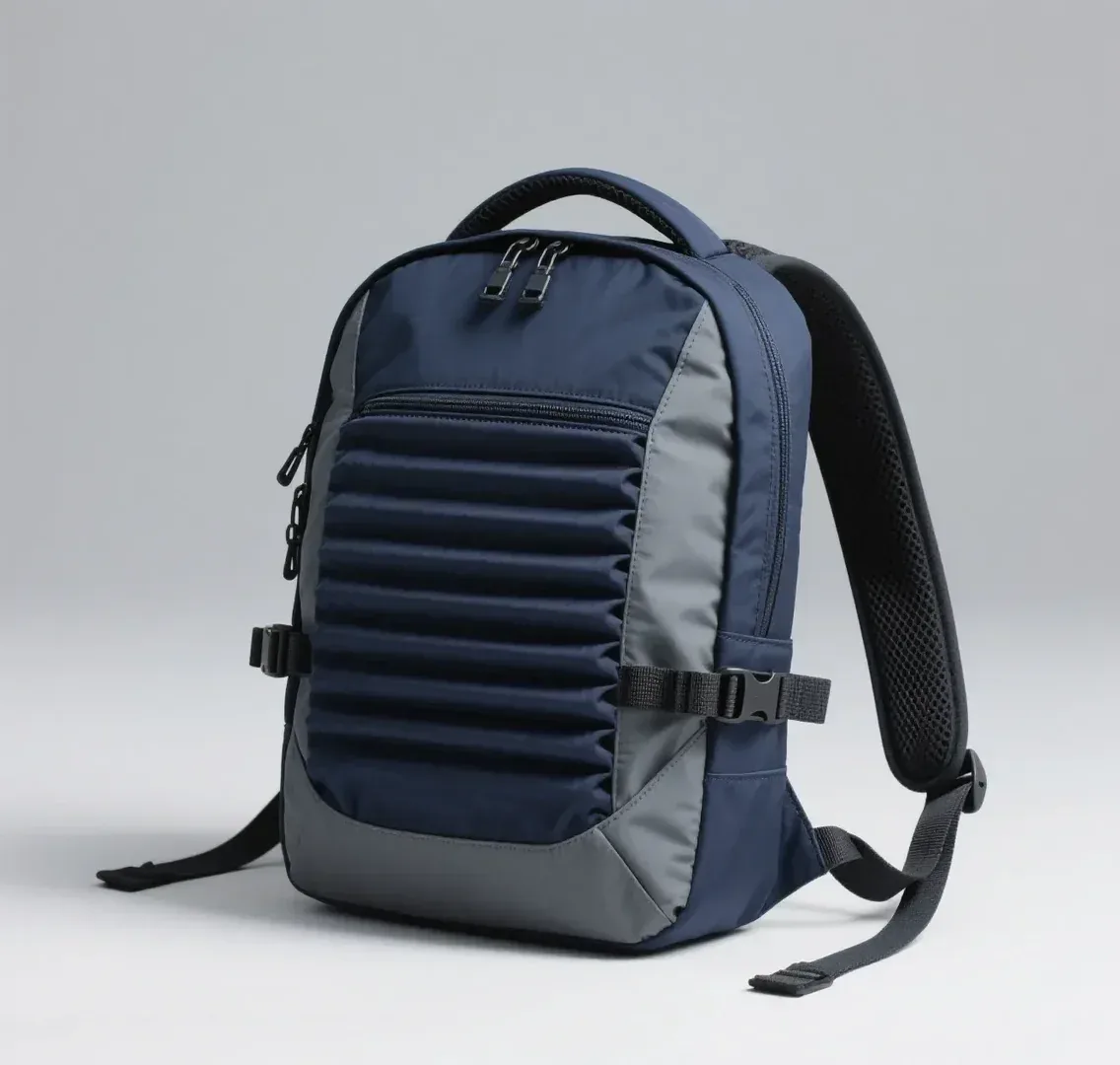
Final quality control involves checking stitching density, edge finish smoothness, hardware alignment, dimensional accuracy, and functional operation of all moving parts.
Stage 8: Packaging & Shipping Preparation (15–30 Minutes per Bag)
The final stage before a bag leaves the factory is packaging — and it matters more than most buyers realize. Luxury packaging protects the product during transit, communicates brand value at first touch, and prevents damage-related returns.
Standard luxury bag packaging includes:
- Shape stuffing: Acid-free tissue paper or inflatable air bags are inserted to maintain the bag's structure during transit.
- Dust bag: A cotton or flannel dust bag protects the surface from scratches and absorbs ambient moisture.
- Protective wrapping: Individual polybag or foam wrap for additional surface protection.
- Export carton: Double-wall corrugated carton with internal dividers for multi-unit shipments. Correct labeling, barcodes, and shipping marks are applied per the buyer's requirements.
- Brand inserts: Care cards, authenticity certificates, branded tissue, and any custom packaging elements the brand provides.
Factory Equipment: What a Professional Leather Bag Factory Needs
The machinery in a leather bag factory determines its capacity, precision, and the range of products it can produce. Here is a reference list of key equipment in a professional luxury bag manufacturing facility:
Production Capacity: What to Expect
Understanding factory capacity helps you set realistic expectations for lead times and order sizing. Here are typical benchmarks for a mid-size professional leather bag factory:
Per-Worker Output
A skilled leather bag artisan — working a standard 8-hour shift — typically completes 1 to 3 bags per day, depending on design complexity. A simple crossbody bag with minimal interior pockets may be completed at 2–3 units per worker per day. A structured handbag with multiple compartments, folded edges, and decorative stitching may take a single artisan 1.5 to 2 days to complete from cutting to final finish.
Factory-Level Capacity
Bespoke Bags' Production Capacity
Our SGS-verified 4,950 m² production floor in Quanzhou, Fujian operates with a production team of experienced artisans specializing in leather bag construction. With an MOQ of 500 pieces per style, we are structured to serve both emerging brands launching their first collection and established brands scaling production across multiple styles and seasonal lines — from luxury handbags to leather backpacks and business bags.
Standard production lead time is 45–60 days after sample approval and material readiness. Rush production (30–40 days) is available for repeat orders with pre-approved materials. Our OEM/ODM service covers the entire process from design development through final packaging and logistics coordination.

Our SGS-verified 4,950 m² production floor supports both OEM and ODM orders, with dedicated production lines for different product categories and an MOQ of 500 pieces per style.
Cost Breakdown: What Goes into the Factory Price of a Leather Bag
Understanding the cost structure helps you evaluate quotes and identify where a factory is — or is not — investing in quality. Here is a typical cost breakdown for a mid-range top-grain leather handbag (factory price, FOB China):
A luxury full-grain leather bag with premium hardware, hand-finished edges, and elaborate packaging can reach $150–$300+ in factory cost. The difference between a $50 factory bag and a $200 factory bag is not primarily the leather — it is the labor hours (3 hours vs. 10+ hours), the hardware quality ($3 vs. $15), and the finishing detail that transforms a product from functional to exceptional.
Handmade vs. Machine Production: When Each Makes Sense
The choice between handmade and machine production is not a binary quality judgment — it is a strategic decision based on your brand positioning, volume requirements, and cost architecture.
When to Choose Handmade Production
- Your brand positioning is ultra-luxury ($500+ retail) or bespoke/artisan
- Production volume is under 500 pieces per style
- Your design involves complex 3D construction, hand-burnished edges, or saddle stitching
- Your target customer values visible craftsmanship and individual character in each piece
When Machine Production Is the Right Call
- Your brand is positioned in the accessible luxury to premium segment ($150–$400 retail)
- Production volume exceeds 500 pieces per style
- Consistency across units is a priority (e.g., wholesale accounts expecting identical products)
- You need predictable lead times and scalable capacity
Most successful bag brands use a hybrid approach: machine construction for the majority of seams (ensuring consistency and speed), supplemented by hand work for edge finishing, decorative stitching, hardware setting, and final detailing. This hybrid model delivers the quality perception of handmade craftsmanship at a production cost and timeline that supports commercial viability.
The Pre-Production Package: What Buyers Should Send Before Stage One Opens
Every hour a technical question takes to answer during sampling is an hour added to the calendar, and most of those questions are predictable. The brands whose programmes move fastest are not the ones with the largest teams — they are the ones whose first email answers the questions before they are asked. Below is the package we ask for before a development slot is opened, mapped to what each item governs downstream, because understanding why something is requested makes it much easier to supply it properly.
| Input | What it governs | What happens without it |
|---|---|---|
| Dimensioned drawings or a marked-up reference bag | Patterns and every subsequent tolerance | The first sample is a guess; one extra sampling round |
| Material specification with finish and thickness | Cutting behaviour, edge finish method, hand-feel | Correct look, wrong drape; panels that will not fold cleanly |
| Hardware list with finishes and load paths | Reinforcement placement and attachment method | Attachment points specified for a lighter load than reality |
| Interior layout with the largest item stated | Capacity-critical dimensions | A bag that holds everything except the one item the buyer carries |
| Branding artwork intended for production | Logo method, tooling lead time | Tooling ordered after sample approval and added to the calendar |
| Target retail price or landed cost ceiling | Every subsequent construction decision | A beautiful sample nobody can sell at the intended price |
The last row is the one most often withheld, usually to protect negotiating position, and it is the most expensive omission in the list. Without a cost ceiling the specification is built blind: the pattern maker chooses the fine edge finish, the buyer loves the sample, and then everybody discovers together that the construction cannot exist at the intended price. Sharing the ceiling does not mean accepting whatever is quoted against it; it means the first proposal is aimed at something reachable. After that, the sampling clock still runs to 6-10 working days per round, or 12-15 where custom hardware is involved, and each round spent discovering the price band is a round that could have been spent refining it.
Tolerance Stacking: Why Half a Millimetre Appears at the Closure
Individual panels can sit inside tolerance and still produce a bag that does not close properly, because the error accumulates. A gusset cut long, a zip tape set low and a lining drafted tight each contribute a fraction of a millimetre, and all three arrive at the same place — the seam where two halves are meant to meet. Reading these symptoms backwards through the process is faster than re-cutting everything, and it usually identifies one clause of the specification that was never written down.
| Symptom on the finished bag | Where it originates | Specification clause to add |
|---|---|---|
| Zip closure ripples or waves when closed | Tape set at a different depth from the panel edge | State insertion depth and seam allowance together, not separately |
| Flap sits proud at one corner only | Asymmetric reinforcement under the leather | Specify reinforcement extent and position on both sides of the pattern |
| Bag leans backwards when set down empty | Base panel and gusset out of proportion for the lining weight | Define lining weight and base stiffener thickness in the same clause |
| Magnetic closure meets off-centre under load | Reinforcement patch smaller than the magnet footprint | Require the patch to exceed hardware footprint by a stated margin |
| Handles sit at visibly different angles | Attachment spacing not dimensioned from a single datum | Dimension all attachments from one stated origin on the pattern |
Four of those five rows are missing clauses rather than bad workmanship. This is the practical reason we insist on a dimensioned reference before cutting: not because operators need instruction, but because nothing else tells the pattern maker where errors are permitted to go. Once the clause exists, inspection to AQL 2.5 (ISO 2859-1), single sampling, general level II catches deviations on the units it samples; without the clause, inspectors are applying a standard to a requirement nobody wrote.
Colour and Lot Continuity Across Repeat Orders
The first order usually looks right. The problem arrives at the second, when the same colour reference produces goods that are close but not identical, and retail asks whether two drops can be displayed together. Hide-to-hide variation is inherent to a natural material, so the objective is not identical dye lots — it is an agreed range, written down, with a physical reference for each end of it. Brands that skip this step end up arguing about whether a difference exists instead of whether it is inside tolerance.
The last two items prevent most problems before they are visible. Thread and edge colour drift independently of the leather, and a mismatch there is what customers notice as sloppiness rather than as natural variation. Booking the next lot early works because a tannery can usually hold a run longer than it can reproduce one: bulk production runs 35-50 days after sample approval, and asking for the next hide allocation in the first third of that window costs nothing and avoids the alternative, which is re-matching colour from scratch and adding another approval cycle.
How a Bulk Order Is Loaded onto the Line
Buyers imagine an order progressing along a single line in one direction. In practice it is sequenced so that expensive operations happen when operators are freshest and so that no downstream station waits for material. Understanding the sequence explains why a change requested mid-run costs disproportionately more than the same change requested before it, and why some amendments genuinely cannot be accepted once certain stations have started.
- Materials are received and checked against the lot records, then rested flat so panels cut from them stay dimensionally stable.
- Cutting is sequenced by yield: the largest panels are nested first, smaller components are placed into the remaining area.
- Edge finishing and preparation of small parts run ahead of assembly so that no station waits for components.
- Sub-assembly stations — pockets, linings, straps — build in parallel batches sized to the line's daily throughput.
- Final assembly takes those sub-assemblies in sequence, with the last assembly step being any closure that sets alignment.
- Inspection runs continuously through the sequence, not only at the end, so defects are found while the cause is still on the line.
- Packing follows inspection per carton, with counts reconciled before the carton is closed and recorded.
Continuous inspection is the part of this sequence that most affects the buyer's calendar. A defect found at final inspection means tracing back to the station that created it, potentially across hundreds of units already assembled; a defect found at the station means correcting the next unit. This is also why a mid-run specification change is expensive rather than merely inconvenient: it invalidates completed work at every station ahead of the change, not just pieces in progress. Minimums of 500 pieces per style and colourway mean there is a lot of work in motion, and shipments leave FOB Xiamen against T/T terms of 30% deposit and 70% before shipment.
Frequently Asked Questions
How long does it take to manufacture a leather bag from start to finish?
The complete process — from design approval to finished goods ready for shipment — typically takes 45 to 90 days. The design and sampling phase requires 15–35 days. Production (cutting through packaging) for a 500-unit order takes approximately 25–40 days. The timeline depends on design complexity, material availability, and whether custom hardware needs to be manufactured. Simple designs with stock materials can be completed in as few as 30 days.
How many bags can one worker produce per day?
A skilled leather bag artisan typically produces 1 to 3 bags per 8-hour working day, depending on design complexity. A simple crossbody bag may be completed at 2–3 units per day, while a structured handbag with multiple compartments and hand-finished edges can take 1.5 to 2 full days per unit. Factories with assembly line organization (where each worker specializes in one operation) can achieve higher total throughput but less individual craftsmanship per bag.
What is the difference between OEM and ODM in leather bag manufacturing?
OEM (Original Equipment Manufacturer) means you provide the design — tech pack, sketches, or physical sample — and the factory produces it exactly to your specifications. ODM (Original Design Manufacturer) means the factory has developed designs that you select from, then customize with your choice of leather, hardware, colors, and branding. OEM gives you full design control but requires a complete tech pack. ODM is faster to market with lower development cost but less design uniqueness. Most OEM factories, including Bespoke Bags' OEM/ODM service, support both models.
What should I look for when auditing a leather bag factory?
Focus on five areas: (1) Stitching density — count stitches per inch on finished samples; luxury bags should show 10+ SPI on main seams. (2) Edge finishing — run your fingernail along edges; smooth, even, no visible fibers. (3) Hardware attachment — pull on handles and strap anchors; no wobble or movement. (4) Material storage — leather should be stored flat, climate-controlled, with hide grading visible. (5) QC documentation — ask to see incoming material inspection records, in-process QC reports, and final inspection standards. A factory that cannot produce these documents is not running a formal quality system.
What MOQ should I expect from a leather bag factory?
MOQ varies significantly by factory size and positioning. Small artisan workshops may accept 10–50 pieces per style. Mid-size OEM factories (50–200 workers) typically require 100–300 pieces per style. Large factories serving major brands may set MOQs at 500–1,000+ pieces per style. At Bespoke Bags, our MOQ is 500 pieces per style — designed to be accessible for emerging brands launching their first collection while still providing the production efficiency needed for competitive pricing. Our small batch service offers additional flexibility for test launches.
Last Updated: August 14, 2026
What is the minimum information needed to start a development request?
A dimensioned drawing or a marked-up reference bag, the intended material with its finish and thickness, the hardware list, and a target cost or retail price. Those four items let a pattern maker start. Everything else can be confirmed during the sampling rounds, but without them the first sample is a guess.
How many sampling rounds should I budget for on a new design?
Two to three for a new construction is normal, and one for a modification of a proven design. Each round runs 6-10 working days, or 12-15 where custom hardware needs tooling. Budgeting for three and finishing in two protects the launch date far better than budgeting for one.
Why do two orders of the same colour not match exactly?
Hide-to-hide variation is inherent to a natural material, so the realistic goal is an agreed range rather than identical lots. Hold signed swatches for both ends of the acceptable range, record lot numbers against the order, and confirm thread and edge colour separately, since those drift independently of the leather.
Can I change the specification once bulk production has started?
It depends how far the order has progressed. Changes before cutting are straightforward; changes once assembly is running invalidate completed work at every station ahead of the change. The cost is the value of that work plus the schedule impact, which is why changes are quoted rather than absorbed.
How should I specify tolerances so inspectors can enforce them?
Dimension every critical relationship from a single stated origin and pair each tolerance with the place it can be measured. A tolerance without a measurement method is unenforceable. Close partners who also know where error may fall produce far better results than tight numbers applied blindly.
What causes a zip closure to ripple even when panels measure correctly?
Usually tape insertion depth relative to the panel edge rather than panel size. Specify the depth and the seam allowance in the same clause so both are set together. Reinforcement extent and any lining thickness must be stated too, since each contributes to the accumulated error at the closure.
Is it worth sending a physical reference bag instead of drawings?
Yes, provided it is marked up with the dimensions that matter. A reference communicates hand-feel and proportion that drawings cannot. Its limitation is that it does not record tolerance, so pair it with a dimensioned specification rather than relying on it alone.
How far ahead should materials be booked for a reorder?
Ask for the next hide allocation during the first third of the current production window. Tanneries can usually hold a run longer than they can reproduce one, and bulk production runs 35-50 days after sample approval, which gives enough runway to secure matching lots before they are needed.