
Leather passport holders work as corporate gifts because they are compact, inexpensive relative to their perceived value, and used at precisely the moments when a traveller is paying attention to what is in their hand: check-in, security, boarding and border control. The specification that succeeds is one that fits the passport booklet exactly, resists the wear of being pulled in and out of a pocket, and carries branding small enough to remain appropriate in an official setting. This article covers formats and dimensional fit, the honest position on RFID shielding, material and construction choices, branding on a small surface, travel sets, market compliance and the ordering sequence.
The category has one structural advantage over almost every other gift: it is used under mild pressure and in public, several times per trip. A recipient who pulls the piece out at a border checkpoint is forming a judgement about it in a way they never would at a desk. That makes the tactile details, the ease of extraction and the absence of anything that looks like advertising disproportionately important.
It also has one structural risk. Passport booklets are not identical across issuing countries, and a holder cut to the wrong dimension is not a minor inconvenience; it is a gift that cannot be used at all. Dimensional verification is therefore the first step of any passport programme, not the last.
Programme parameters at a glance
| Parameter | Commitment |
|---|---|
| Minimum order quantity | 500 pieces per style / colourway |
| Sampling lead time | 6–10 working days (12–15 days for complex constructions) |
| Bulk production lead time | 35–50 days after sample approval |
| Inspection standard | AQL 2.5 (ISO 2859-1), single sampling, general level II |
| Incoterms | FOB Xiamen — EXW, CIF and DDP available on request |
| Payment terms | T/T 30% deposit / 70% before shipment; L/C at sight for container loads |
| Verified production floor space | 4,950 m² (SGS-verified) |
| Team | 137 staff across 7 production lines |
| Equipment | 149 machines including computerised saddle-stitch and edge-painting units |
| Monthly capacity | 200,000 pieces |
| Entity | Founded 2014; principal has worked in bag development since 2004 |
Why travel small goods are retained
Travel pieces are used intensively but intermittently. That pattern produces a specific psychological effect: the object feels fresh each time it is used, and the association formed with the trip attaches to the sender. Few gift categories behave this way.
| Property | Effect | Programme consequence |
|---|---|---|
| Intensive intermittent use | Feels new at each trip | Perceived value stays high over years |
| High-attention moments | Examined closely at checkpoints | Finish and branding must be restrained |
| Compact size | Fits a pocket or a bag organiser | Low freight cost per unit |
| Low unit cost | Affordable at broad tiers | Suits high-volume programmes |
| Pairing potential | Combines into a travel set | Allows tiering without new tooling |
The compactness of the category is also a commercial argument. Passport holders, luggage tags and eye masks ship at a fraction of the volume weight of desk goods or journals, which means a travel programme can reach a far larger recipient list within the same freight budget. Where a programme is freight-constrained rather than unit-cost-constrained, travel small goods are usually the answer.

Formats and getting the dimensions right
Passport booklets follow a widely adopted international format, but issuing countries vary, and a holder specified against a nominal size will reject a proportion of real booklets. The programme team verifies against physical specimens from the destination markets before releasing a specification.
| Consideration | Guidance | Reason |
|---|---|---|
| Booklet format | Verify against the ISO ID-3 format used by most issuers, 125 by 88 millimetres closed | The majority of booklets conform, but not all |
| Tolerance | Add 2 to 3 millimetres to the internal pocket dimension | Prevents the most common complaint in the category |
| Opening direction | Confirm top-opening versus side-opening | Affects how easily the booklet is extracted |
| Cover stiffness | Confirm whether the recipient's booklet has a rigid cover | Rigid covers need a slightly larger pocket |
| Additional pages | Allow for expanded or frequent-traveller booklets | Thicker booklets strain a tight pocket |
Extraction is the usability variable that specifications most often miss. A pocket cut tight looks neat in a photograph and is frustrating in a queue. A pocket with a thumb notch or a slightly extended rear panel lets the recipient pull the booklet out one-handed, and that small detail is what determines whether the piece is used or left in the hotel safe.
RFID shielding: what can honestly be claimed
RFID shielding is the most frequently requested and most frequently overstated feature in this category. The honest position is narrower than most marketing copy suggests, and a programme that makes an unsupported claim is exposed if a recipient tests it.
| Claim | Status | What to specify instead |
|---|---|---|
| Blocks all electronic pickpocketing | Overstated and untestable as written | State the frequency band and test method |
| Shields the passport's contactless chip | Testable, depends on the laminate and full coverage | Require test data at the stated frequency |
| Protects contactless payment cards | Depends on the card, the reader and the shielding layer | Frame as attenuation, not as a guarantee |
| Equivalent to a labelled shielding card | Comparable only if tested the same way | Request the test report, not a marketing sheet |
| No shielding needed at all | Defensible; risk of skimming is debated | Offer both and let the buyer choose |
Where shielding is specified, the construction requirement is complete coverage. A shielding laminate inside the front panel only leaves the rear of the booklet exposed, and a partially shielded case performs little better than an unshielded one. The laminate must be continuous across the pocket, including the gusset, and the specification should say so.
Testing should be stated by method and frequency rather than asserted. Industry estimates on the real-world incidence of contactless skimming vary widely, and the programme team's position is that shielding is a reasonable option to offer, not a feature to oversell. Where a buyer wants the claim on the packaging, the test report should be in the order file first.
Materials and construction
Travel goods take a specific kind of wear: abrasion from pockets and bag linings, flexing at the fold, and exposure to humidity and handling liquids. Material choice should follow that pattern rather than the showroom impression.
| Material | Abrasion behaviour | Flex behaviour | Suitability |
|---|---|---|---|
| Full-grain aniline | Marks readily, patinas well | Softens with use | Senior tiers; accept marking |
| Semi-aniline top-grain | Good resistance, even patina | Stable | Default for corporate programmes |
| Pigmented top-grain | Best resistance to scuffing | Slightly firmer | High-volume and event tiers |
| Saffiano-finished | Excellent scuff resistance | Firm, holds shape | Travel goods generally |
| Vegetable-tanned | Marks, patinas strongly | Softens considerably | Where a natural look is wanted |
- Specify skived turn-edges rather than raw cut edges on the pocket mouth; raw edges fray at the point of most friction.
- Use bonded nylon or polyester thread; cotton thread abrades faster in this application.
- Back-stitch at every start and stop, particularly at the pocket corners where stress concentrates.
- Keep the overall build under about 8 millimetres thick when empty, or it will not sit comfortably in a pocket.
- Specify edge paint that flexes rather than a hard coating, which cracks at the fold.
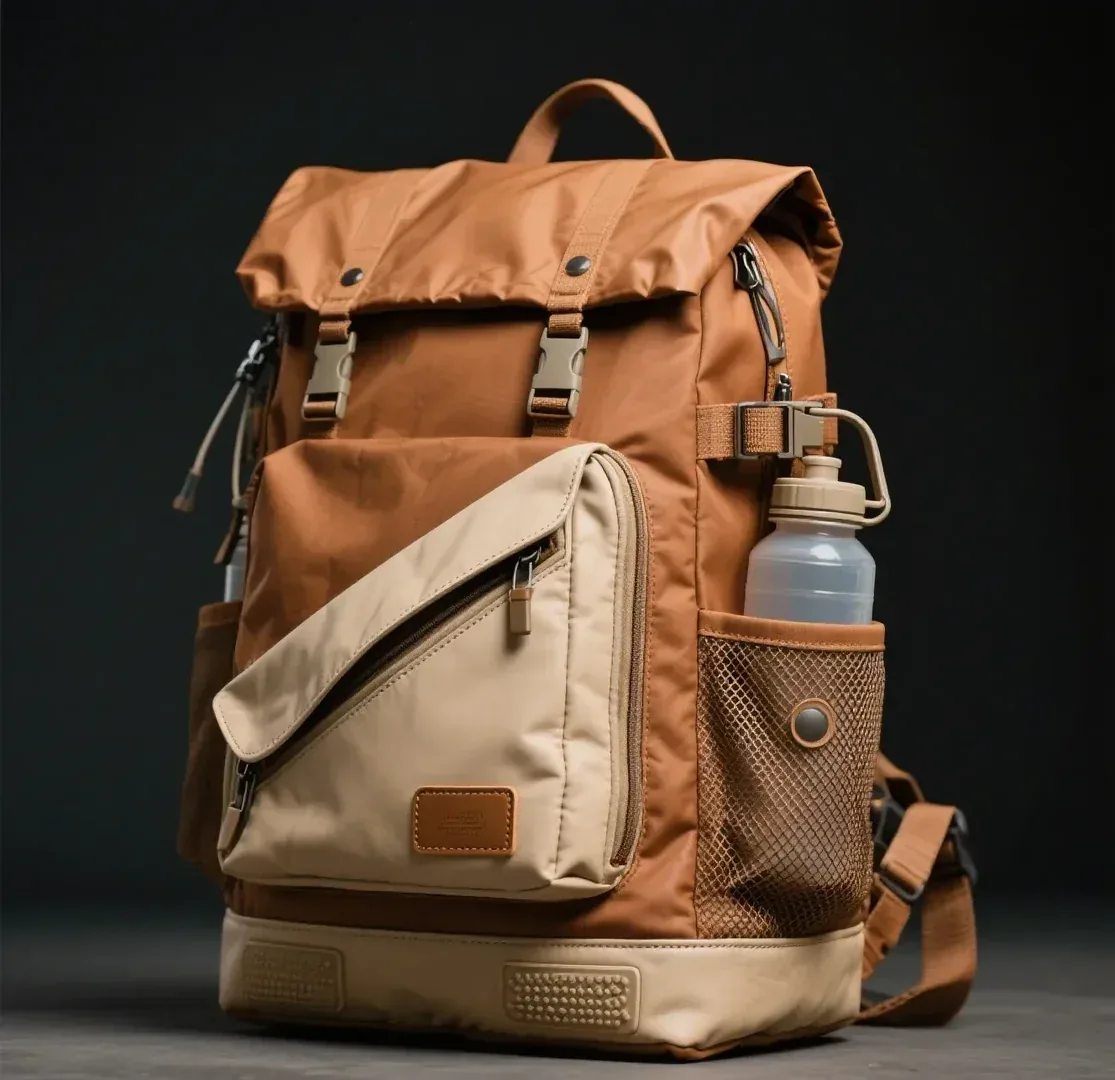
Hardware deserves a separate note because it is where travel goods most often fail after a season of use. A metal corner, a snap or a zip puller specified for appearance rather than for corrosion resistance will mark or seize after exposure to humidity and handling liquids. Specify a tested finish, confirm the plating thickness, and check the puller action after a salt-spray or humidity test where the recipient list is concentrated in coastal or tropical markets.
Branding on a small surface
A passport holder offers less branding area than almost any other gift, and it is held in front of immigration officers and airline staff. Small and discreet is not merely tasteful here; it is the only workable approach.
| Placement | Method | Reads as | Recommendation |
|---|---|---|---|
| Front cover, lower right | Blind deboss under 30 millimetres | Ownership | Standard choice |
| Inside left panel | Foil or deboss | Provenance | Good, invisible during use |
| Rear panel | Small deboss | Discreet | Acceptable, keep very small |
| Front cover, centred | Large foil or print | Promotion | Avoid in this category |
| Matching luggage tag | Deboss or foil | Identification | Best surface for a slightly larger mark |
Personalisation behaves differently here than in other categories. Initials on a passport holder read as ownership and are widely appreciated, but they should be small and positioned away from any area the recipient handles at a checkpoint. A monogram on the inside panel or the lower rear is the safest placement.
Building a travel set
Passport holders rarely travel alone. The set is the natural unit for a travel-themed programme, and it allows tiering without developing separate tooling for each tier.
| Set composition | Suitable tier | Indicative perceived value | Note |
|---|---|---|---|
| Passport holder alone | Broad tier and event use | Moderate | Compact and inexpensive to ship |
| Holder plus luggage tag | Core tier | High | The strongest value-per-cost combination |
| Holder, tag and eye mask | Core to strategic | High | Adds a soft component; confirm material compliance |
| Holder, tag and wash bag | Strategic tier | Very high | Larger freight volume; plan cartons accordingly |
| Full travel set with packing cubes | Strategic and VIP | Very high | Highest freight volume; sea freight usually required |
- Develop the set against one leather family and one hardware finish so colour references match across pieces.
- Use the luggage tag as the surface for any larger branding, keeping the holder discreet.
- Confirm the eye mask and any textile component against the same substance requirements as the leather.
- Pack sets in a single box rather than separate cartons, so the recipient receives one object.
- Hold spare holders as contingency, since these are the pieces most often lost before an event.
Compliance and market variation
Travel goods move across borders by definition, which means the compliance question is not hypothetical. The checks below should run at brief stage for every market on the recipient list.
| Market | Requirement | Action |
|---|---|---|
| European Union | REACH restrictions on substances in articles | Specify compliant leather chemistry and retain declarations |
| United States | General product safety expectations; CPSIA where relevant | Confirm coatings and hardware finishes |
| United Kingdom | UK REACH and post-transition labelling | Confirm origin labelling format |
| Australia and New Zealand | Duty and GST on imported gifts | Budget landed cost rather than FOB cost |
| Middle East and Asia | Varying labelling and language requirements | Confirm whether origin marking must be permanent |
Two certifications resolve most buyer questions without further argument. OEKO-TEX on the leather and lining covers residual substances, and Leather Working Group status on the tannery addresses traceability. Where a set includes textile components such as an eye mask or packing cubes, those should be certified to the same standard rather than treated as accessories outside the specification.
Inspecting and ordering travel small goods
Inspection runs to AQL 2.5 under ISO 2859-1, single sampling, general level II. Within that framework, the defect classes specific to this category are listed below.
| Check | Defect condition | Class | Why it matters |
|---|---|---|---|
| Pocket dimension | Booklet will not seat or is loose | Critical | The piece is unusable |
| Corner stitching | Back-stitch missing at a pocket corner | Major | Progressive failure at the stress point |
| Edge finish | Paint cracking at the fold | Major | Visible immediately and permanent |
| Logo registration | Crooked or misplaced deboss | Major | Obvious on a small flat surface |
| Shielding continuity | Gap in the laminate at the gusset | Major where specified | Defeats the stated function |
| Thickness | Build exceeds the specified profile | Minor | Affects pocket comfort |
- Verify the passport dimension against physical specimens from the destination markets before specifying.
- Approve a sample in the standard 6 to 10 working day window, or 12 to 15 for zip-around or shielded constructions.
- Test the sample with a real passport booklet, not with a card of similar size.
- Lock personalisation data before bulk begins, with diacritics confirmed.
- Approve a pre-production sample from bulk materials before the line is scheduled.
- Release bulk against the standard 35 to 50 day window after sample approval.
- Inspect to AQL 2.5 and retain the report with the shipment documents.
- Ship on the agreed Incoterm, FOB Xiamen as standard, with EXW, CIF or DDP available on request.
Our SGS-verified production floor in Quanzhou, Fujian operates seven lines with 137 staff and 149 machines across 4,950 square metres, with capacity to 200,000 pieces a month. For travel programmes that capacity is rarely the constraint; the constraint is dimensional verification, which is why the programme team insists on physical specimens at brief stage rather than nominal dimensions.

Specify a travel gifting set
Send your destination markets, recipient tiers and branding guidelines. The programme team will verify passport dimensions, return a set specification and a sampling plan. Email service@junyuanbags.com or WhatsApp +86 177 5002 0688.
Frequently Asked Questions
What size should a leather passport holder be?
Verify against the international ID-3 booklet format of 125 by 88 millimetres closed, then add two to three millimetres of tolerance to the internal pocket. Most issuing countries conform to that format, but not all, and a holder cut to a nominal dimension will reject a proportion of real booklets. Always test the sample with a physical passport rather than a card of similar size.
Do leather passport holders block RFID scanning?
Shielding depends entirely on the laminate used and on whether coverage is complete, including the gusset. A claim should be stated with a frequency band and a test method, and supported by a test report rather than a marketing sheet. Where shielding is specified, the programme team requires continuous coverage, since a partially shielded case performs little better than an unshielded one.
Why are passport holders good corporate gifts?
They are compact, inexpensive relative to perceived value, and used several times per trip at moments when the recipient is paying attention to what they hold. Being used intensively but intermittently keeps the object feeling fresh. They also ship cheaply because of their small volume, which allows a programme to reach a larger recipient list within the same freight budget.
Can passport holders be personalised with initials?
Yes, and initials are widely appreciated on travel pieces. Keep them small and place them on the inside panel or the lower rear, away from the area handled at a checkpoint. Data must be locked before bulk production begins, with one row per recipient, diacritics checked and name order confirmed per market, since errors are visible and permanent.
Which leather is best for a travel gift?
Semi-aniline top-grain is the safe default, offering good scuff resistance with an even patina. Saffiano-finished leather performs particularly well in travel goods because it resists the abrasion of pockets and bag linings. Full-grain aniline suits senior tiers where marking is welcome. Specify skived turn-edges and bonded nylon thread, since the pocket mouth is the highest-friction point.
What is the minimum order for custom passport holders?
The standard minimum is 500 pieces per style and colourway, reflecting material purchasing, cutting yield and line set-up. Small-batch pilots are available where a programme wants to validate a format or a set composition first. Because sets share a leather family and hardware finish, a pilot on the holder usually validates the whole travel set.
How long does a passport holder order take?
Sampling takes 6 to 10 working days, extending to 12 to 15 for zip-around or shielded constructions. Bulk production runs 35 to 50 days after sample approval, with freight added on top. Because these pieces are compact, air freight is often viable where the calendar is tight, unlike desk goods or journals where weight usually forces sea freight.
Should we give a passport holder or a travel set?
A holder alone suits the broad tier and event distribution. A holder plus a matching luggage tag is the strongest value-per-cost combination and suits the core tier. Adding a wash bag or packing cubes raises perceived value considerably but increases freight volume, so those sets usually require sea freight. Develop all pieces against one leather family.
Where should the logo go on a passport holder?
The front cover lower right, blind debossed and under 30 millimetres, is the standard placement. Inside panels are good for a fuller mark. Use the matching luggage tag for any larger branding, since it is a more forgiving surface. Avoid a large centred foil on the front, which reads as promotion and is inappropriate in an official setting.
Which compliance standards apply to leather travel gifts?
REACH governs substances in articles placed on the European Union market and covers leather finishing chemistry. OEKO-TEX certification on leather and lining answers most buyer questions on residual substances, and Leather Working Group status addresses tannery traceability. Where a set includes textile components such as an eye mask, certify those to the same standard rather than treating them as outside the specification.
How do we inspect passport holders before dispatch?
Inspection runs to AQL 2.5 under ISO 2859-1, single sampling, general level II. The category-specific checks are pocket dimension, back-stitching at pocket corners, edge paint flexibility at the fold, logo registration on a small flat surface, and shielding continuity at the gusset where shielding is specified. Retain the report with the shipment documents.
Can we ship travel gifts directly to recipients?
Yes, and passport holders are unusually well suited to it because of their low weight and volume. Consolidated freight to a regional hub followed by local distribution is usually more economical than individual courier shipment above a couple of hundred recipients, but the gap is smaller here than for heavier categories. FOB Xiamen is standard, with EXW, CIF and DDP available.
Do passports from different countries fit the same holder?
Most conform to the international ID-3 booklet format, but there is enough variation that a holder specified against a nominal size will reject some booklets. Verify against physical specimens from the destination markets, add tolerance to the pocket, and consider whether the booklet has a rigid cover. Thicker frequent-traveller booklets also need additional pocket allowance.
What makes a passport holder easy to use in practice?
Ease of extraction is the decisive detail. A pocket cut tight looks neat and is frustrating in a queue, so specify a thumb notch or a slightly extended rear panel for one-handed removal. Keep the empty build under roughly 8 millimetres thick so it sits comfortably in a pocket, and use edge paint that flexes rather than a hard coating that cracks at the fold.
Can leftover travel stock be reused next year?
Yes, provided the colourway is neutral and the branding is not event-specific. Avoid printing a year, city or event name on the piece and put that information on the insert card instead. Passport holders and luggage tags in neutral colours can be redeployed at the next event, issued as staff travel kit, or absorbed into a lower gifting tier.