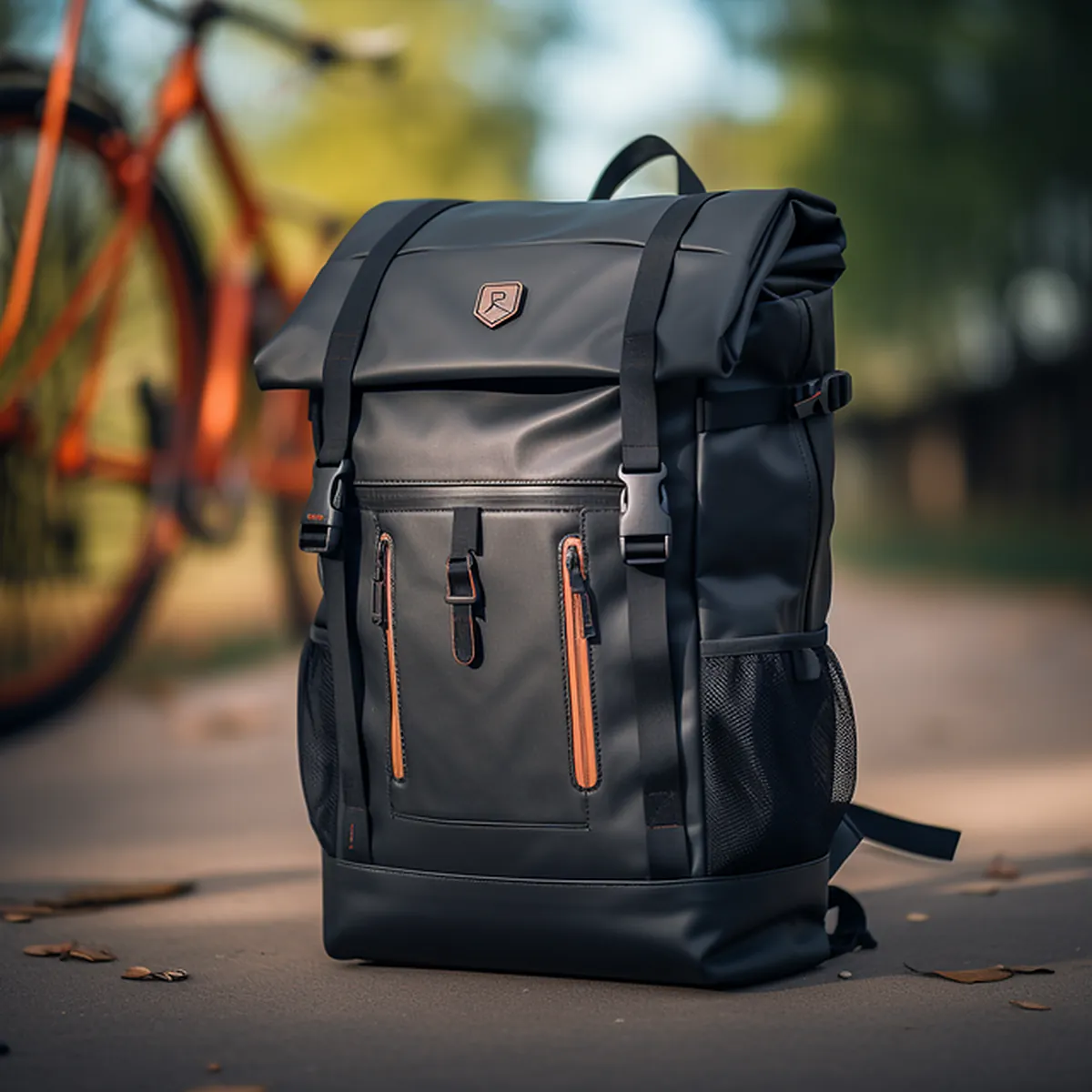
Water resistance in bags is described with a confident vagueness that survives until the first rainy commute. A fabric described as waterproof may keep out a shower and fail in sustained rain, because the seams were not sealed. A fabric that beads water beautifully in a spray test may let it through under pressure, because beading and pressure resistance are different measurements.
The distinction that matters commercially is between repellency and impermeability. Repellency keeps water from wetting the surface; impermeability prevents water passing through under pressure. A bag needs the first almost always, the second only when it is genuinely intended for sustained exposure.
Repellency: The Spray Rating
The standard spray test, AATCC 22, sprays a measured volume of water onto a taut specimen and compares the result to a reference scale from 0 to 100 in steps of ten. A rating of 100 means no wetting of the surface; 50 means the whole surface is wet. It is a visual, fast and inexpensive test, and it is the one that correlates with the everyday experience of water beading and rolling off.
DWR — durable water repellent — is the finish that produces this effect. It works by lowering the surface energy of the fibres rather than by blocking the gaps between them, which is why a fabric with excellent spray rating can still be breathable and still let water through under pressure.
| Spray rating (AATCC 22) | Description | Practical meaning |
|---|---|---|
| 100 | No sticking or wetting of the upper surface | Excellent beading; rain rolls off |
| 90 | Slight random sticking or wetting | Very good for most bag uses |
| 80 | Wetting at spray points | Good; acceptable for a bag body |
| 70 | Partial wetting of the whole surface | Marginal; water begins to be absorbed |
| 50 | Complete wetting of the whole surface | Poor; the surface darkens and soaks |
| 0 | Complete wetting of both surfaces | No repellency |
Eighty or better after five home launderings is a more meaningful specification than a hundred on a virgin sample, because DWR durability is the property that actually fails in use.
Impermeability: Hydrostatic Head
Hydrostatic head measures the pressure of water a fabric resists before it passes through, expressed in millimetres of water column. A fabric rated at 1,500 mm resists a 1.5 metre column. The test is AATCC 127 or ISO 811, and the result is a different kind of number from a spray rating: it describes pressure resistance, not surface behaviour.
For bags, the useful bands are lower than for tents or technical shells, because a bag rarely sits under standing water. What matters more is the pressure generated by a shoulder strap pressing against a wet jacket, or a bag resting on wet ground.
| Hydrostatic head | Resistance | Appropriate for |
|---|---|---|
| < 800 mm | Water resistant only | Light showers; fashion bags with a DWR finish |
| 800–1,500 mm | Water resistant | Urban bags, day packs, laptop sleeves |
| 1,500–5,000 mm | Waterproof for normal use | Technical day packs, camera bags, bike bags |
| 5,000–10,000 mm | Waterproof | Trekking packs, outdoor use in sustained rain |
| > 10,000 mm | Highly waterproof | Expedition, marine, prolonged exposure |
Programme parameters at a glance
| Parameter | Commitment |
|---|---|
| Minimum order quantity | 500 pieces per style / colourway |
| Sampling lead time | 6–10 working days (12–15 days for complex constructions) |
| Bulk production lead time | 35–50 days after sample approval |
| Inspection standard | AQL 2.5 (ISO 2859-1), single sampling, general level II |
| Incoterms | FOB Xiamen — EXW, CIF and DDP available on request |
| Payment terms | T/T 30% deposit / 70% before shipment; L/C at sight for container loads |
| Verified production floor space | 4,950 m² (SGS-verified) |
| Team | 137 staff across 7 production lines |
| Equipment | 149 machines including computerised saddle-stitch and edge-painting units |
| Monthly capacity | 200,000 pieces |
| Entity | Founded 2014; principal has worked in bag development since 2004 |
Seams Are Where Waterproofing Fails
A fabric rated at 10,000 mm in a bag with unsealed seams will leak through the needle holes long before the fabric fails. Seam treatment is not an accessory to waterproofing; it is the majority of it.
- **Seam sealing tape.** A heat-applied tape over the seam is the only reliable method for a waterproof claim. It must be applied to a compatible fabric and inspected for lifting at curves.
- **Seam gusseting or lapped seams.** A folded and lapped seam reduces the leak path without tape, and is adequate for water-resistant rather than waterproof claims.
- **Coated thread or thread thickening.** Thread swells when wet and closes the needle holes, which helps but does not replace taping.
- **Zip choice.** A water-resistant zip reduces ingress but is not waterproof. A storm flap over the zip is more effective than an upgraded zip.
- **Base and corners.** The base is the wettest zone. A heavier coated fabric, a sealed base seam and drainage where appropriate matter more than the body specification.
PFC-Free DWR and the Durability Trade
Fluorocarbon-based DWR finishes perform best and are being phased out under regulatory pressure in several markets. The alternatives — shorter-chain fluorocarbons and fluorine-free chemistries — are improving but generally have shorter effective lives, particularly against oils as well as water.
For a bag programme the practical consequence is that a PFC-free DWR needs a higher initial specification and a re-treatment recommendation in the care instructions. It is also worth testing after laundering rather than only on a virgin sample, because the drop-off is where the difference appears.
Two numbers, one claim
A spray rating of 90 on a virgin sample and 50 after five washes describes a finish that will be gone in a season. Specify the after-wash figure and the number of washes.
Leather and Coated Fabric Behave Differently
Leather is naturally water resistant to a degree, and its treatment is a different question from a textile DWR. A finished leather may have a topcoat that repels water; an aniline leather will spot and darken. Neither is a DWR in the textile sense, and neither should be marketed as waterproof.
Coated fabrics are impermeable by construction — the coating is the barrier — so the question shifts to the seams, the coating's flexibility and its hydrolysis resistance. A PU-coated fabric with sealed seams is genuinely waterproof; the same fabric with a stitched and untaped seam is water resistant at best.
A Specification That Can Be Enforced
The clause needs the test, the condition and the value, and it should distinguish between the fabric and the finished bag.
Marketing Language and What It Commits You To
The words carry legal weight in several markets. Water repellent describes surface behaviour; water resistant implies resistance to penetration under normal use; waterproof implies impermeability and, in some jurisdictions, is treated as an absolute claim that must hold in the conditions a reasonable consumer would expect.
The safe approach is to match the word to the test that was run. If the product passed a ten-minute shower test with taped seams, waterproof is defensible. If it passed a spray rating on the fabric only, water repellent is the accurate description, and the copy should say so.
Where the Programme Fits
QUANZHOU JUNYUAN BAGS specifies water resistance by end use rather than by fabric, testing the finished bag rather than only the material, and records the seam treatment and zip specification on the construction drawing so that they cannot be dropped in production without a visible change.
Match the claim to the test
Send the intended use and the claim you want to make. The programme team will propose the fabric, the seam treatment and the test that supports the wording.
Frequently Asked Questions
What is the difference between water repellent and waterproof?
Water repellent describes surface behaviour — water beads and rolls off. Waterproof implies that water cannot pass through, including at the seams and closures. A water repellent fabric in a bag with unsealed seams is not waterproof.
What does a hydrostatic head of 1,500 mm mean?
The fabric resists the pressure of a 1.5 metre column of water before water passes through. For bags that is a reasonable water-resistant specification for urban and commute use; 5,000 mm and above suits sustained outdoor exposure.
What is a good spray rating for a bag?
Eighty or better is good, and ninety or better is very good. The more important figure is the rating after five washes, because DWR durability is the property that fails in use.
What is DWR?
Durable water repellent — a finish that lowers the surface energy of the fibres so water beads rather than wetting. It does not block the gaps between fibres, which is why a high spray rating does not make a fabric waterproof.
Why does my waterproof bag leak at the seams?
Because the seams are not sealed. Needle holes create a continuous leak path through an otherwise impermeable fabric. Taped seams are the only reliable method for a genuine waterproof claim.
Are water-resistant zips waterproof?
No. They reduce ingress but do not stop it under pressure or in sustained rain. A storm flap over the zip is more effective than upgrading the zip alone.
What is PFC-free DWR and is it as good?
It is a fluorine-free repellent finish adopted in response to regulatory pressure on fluorocarbons. Performance is improving but its effective life against oils and repeated washing is generally shorter, which is why the after-wash rating matters more than the virgin figure.
Can leather be waterproof?
Leather can be water resistant through finishing, but aniline and unfinished leathers spot and darken when wet. Leather should not be marketed as waterproof unless the construction and treatment genuinely support the claim.
How do I test a finished bag for water resistance?
A shower test: ten minutes under a defined flow, then inspect inside the main compartment for water. It is the only test that captures seams, zips and closures together, which is where the failures are.
When can I use the word waterproof?
When the finished assembly has passed a shower test and the seams and closures are engineered for it. Matching the marketing word to the test that was actually run is the only defensible position, and it is what a regulator or a customer will ask for.