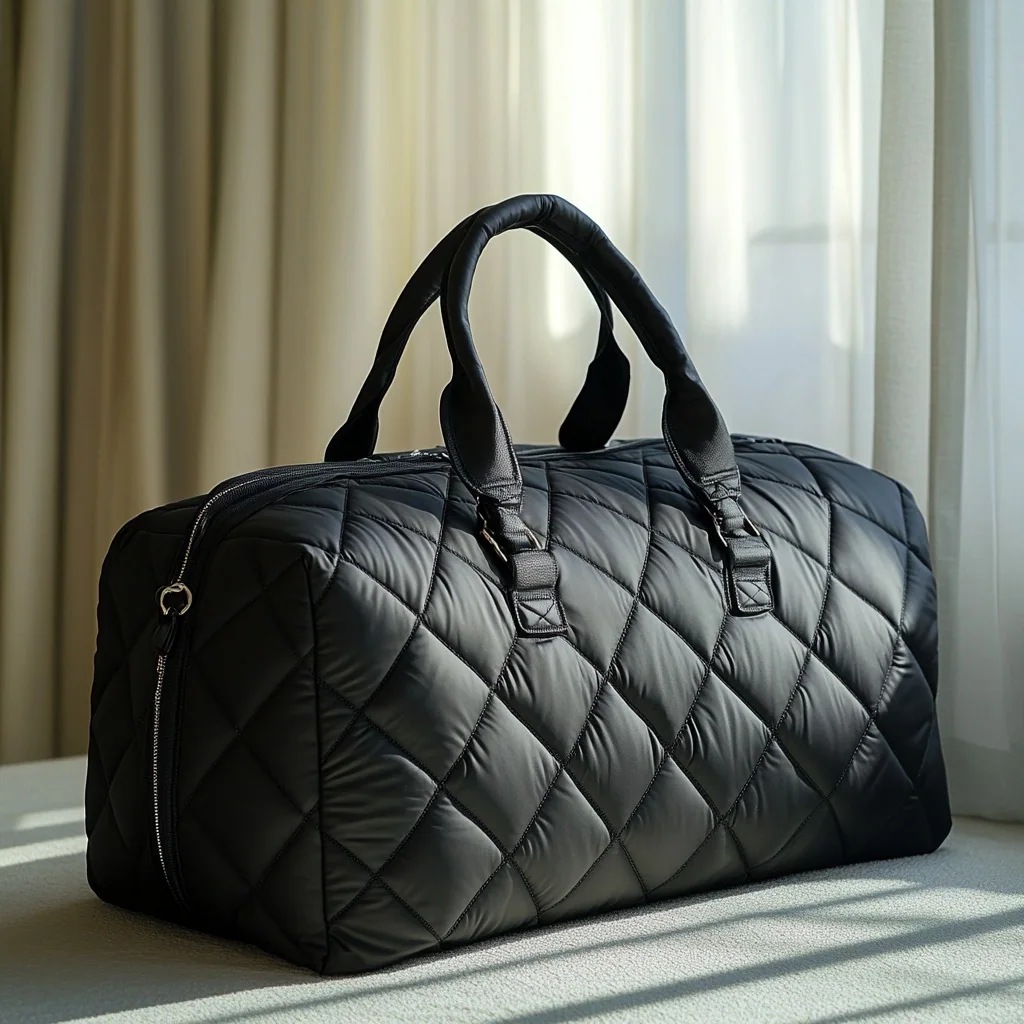
Bespoke Duffel Bags
A holdall is specified by what happens when it is full and lifted by one handle — opening geometry, handle assembly and base structure decide that.
A bespoke duffel is a soft holdall cut to your volume, footprint and opening geometry, with the handle assembly, base structure and compartments set on the tech pack and fixed in a sealed pre-production sample. Runs begin at 500 pieces per style and colourway; sampling takes 6–10 working days, or 12–15 where custom hardware or a welded wet zone is developed; bulk is 35–50 days after approval. Lots pass at AQL 2.5 under ISO 2859-1 and ship FOB Xiamen.
Programme parameters at a glance
| Parameter | Commitment |
|---|---|
| Minimum order quantity | 500 pieces per style / colourway |
| Sampling lead time | 6–10 working days (12–15 days for complex constructions) |
| Bulk production lead time | 35–50 days after sample approval |
| Inspection standard | AQL 2.5 (ISO 2859-1), single sampling, general level II |
| Incoterms | FOB Xiamen — EXW, CIF and DDP available on request |
| Payment terms | T/T 30% deposit / 70% before shipment; L/C at sight for container loads |
| Verified production floor space | 4,950 m² (SGS-verified) |
| Team | 137 staff across 7 production lines |
| Equipment | 149 machines including computerised saddle-stitch and edge-painting units |
| Monthly capacity | 200,000 pieces |
| Entity | Founded 2014; principal has worked in bag development since 2004 |
Volume, Shape and Packing Behaviour
Volume on paper and volume in use are different numbers. A duffel packs soft items well and hard items badly: rolled clothing fills a barrel section almost completely, while a pair of boots or a wash bag leaves voids that the same litre figure hides. Choose the section first, then the volume.
Barrel section or box section
A barrel section — rounded ends, a single curved panel — distributes stress around the body and suits canvas and leather builds that soften with use. A box section gives a flat, print-friendly front panel and stacks better for retail, but it concentrates load at the end seams and needs a heavier interlining to stop the ends bowing. Expedition and gym programmes tend to take the box; heritage and leather ranges take the barrel.
| Nominal size | Volume (L) | Body H × W × D (cm) | Empty weight, canvas (kg) | Carry |
|---|---|---|---|---|
| Cabin holdall | 25–30 | 26 × 48 × 26 | 0.9 | Handle pair plus sling |
| Weekender | 40–45 | 30 × 55 × 28 | 1.1 | Handle pair, padded sling |
| Team kit | 55–60 | 32 × 62 × 30 | 1.4 | Handle pair, sling, end grab |
| Expedition | 75–80 | 36 × 70 × 34 | 1.8 | Handles, backpack conversion |
| Large holdall | 95–100 | 38 × 78 × 36 | 2.2 | Handles, sling, shoulder pad |
Empty weight is the figure retail buyers ask for first and the one that suffers when a specification grows. Every added board, foot and pocket adds grams; a leather-trimmed 45 litre weekender can reach 2.4 kg before the first item goes in, which is worth knowing before a price is quoted rather than after.
Opening Geometry and Zip Specification
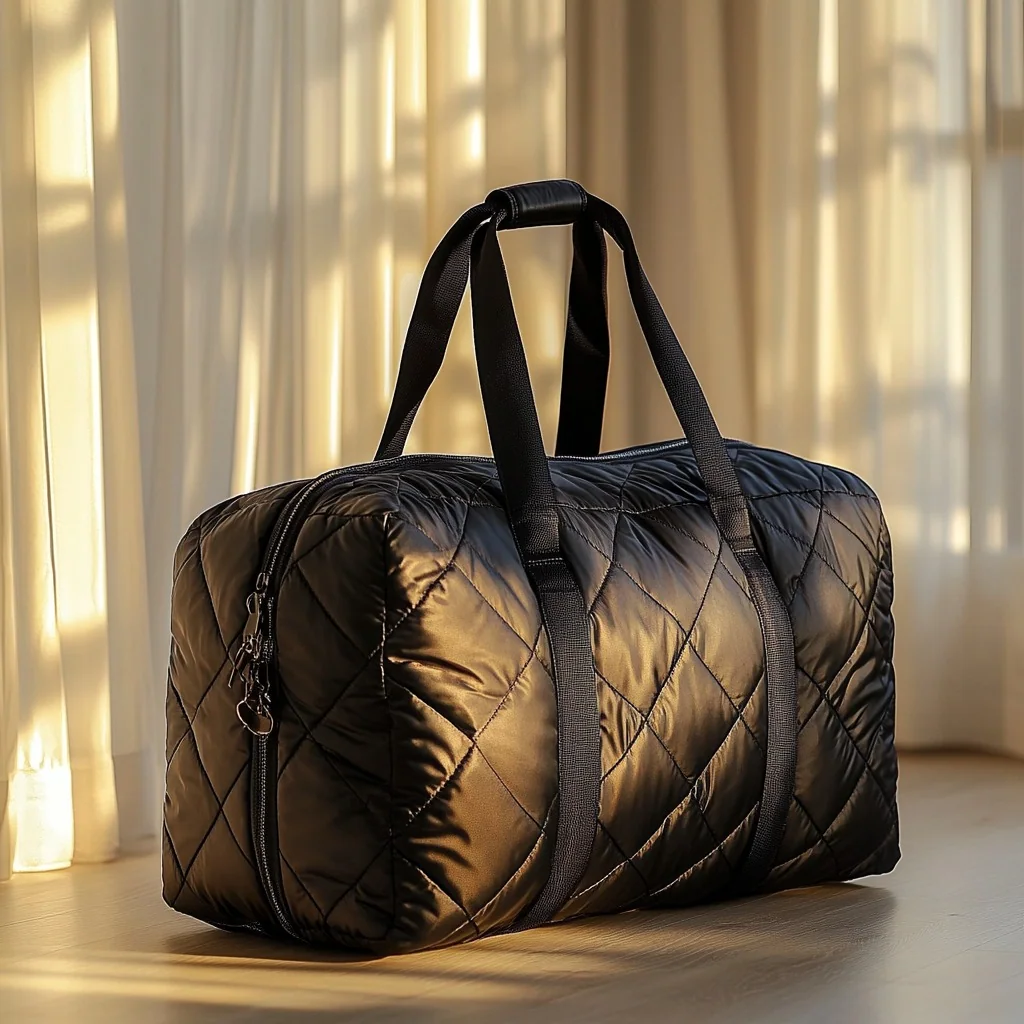
The opening decides whether a duffel is pleasant or infuriating. A straight zip across the top forces the user to dig; a horseshoe or U-shaped zip running down both ends opens the bag into a tray. The longer chain costs more and needs a cleaner run, and it is the single upgrade most worth paying for above 40 litres.
- Shoe compartment — a lined end bay sized to a stated shoe length, vented through two 8 mm grommets set behind a rain lip.
- Wet pocket — welded rather than stitched, so there are no needle holes to leak, with a 300 mm zip on the interior face.
- Laundry divider — a removable mesh panel on press studs, washable and replaceable, holding 8 litres.
- External lash — four 20 mm webbing loops on the base panel for a mat or a tripod, bartacked at 25 mm.
- Internal organisation — two zip pockets and three slip pockets on the lining, set above the compression line.
- Trolley sleeve — a 220 mm panel with a zip base, so the bag converts to stacked carry without a second strap.
Handles, Sling and Convertible Carry
A full duffel is lifted by one handle, swung, and set down on a corner. The handle assembly therefore carries the whole load path, and it is specified as a system: webbing core, grip, wrap, stitch density and the reinforcement patch it lands on. Handles joined by a continuous wrap that runs under the body carry better than two handles stitched to the top seam.
The sling is the second carry, and it is where a heavy programme is won or lost. A 38 mm strap over a 15 kg load is uncomfortable within ten minutes; 50 mm with a 250 × 80 mm pad is acceptable for an hour. Convertible builds add stowable backpack straps, which cost two more attachment patches and four more reinforcement points on the pattern.
Base, Feet and Wet-Zone Construction
The base takes the abuse a duffel gets and gives nothing back in appearance, so it is the first place a weak specification shows. A boarded base spreads load, feet keep the board off wet ground, and a wrapped leather or heavy-grade panel stops the corners polishing through.
| Element | Stock level | Specified level | Acceptance |
|---|---|---|---|
| Base board | 1.5 mm greyboard in a sleeve | 3.0 mm board, removable, wrapped in 210D with bound edges | Sag under 8 mm at 20 kg over a 300 mm span |
| Feet | None | Five studs at 15 mm diameter on a reinforcement patch | Loaded set-down, 500 cycles on concrete |
| Handle assembly | 25 mm webbing, no core | Layered wrap over a 20 mm grip core, stitched at 7 SPI | 500 N pull, 60 second hold |
| Handle wrap | Two short sleeves | Continuous wrap running under the body, joined at the balance point | Carry swing, 1,500 cycles at 15 kg |
| Wet-zone seam | Stitched and taped | Radio-frequency welded, 15 mm seam width, no needle holes | Water hold, 30 minutes, no weep |
Welded wet zones cost more than taped ones and are worth it wherever a gym, swim or expedition programme is involved. A stitched seam leaks eventually, and a leaking compartment generates the kind of return that costs more than the saving.
Load Testing a Heavy Soft Bag
- Fill the bag to its stated volume with a calibrated load, distributed as a user would pack it.
- Lift by one handle and hold for 60 seconds, then repeat on the second handle and on the wrap.
- Swing the loaded bag through 1,500 cycles and inspect the handle roots, D-rings and base corners.
- Set the loaded bag down on a concrete corner 500 times and measure corner wear and base sag.
- Run the main zip open and closed 3,000 times loaded, watching for tooth separation at the corners.
- Fill the wet zone, stand the bag upright for 30 minutes and check every seam for weeping.
Those six checks take a day and remove most of the risk from a first run. Where a programme sells into a market that expects third-party verification, the same sequence is run by an external laboratory and reported before shipment.
Freight, Carton Cube and Retail Packing
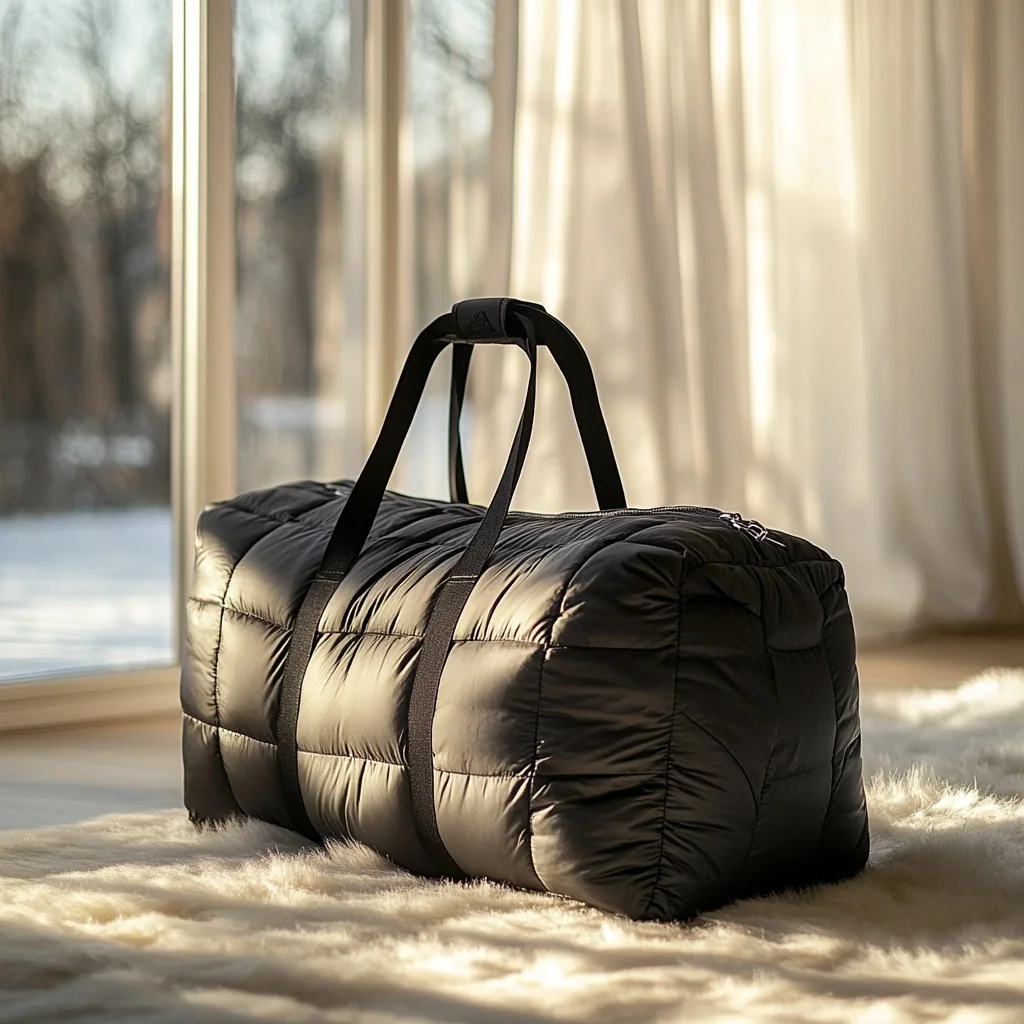
Large soft bags are air freighted as much as anything, and cube drives the landed cost. A 60 litre duffel nested flat takes roughly 0.045 m³ per carton of ten; the same bag boxed individually takes well over twice that, so the pack-out decision belongs at costing rather than at booking.
- Lot sampling — AQL 2.5 under ISO 2859-1, single sampling, general level II, with defects graded critical, major and minor before release.
- Chemical declarations — REACH and CPSIA documentation issued with the programme; OEKO-TEX Standard 100 fabrics and LWG-sourced hides on request.
- Abrasion and colour — Martindale and colour-fastness testing against ASTM methods, with leather grain-crack resistance available under ASTM D2210.
- Production base — an SGS-verified 4,950 m² floor in Quanzhou, Fujian, with 137 staff, 7 lines and 149 machines, with documented quality and environmental procedures aligned with ISO 9001 / ISO 14001 principles.
- Pack-out — nested or individual cartons, barcodes, care cards and hangtags specified with the programme and applied at origin.
One practical note on carton counts: a duffel that nests well in a sample carton often nests differently once the base board and feet are added. Carton quantities are confirmed on the pre-production sample, not on the prototype.
Interior Organisation and the Empty-Bag Problem
A duffel has no structure of its own when it is empty, which means the interior does two jobs at once: it has to organise the contents when the bag is full and keep its own shape when the bag is not. Interior specification is therefore a weight question as much as a layout one, and the most common mistake is adding organisation that costs grams and stiffens the body at the same time.
| Interior element | Placement | Why it matters |
|---|---|---|
| Zipped end pocket | Inside one end cap, above the compression line | Uses volume that a soft body otherwise wastes |
| Mesh laundry divider | Removable on press studs, 8 litres | Separates worn kit without a second compartment |
| Welded wet pocket | Interior face, 300 mm zip | No needle holes, so it cannot weep into the lining |
| Key clip | On a load-bearing seam near the opening | Stops small items reaching the bottom of the bag |
| Slip pockets | Two or three on the side wall, bound top edge | Keeps phone and documents findable mid-trip |
| Lining colour | Mid-tone rather than black | Makes the interior usable without added lighting |
Placement above the compression line is the rule that gets missed. A pocket set below the strap line ends up crushed every time the bag is compressed, and a pocket on the base panel sits directly on the board where it both wears and makes the base feel lumpy under a load.
- Set every interior pocket above the compression line so it is not crushed when the straps are pulled.
- Keep the wet pocket welded and on the interior face rather than stitched into a side seam.
- Use a mid-tone lining, since a black interior makes a deep body hard to search.
- Anchor the lining at two points so it does not drop below the base board when the bag is empty.
- Limit organisation to what the programme needs; every pocket adds weight in a bag sold on empty weight.
Empty weight deserves a hard look at this stage. Buyers ask for it first and it suffers every time the specification grows, so interior elements should be justified by the programme rather than added by default. A team kit bag genuinely needs a vented shoe bay; a 25-litre cabin holdall usually does not need six pockets.
The empty state is worth designing for as well. A duffel standing on a shop floor or in a locker is judged half-full at best, and one that collapses into a shapeless heap photographs badly and reads as cheap. Two lining anchor points and a base board that is stiff enough to hold the footprint are usually enough to keep an empty bag presentable without adding the weight of a framed construction.
Personalisation Routes for Team and Corporate Programmes
Duffels are the bag category most often personalised, because team, gym and corporate programmes all need a mark that survives being thrown into a boot or a locker. The route is chosen against the body material and the wash or abrasion cycle the bag will meet, and the decision belongs at costing because some routes commit the programme to a component.
| Route | Best for | Watch point |
|---|---|---|
| Embroidery | Canvas and heavy nylon bodies | Adds bulk at the needle holes; keep clear of handle roots |
| Woven badge | End cap or front panel on any body | Needs a bound edge so it does not fray in a locker |
| Silicone or TPU patch | Gym and swim programmes | Bond tested on the actual coated shell, not on a swatch |
| Screen print | Flat box-section panels | Large solids across a fold line will crack |
| Individual numbering | Team kit and issued fleet stock | Numbers must be applied after the body is assembled |
| Colourway blocking | Range-level identity | Each colourway still needs to clear the minimum run |
Numbering is the requirement most often discovered late. A team bag issued to a named individual needs the number applied after assembly, which means it sits outside the normal panel print sequence and needs its own station and its own quality check. Planning that at costing is cheaper than adding it after the first run has been packed.
- Choose the route against the body material, since a bond that holds on canvas may fail on a coated shell.
- Keep embroidery and badges clear of the handle wrap, where the body is already thick.
- Confirm whether numbering is required before artwork is released, because it changes the pack-out sequence.
- Test any bonded patch on the production shell rather than on a flat sample swatch.
- Record the artwork reference against the style code so a re-order reproduces the same mark.
Corporate programmes add a packaging dimension. A duffel given to staff or to a client arrives with a care card, a dust bag and often a printed insert, and those items are specified with the programme rather than sourced separately. Consolidating them at origin is usually cheaper and avoids a second packing operation at the destination.
Colour approval deserves a separate step from artwork approval. A brand colour reproduced in embroidery thread, in a woven badge and in a printed mark will not match exactly, and deciding in advance which one is the reference prevents a three-way argument at the sample stage. Approve the reference first, then the other two against it under the lighting the bag will actually be sold under.
Choosing the Body Material: Canvas, Nylon and Leather
Body material decides empty weight, abrasion behaviour, how the bag ages and what the programme can credibly claim. Canvas reads heritage and takes a print well; nylon and polyester win on weight and wet performance; leather gives the best ageing but adds kilos and needs a different base specification. The choice should follow the programme rather than the mood board.
| Material | Typical specification | Programme fit | Trade-off |
|---|---|---|---|
| Cotton canvas | 430-610 gsm, often waxed or coated | Heritage ranges, retail shoppers, print-led designs | Heaviest option; slow drying when wet |
| Polyester or nylon | 420-900D with a PU or TPU face | Gym, team and expedition programmes | Lightest and quickest drying, but less character |
| TPU-laminated knit | 0.15-0.30 mm film on a knit base | Swim, wet-zone and washable builds | Excellent water hold, limited hand-feel range |
| Full-grain leather | 1.4-2.0 mm, matched by hide and grain | Luxury weekender and heritage ranges | Adds 0.8-1.2 kg over an equivalent canvas build |
| Coated canvas | Cotton base with a PU coating | Branded ranges needing cleanability | Coating can craze at tight fold radii |
The base specification follows the body. A leather duffel carries far more weight than a nylon one at the same volume, so it needs a stiffer board and a wrapped panel to stop the corners polishing through, while a nylon body can use a lighter board and rely on the feet. Reusing the same base across two body materials is a common source of sag complaints.
Mixed builds are worth considering. A coated canvas body with leather handle wrap and base trim gives most of the heritage appearance at a fraction of the weight penalty, and it keeps the print-friendly panel that a full leather body does not offer. Mixed builds are usually the best answer when the brief asks for character and a weight target at the same time.
Leather bodies also need hide selection written into the specification. A duffel uses far more area than a handbag, so shade consistency between panels and between units matters more, and cutting from matched hides paired by grain is what keeps a production run looking like a range rather than a batch. Stating the selection rule on the tech pack costs nothing and prevents the batch-to-batch variation that otherwise arrives as a retailer complaint.
Hardware follows the body rather than the other way round. A brass-finish D-ring on a nylon gym build reads incongruous and adds weight for no benefit, while a black-coated fitting on a heritage canvas body reads as a cost saving. Choosing one plating reference per body family and holding it across the range simplifies component intake, keeps colour consistent between seasons and makes the programme look deliberate rather than assembled.
Documentation, Labelling and Market Readiness
A duffel programme selling into more than one market needs a documentation set rather than a single certificate. Retailers ask for chemical declarations, test reports and origin statements at onboarding, and the questions arrive in a fixed order that can be prepared for rather than answered one at a time under a deadline.
- Confirm the destination markets and the declarations each one requires before artwork is released.
- List body, lining, coating and trim separately, since each carries its own restricted-substance exposure.
- Run the load, abrasion and colour-fastness tests during sampling so results exist before bulk ships.
- Keep the origin statement identical across the label, the carton and the commercial invoice.
- Hold one documentation file per style code so a re-order is covered without re-testing.
| Document | Covers | When it is needed |
|---|---|---|
| REACH declaration | Substances of concern for the European market | Retailer onboarding and customs queries |
| CPSIA documentation | United States market, including lead and phthalates | Before the first shipment to a US buyer |
| Test report | Load, abrasion, colour fastness and zip cycling | Buyer approval and internal acceptance |
| Fibre and material statement | Composition of body, lining and trim | Labelling and marketplace listings |
| Origin statement | Country of origin | Invoice, carton and retail label |
Labelling is the visible end of the same file. Composition, origin and care should be printed where they survive the life of the bag — a sewn label rather than a hangtag — and the wording should match the documentation exactly. A label that contradicts the declaration is the fastest way to turn a routine onboarding into a review.
Preparing the file during sampling rather than after approval is what keeps a launch on schedule. Material, hardware and coating references are all being selected in that window, so collecting declarations then costs an email; collecting them after bulk has shipped means chasing suppliers whose orders have already closed.
Care instructions close the same loop from the customer's side. A duffel with a welded wet zone, a removable board and a coated shell has three different care requirements, and the card should name them plainly rather than offer generic advice. Matching the card to the least tolerant component is what prevents the kind of damage that arrives back as a warranty claim rather than as a question.
Brief a duffel programme
Send the volume, the footprint limit and the compartments you need. We will return a costed opening and handle specification.
Frequently Asked Questions
What is the largest duffel volume you can pattern without a frame?
Around 100 litres is the practical ceiling for an unframed soft body. Beyond that, the ends bow and the handle roots carry more than a stitch line should. Expedition builds above 80 litres usually add a removable base board and a backpack harness, which keeps the shape without turning the bag into a rigid case.
Can handles be specified as a wrap with a grip core?
Yes, and it is recommended above 40 litres. A layered wrap over a 20 mm grip core, stitched at seven stitches per inch, spreads the load across the palm and stops the webbing rolling. The handle assembly is pull-tested to 500 N with a 60 second hold, and the wrap is cycled 1,500 times at 15 kg.
How is a horseshoe zip specified to resist bursting?
Number 10 coil chain above 40 litres, a corner radius of 45 mm or more at each turn, tape reinforcement behind the chain and a garage at both ends. The loaded bag is cycled 3,000 times on approval and inspected for tooth separation, which is what happens when a chain is asked to turn a tight corner under load.
Can a wet compartment or shoe bay be added without leaking?
Yes, if the seam is welded rather than stitched. A 210D TPU-laminated liner at 0.15 mm, joined by radio-frequency welding at a 15 mm seam width, has no needle holes to leak. The compartment is filled and stood upright for 30 minutes on approval and checked for weeping.
How do you stop the base sagging when the bag is full?
A 3.0 mm removable board in a bound sleeve, sitting under the lining and above the base panel, with five studs at 15 mm diameter spreading the load. Acceptance is under 8 mm of sag at 20 kg measured across a 300 mm span. Leather builds add a 1.4 mm wrap over the same board.
What shoulder strap specification suits a fully loaded duffel?
Fifty millimetres of webbing with a 250 × 80 mm sliding pad for loads above 12 kg, attached through welded D-rings on reinforced patches. Below that, 38 mm is comfortable. Convertible builds use stowable backpack straps, which need four more reinforcement points and are costed at the design stage.
Can the same duffel fold flat for retail packaging?
A soft body with a removable board folds reasonably flat; a box-section body with a fixed board does not. Where flat packing is a requirement, the base board is specified as removable and the end panels are left unlined, which lets the bag ship in a retail carton at a lower cube.
How are duffels tested for handle and strap strength?
Handle assemblies are pulled to 500 N and held for 60 seconds, then swing-cycled 1,500 times at 15 kg. Straps and D-rings are pulled at their attachment patches and the bag is set down on a loaded corner 500 times. Tests run against ASTM methods and results are reported before bulk release.
Is a trolley sleeve worth adding to a large duffel?
On anything above 55 litres, yes. A 220 mm sleeve panel with a zip base lets the bag stack on a rolling case, which removes shoulder strain on long transfers and costs one panel and two seams. It is more useful than a second external pocket on most travel-led programmes.
How many units fit in a carton and what does that do to freight?
A 60 litre duffel nested flat packs ten to a carton at roughly 0.045 m³, while the same bag boxed individually more than doubles the cube. Carton quantities are confirmed on the pre-production sample because board and feet change how the body nests, and the pack-out is agreed at costing.
How should a duffel interior be organised without adding weight?
Place every pocket above the compression line so it is not crushed when the straps are pulled, and keep the wet pocket welded rather than stitched. A mid-tone lining makes a deep body usable without extra weight. Limit organisation to what the programme actually needs, since buyers ask for empty weight first and it suffers each time the specification grows.
Which personalisation route suits a team kit programme?
Embroidery on canvas or heavy nylon, a woven badge on the end cap, and individual numbering where bags are issued to named people. Numbering must be applied after assembly, so it needs its own station and check. Confirm it before artwork is released, because adding it after the first run is packed costs considerably more.
Does a leather duffel need a different base specification?
Yes. A leather body carries far more weight than a nylon one at the same volume, so it needs a stiffer board, a wrapped panel and feet sized for the heavier load. Reusing a nylon base specification on a leather build is a common cause of sag complaints, and the corners polish through without the wrap.
What documentation ships with a duffel programme?
REACH declarations for the European market, CPSIA documentation for the United States, test reports covering load, abrasion, colour fastness and zip cycling, plus fibre and origin statements. List body, lining, coating and trim separately, and keep the origin statement identical across the label, carton and commercial invoice.