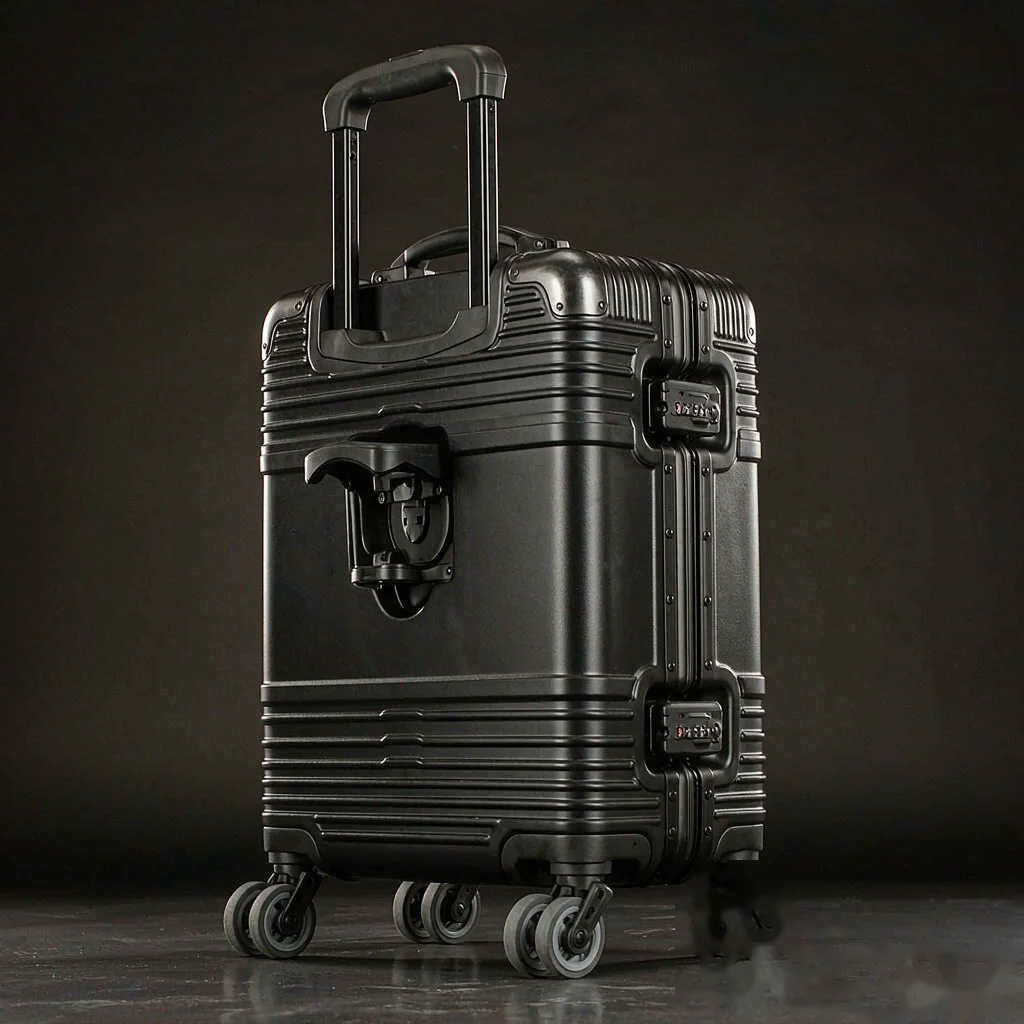
A wheeled bag meets forces that no hand-carried bag sees. It is dropped onto corners from car boot height, dragged over kerbs and cobbles, loaded until the shell bows, and lifted by a handle that is extended two feet above its centre of gravity. Each of those events attacks a different component, and each can be reproduced on a test rig before bulk.
Most luggage warranty claims fall into four groups: wheel failure, trolley handle failure, shell cracking at the corner, and zip or seam failure at the packing seam. A testing programme that addresses those four is more useful than a long list of tests that never reproduce a real failure.
The Four Failure Modes That Matter
Before choosing a test, it helps to be specific about what fails. The mechanisms are consistent across price points; what changes is how quickly they appear.
| Failure | Mechanism | Reproduced by |
|---|---|---|
| Wheel detachment or flat-spotting | Axle fatigue, housing crack, tread wear on abrasive surfaces | Wheel rolling rig on mixed surfaces; static load on the wheel |
| Trolley handle jam or break | Tube fatigue at the telescoping joint, lock button wear | Handle cycle rig with a lateral load; jerk test |
| Shell cracking at the corner | Impact concentrated on a small radius; brittle shell material at low temperature | Corner drop test, loaded, at ambient and at −10 °C |
| Zip or seam burst at the packing seam | Over-packing plus impact; seam takes the load | Compression test, plus a burst test on the packing seam |
Add a fifth for soft and hybrid luggage: abrasion of the base and back panel, which is a Taber or Wyzenbeek question rather than a mechanical one.
Drop Testing: Height, Orientation and Load
The drop test is the simplest and the most often mis-specified. Three variables decide whether it means anything: the drop height, the orientation, and whether the bag is loaded.
A loaded bag dropped from 90 cm onto each of its eight corners, then onto each of its three faces, is a reasonable representation of handling in a car boot and at a luggage carousel. Unloaded drops prove very little. Drop height should also be tied to the product's intended use: cabin luggage is lifted to overhead bin height, while a large checked case is thrown further. ASTM D5276 describes the general procedure for loaded drop testing and is a defensible reference for the method.
| Product | Drop height | Orientations | Pass criterion |
|---|---|---|---|
| Cabin and carry-on | 90 cm loaded | 8 corners, 3 edges | No crack, no wheel or handle deformation, no seam opening |
| Medium checked case | 90–100 cm loaded | 8 corners, 3 faces | No cracking through the shell wall; corner deformation permitted within limits |
| Large checked case | 100–120 cm loaded | 8 corners, 3 faces | As above, plus no trolley tube distortion |
| Soft and hybrid | 90 cm loaded | 8 corners, 3 faces | No fabric puncture, no frame deformation, no seam burst |
Cold-condition drops are where hard shells fail. Repeat the corner drops after 4 hours at −10 °C if the product will be used in winter markets; polypropylene and polycarbonate behave very differently at low temperature.
Programme parameters at a glance
| Parameter | Commitment |
|---|---|
| Minimum order quantity | 500 pieces per style / colourway |
| Sampling lead time | 6–10 working days (12–15 days for complex constructions) |
| Bulk production lead time | 35–50 days after sample approval |
| Inspection standard | AQL 2.5 (ISO 2859-1), single sampling, general level II |
| Incoterms | FOB Xiamen — EXW, CIF and DDP available on request |
| Payment terms | T/T 30% deposit / 70% before shipment; L/C at sight for container loads |
| Verified production floor space | 4,950 m² (SGS-verified) |
| Team | 137 staff across 7 production lines |
| Equipment | 149 machines including computerised saddle-stitch and edge-painting units |
| Monthly capacity | 200,000 pieces |
| Entity | Founded 2014; principal has worked in bag development since 2004 |
Wheel Testing: Rolling Distance and Load
Wheel wear is a distance problem. Industry test protocols commonly run a loaded case over a mixed course — smooth floor, tile, coir mat, a cobble section and a kerb step — for a distance measured in tens of kilometres, which represents roughly a couple of years of frequent business travel. Thirty-two kilometres is a widely used internal benchmark for a spinner set.
Two measurements come out of the rig: whether the wheel still rolls, and whether the tread has worn to a flat. A wheel that develops a flat spot is functionally failed even if it has not detached, because the case will wobble and pull. Record tread depth before and after, and specify a maximum loss alongside the pass-or-fail.
Trolley Handle Testing
The trolley handle is a lever. Every time the case is pulled at an angle, the telescoping tubes see a bending moment that is amplified by extension length. The two tests that reproduce this are a cycle test with a lateral load applied, and a jerk test that simulates lifting the case by the extended handle.
A common protocol is 1,500 to 3,000 extension and retraction cycles under a lateral load of 20 to 30 kg applied at the handle grip, followed by a jerk test of 10 to 20 cycles with the case loaded. What fails is usually not the tube but the lock button mechanism and the plastic housing at the base of the tube, so inspect those specifically rather than only checking that the handle still extends.
Compression and Packing-Seam Burst
Airline and courier handling stacks weight on luggage. A compression test applies a distributed load to the closed case — ASTM D642 describes the general procedure — and reveals two things: whether the shell or frame bows permanently, and whether the packing seam opens under load that the case was never designed to carry internally.
The second is the more common field failure. A case packed to capacity and then compressed has nowhere for the contents to go, and the zip or the seam takes the load. Test with the case packed to its rated volume using a standard fill, not empty, and inspect the zip tape and the seam at the point of maximum curvature.
Building a Test Plan You Can Afford
Full mechanical testing for every style is not economic at 500 pieces. A proportionate plan tests the platform once and then tests what changes.
- Test the wheel and trolley system once per hardware platform, and re-test only when the wheel, axle, housing or tube changes.
- Drop test each shell size once, because corner radius and wall thickness change with size even when the material does not.
- Test each shell material once at ambient and once cold if the product will sell into winter markets.
- Compression test each construction once — the frame, the seam layout and the zip position define the result.
- Re-test after any change of wheel supplier, shell moulder or zip specification, even if the drawing is unchanged.
What the Numbers Cannot Tell You
Accelerated mechanical testing is a screening tool, not a warranty model. A case that survives 32 km on a test course has demonstrated that its wheels are not obviously under-designed; it has not demonstrated that it will survive three years of airport handling in a specific market.
The gap widens with the variables the rig cannot reproduce: airport conveyor transitions, being thrown onto a belt, being over-packed by the traveller, and the very wide temperature and humidity range of a cargo hold. Where a programme has field data, use it — a warranty return rate by component is more informative than any single rig result, and it tells you which test to weight next time.
The most useful test is the one you repeat
A single passing test is a snapshot. Running the same protocol on each production platform, and comparing results over time, is what turns testing into a quality system.
Fitting It Into the Programme
Mechanical testing adds two to three weeks to a luggage development cycle if it is done properly, which sits outside the standard 6–10 working day sampling window. Start it in parallel with sampling rather than after sample approval, and specify the pass criteria before the first rig run so the result is a decision rather than a discussion.
QUANZHOU JUNYUAN BAGS arranges wheel, trolley and drop testing alongside sampling for rolling programmes, and holds the tested reference sample against the approved specification so that subsequent production can be compared with it.
Test the platform once, properly
Send the luggage drawings and the target market. The programme team will propose a test plan weighted to the components most likely to generate warranty claims.
Frequently Asked Questions
What is a realistic drop height for luggage testing?
Ninety centimetres loaded, onto all eight corners and three faces, represents car boot and carousel handling reasonably. Large checked cases are often tested at 100 to 120 cm because they are handled further.
How far should a luggage wheel be tested?
Thirty-two kilometres on a mixed surface course is a widely used internal benchmark for a spinner set, representing roughly two years of frequent travel. What matters more than the distance is that the surface mix includes an abrasive section and a kerb step.
Should the case be loaded during testing?
Yes, for drop, wheel, compression and jerk tests. An unloaded case distributes forces differently and will pass tests that a loaded case fails, which is the opposite of what you need.
Why do hard shells crack at the corners?
Because impact concentrates on a small radius, and because shell materials become more brittle at low temperature. Test corner drops after cold conditioning if the product sells into winter markets, and specify the corner radius in the tooling drawing.
How many trolley handle cycles are normal?
1,500 to 3,000 extension and retraction cycles under a lateral load of 20 to 30 kg, followed by a jerk test with the case loaded. Inspect the lock button and the base housing, which fail before the tubes do.
What is the most common warranty failure on rolling luggage?
Wheels, followed by trolley handles. Both are assemblies with multiple small components, and both are usually under-specified relative to the shell, which gets the design attention.
Do I need to test every size?
Test each shell size at least once for drop, because corner radius and wall thickness scale with size. Wheel and trolley platforms can be tested once and re-tested only when the component changes.
How does compression testing work?
A distributed load is applied to the closed, packed case, typically following the general approach of ASTM D642. The findings are permanent deformation of the shell or frame and opening of the packing seam or zip under load.
Can testing replace field warranty data?
No. Rig testing screens designs; warranty return rates by component tell you which design actually fails in the market. Use both, and let the field data decide which test to weight in the next development cycle.
How long does mechanical testing add to a luggage programme?
Two to three weeks if done properly, which runs outside the standard 6–10 working day sampling window. Start it in parallel with sampling so the result arrives before the bulk order is placed.