
Bespoke luggage hardware — wheels, trolley handles, locks, corner fittings and closures — accounts for a small share of unit cost and the majority of service failures. The reason is simple: hardware is the only part of a travel bag that is loaded mechanically, repeatedly, and often by people other than the owner. A specification built around three questions — what load, what surface, what service life — produces a bag that still works at year five. A specification built around appearance alone produces a bag that returns to the retailer at month fourteen.
Why Hardware Decides Luggage Longevity
Field data from warranty claims is consistent across the category. Wheels and wheel housings fail most often, followed by trolley handle extension mechanisms, then zip sliders, then corner fittings. Leather and fabric, which receive most of the attention at the design stage, rarely cause a return on their own. The practical conclusion is that a programme should over-specify hardware and treat it as the structural element it is, rather than as trim.
| Component | Typical failure mode | Root cause | Design response |
|---|---|---|---|
| Wheels | Flat spot, seized bearing, cracked hub | Continuous load on one contact point | Larger diameter, serviceable bearings |
| Wheel housing | Cracking at the mounting face | Impact combined with a brittle material | Ribbed nylon housing with a spread footprint |
| Trolley handle | Sticking or collapsing under load | Wear in the tube and locking detents | Aluminium tubes, twin locking positions |
| Zip slider | Spreading or losing teeth | Undersized zip for the opening length | Number eight or ten coil, reverse sliders |
| Corner fitting | Tearing away from the shell | Riveted into lining rather than structure | Backing plate riveted to the frame |
| Locks | Jamming or being forced | Fine mechanism exposed to grit | Covered keyway, TSA-compatible where needed |
Programme parameters at a glance
| Parameter | Commitment |
|---|---|
| Minimum order quantity | 500 pieces per style / colourway |
| Sampling lead time | 6–10 working days (12–15 days for complex constructions) |
| Bulk production lead time | 35–50 days after sample approval |
| Inspection standard | AQL 2.5 (ISO 2859-1), single sampling, general level II |
| Incoterms | FOB Xiamen — EXW, CIF and DDP available on request |
| Payment terms | T/T 30% deposit / 70% before shipment; L/C at sight for container loads |
| Verified production floor space | 4,950 m² (SGS-verified) |
| Team | 137 staff across 7 production lines |
| Equipment | 149 machines including computerised saddle-stitch and edge-painting units |
| Monthly capacity | 200,000 pieces |
| Entity | Founded 2014; principal has worked in bag development since 2004 |
Two rules follow from that table and apply to every piece in a travel range. First, hardware should be replaceable: a worn wheel costs a few pounds to swap and a rebuilt base costs a return. Second, every mechanical fitting should be attached to structure rather than to the shell surface, because a rivet that passes through leather and lining alone will eventually pull through both.

Wheels: Spinner, Inline and Fixed
Wheel choice is a use-case decision before it is a cost decision. Spinner configurations offer four-wheel manoeuvrability on smooth floors and behave poorly on cobbles and gravel, where they transmit every vibration into the handle. Two-wheel inline configurations are slower to steer but track better over rough ground and take more load per wheel. For a bespoke range, the honest answer is that the wheel should match the surfaces the owner actually encounters.
| Wheel configuration | Best surface | Load capacity | Trade-offs |
|---|---|---|---|
| Four-wheel spinner, 50–60 mm | Airport and hotel floors | Moderate per wheel | Poor on rough ground; wider footprint |
| Four-wheel spinner, 70–80 mm | Mixed urban surfaces | Higher; better obstacle clearance | Consumes 20–30 mm of internal or external height |
| Two-wheel inline, 70–90 mm | Rough ground, kerbs, gravel | High per wheel | Requires tilting; slower in terminals |
| Fixed glides or skids | Cabin luggage, minimal rolling | Low | No manoeuvrability; near-zero weight and cost |
| Replaceable wheel module | Anywhere the piece will be serviced | Design-dependent | Higher initial cost, far longer service life |
Three specification details separate a wheel that lasts from one that does not: diameter, bearing type and hub material. Larger wheels roll over obstacles rather than being stopped by them, which reduces peak load on the housing. Sealed or serviceable bearings keep grit out of the race. A glass-filled nylon hub survives impacts that crack a brittle moulding. None of these adds materially to unit cost, and all three reduce returns.
Wheel replacement is a design decision, not an afterthought. A module that unscrews from the outside of the case can be swapped by the owner in a hotel room with one tool; a module set into the shell requires the piece to return to a workshop. Where a range is sold with an aftercare promise, an externally serviceable wheel module, spare feet and a stock of zip sliders will cover the overwhelming majority of repairs for years. The engineering cost is trivial and the commercial return is disproportionate.
Handles, Trolley Systems and Grip Options
The trolley handle is the interface the owner touches most, and it is asked to transmit every lateral force the case experiences. Tubes should be aluminium rather than thin steel, with a wall thickness that resists bending when the case is dragged sideways. The grip should be a material that stays secure in a wet hand and does not become slick in heat, which is a practical concern across Gulf and Asian markets.
| Handle element | Specification | Why it matters |
|---|---|---|
| Trolley tubes | Aluminium, two-stage, 0.9–1.2 mm wall | Resists bending under lateral load |
| Locking positions | Two or three detents with positive engagement | Prevents collapse when pushed |
| Grip material | TPU, leather wrap or textured ABS | Grip security in wet or hot conditions |
| Top carry handle | Padded, load-rated to the packed weight | Used when the case is lifted onto a belt |
| Side handle | Reinforced to the frame, not the lining | The side handle takes the heaviest lift |
| Retention | Internal bungee or sprung return | Stops the handle rattling in transit |
For soft luggage, the equivalent decisions are strap width, handle anchoring and the presence of a trolley sleeve. A carry-on holdall specified with a rear sleeve that slides over a trolley handle is a small addition that materially changes how often the piece is used, because it lets the owner travel with a case and a soft bag as a single unit.
Handle height is worth setting rather than assuming. A trolley handle that is too short forces the traveller to stoop, which puts lateral load on the tubes and accelerates wear; one that is too long flexes under a heavy case. Two or three locking positions covering the range from roughly 95 cm to 105 cm of handle height above the floor suit most adults, and the middle position is the one that gets used. Adjustable positions also let a programme serve a mixed group with one specification.
Locks, Zips and Closures
Locking requirements differ by market and by whether the piece is carried or checked. For checked luggage destined for the United States, TSA-accepted locks avoid the case being cut open during inspection. For cabin luggage, a lockable slider pair is more often a deterrent against opportunity theft than a genuine security measure, and should be specified in proportion to that risk.
| Closure | Specification | Appropriate for |
|---|---|---|
| Zip, coil, number eight or ten | Reverse sliders, lockable pair, bound ends | Checked and cabin soft luggage |
| Zip, number five | Light usage only | Interior pockets and wash bags |
| Combination padlock, TSA-accepted | Three-dial mechanism, covered keyway | Checked luggage to the US |
| Keyed lock, flush mounted | Two keys supplied, spare keypath | Premium checked cases |
| Framed latch closure | Twin latches with a central lock | Attaché and framed cases |
| Magnetic or snap closure | Reinforced with a mechanical backup | Wash bags and interior flaps |
- Specify a number eight or ten coil zip on any main compartment longer than 30 cm.
- Ask for reverse sliders on luggage; the pullers sit flush and snag less on belts.
- Bind both zip ends and add a storm flap over exterior runs to keep water out of the needle line.
- Where a lock is specified, insist on a covered keyway so grit does not enter the mechanism.
- Test every lock and zip on a drawn sample under load, not empty, before bulk approval.
- Hold spare sliders and pullers in stock for aftercare; they are the cheapest warranty fix available.
Zips on luggage also need a maintenance path. Sliders wear more quickly on checked pieces because the bag flexes under load in handling, and a worn slider is a two-minute repair that saves the piece. Keeping a small stock of the specified slider and puller against a programme, in the correct finish and size, costs very little and turns a potential return into a service. It is the same logic that applies to wheels, and it applies to buckles and D-rings on soft luggage as well.
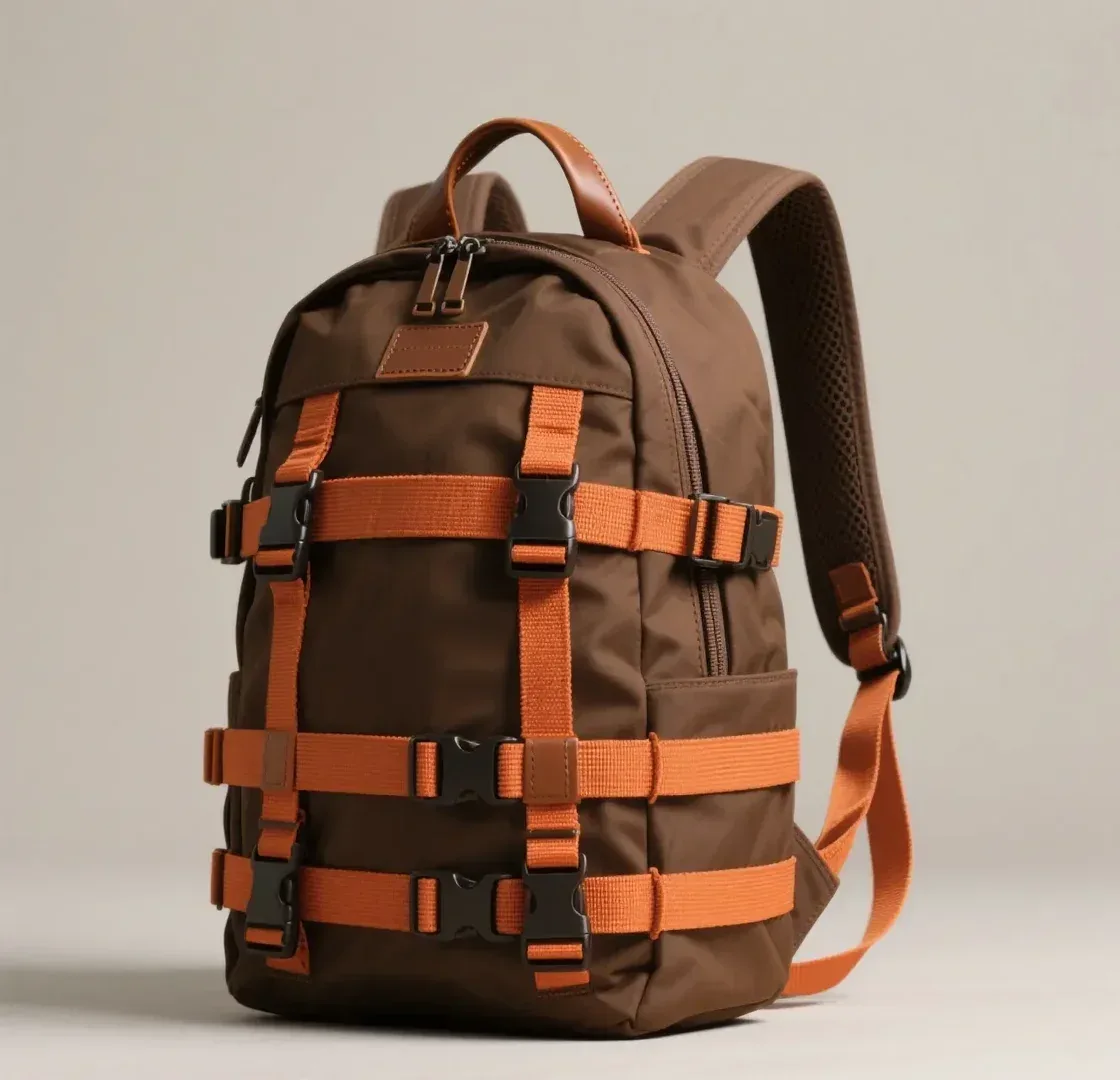
Corner Guards, Feet and Structural Fittings
Corner fittings and feet are the parts that touch the ground, and they are usually under-designed on premium soft luggage because they are treated as decoration. A leather corner sewn onto the shell and nothing else will abrade through within a year of regular checked travel. The version that survives is a shaped fitting riveted through the shell into a backing plate or the frame, with the rivet heads set rather than proud.
| Fitting | Construction that lasts | Construction that fails |
|---|---|---|
| Corner guard | Moulded fitting, riveted through to the frame | Leather patch stitched to shell only |
| Base feet | Recessed, replaceable, five-point placement | Surface-mounted studs, four-point |
| Base rail | Full-length rail screwed into the frame | Rail bonded with adhesive |
| D-ring and shackle | Welded ring on a webbing tab through the frame | Sewn loop through lining |
| Shoulder strap anchor | Metal ring on a box-X stitched tab | Single-row stitching into the shell |
A note on weight: a full set of metal corner guards, base feet and a rail adds 400–700 g. On a checked piece that is irrelevant. On a cabin bag fighting a 7 kg allowance it is decisive, which is why the specification should differ by piece rather than being applied uniformly across a range.
Attachment method carries more weight than material in most failures. Rivets through a backing plate, screws into a threaded insert, and box-X stitching on a webbing tab are the three joins that hold; single-row stitching into a leather shell or a rivet set into lining alone are the three that fail. Specifying the join rather than the fitting is what removes this class of claim, because a modest fitting correctly attached outperforms an expensive one attached badly.
Finishes, Platings and Compliance
Finish choice affects both appearance and compliance. Plated finishes vary in hardness and in their behaviour against nickel release limits, and a programme selling into the EU should confirm that the plating specification meets the applicable restricted substances requirement rather than assuming it does. Recycled content claims on metal components need a certificate behind them for the same reason.
| Finish | Appearance | Practical considerations |
|---|---|---|
| Brushed nickel | Neutral, satin | Wears evenly; check nickel release compliance |
| Antique brass | Warm, heritage | Patina suits leather; lacquer may chip |
| Polished chrome | Bright, high contrast | Shows fingerprints and scratches |
| Gunmetal | Dark, understated | Chips reveal a lighter base metal if poorly plated |
| Blackened steel | Matte, technical | Best matched to woven shells |
| PVD-coated | Hard wearing, colour-stable | Higher cost; specify coating thickness |
Consistency across a range matters more than the finish itself. A programme that specifies brushed nickel on every piece reads as deliberate; the same programme with three different metal finishes across a set reads as uncontrolled. Where a set is sold together, the finish should be fixed once and applied to handles, zip pullers, feet and any branding plate.
Where a programme involves branding on hardware, the marking method deserves a decision of its own. Laser marking on metal is permanent and produces a tonal result; etching is subtler but slower; a moulded plate allows deeper relief at lower unit cost once tooling exists. All three survive handling, and all three need to be settled before tooling is cut, because changing a plate design after the mould exists means paying for the mould twice.
Testing Hardware Before Bulk
Hardware can be validated cheaply at sample stage on our production floor in Quanzhou, and the tests take less than a day. The programme below is the one applied before a bulk release, run on samples built with production-intent components rather than with a substitute set.
- Static load test: the piece is loaded to its rated weight and lifted by each handle in turn.
- Rolling test: a loaded case is rolled over a defined obstacle course and inspected for housing or hub damage.
- Trolley cycle test: the handle is extended and retracted repeatedly under load and checked for stick or play.
- Zip load test: the main zip is cycled with the bag full and inspected for slider spread or tooth damage.
- Lock function test: every lock on a drawn sample is operated, keyed and reset, including spare keys.
- Fitting pull test: corner guards, feet and anchors are pulled to a stated load and the join inspected.
- Final inspection to AQL 2.5 (ISO 2859-1), single sampling, general level II, on packed cartons.
The results of those tests belong in the tech pack, not in a folder of emails, because they become the acceptance criteria for bulk. A statement that the trolley handle must complete a defined number of extension cycles under load is something an inspector can check and a supplier can be held to. A statement that the handle must feel solid is not. Writing the test into the specification is what converts it from an intention into a control.
Specify luggage hardware around the load and the surface
Send the piece list, the loads it must carry and the surfaces it will meet, and the programme team will return a hardware schedule with a replacement plan. Email service@junyuanbags.com or WhatsApp +86 177 5002 0688.
Frequently Asked Questions
What is the most important hardware on a piece of luggage?
The wheel assembly. Field data across the category shows wheels and wheel housings account for the largest share of warranty claims, followed by trolley handle mechanisms and then zip sliders. Shell materials, which receive most of the design attention, rarely cause a return on their own. Over-specifying the moving parts is the single most effective durability decision.
Should I choose four-wheel spinner or two-wheel luggage?
Four-wheel spinners are better on airport and hotel floors, where they can be pushed upright with minimal effort. Two-wheel inline cases track better over cobbles, gravel and kerbs, and each wheel takes a higher load. For a bespoke range serving frequent travellers on mixed surfaces, the two-wheel configuration often wears better despite being less fashionable.
What size wheels are best for a rolling case?
Between 70 and 80 mm for mixed urban surfaces and 50–60 mm for terminal and hotel use. Larger wheels roll over obstacles rather than being stopped by them, which reduces peak load on the housing. The trade is height: an 80 mm wheel set can consume 20–30 mm of external envelope, which matters on a cabin case.
How many wheels should a carry-on bag have?
Two or four depending on use. Four-wheel spinners are convenient in terminals, but on a cabin piece the wheel assembly competes with packing volume and weight. Two-wheel inline designs with small wheels retain more usable internal space. Some programmes specify a fixed glide base for under-seat bags, which saves both weight and cost.
Do I need a TSA lock on bespoke luggage?
Only where the piece will be checked into, or through, the United States. A TSA-accepted lock lets an inspector open the case without cutting it. For cabin luggage, a lockable slider pair is a deterrent against opportunistic access rather than genuine security, and should be specified in proportion to the actual risk the traveller faces.
Why do zips fail on luggage?
Zip failure on luggage is almost always a sizing problem rather than a quality problem. A number five zip on a 40-litre panel is being asked to resist a load it was not designed for, and the slider spreads under tension. A number eight or ten coil zip with reverse sliders, bound at both ends, resolves the majority of claims in this category.
Are replaceable wheels worth specifying?
Yes, for any piece expected to be serviced. A wheel module that can be swapped in minutes costs a few pounds to replace and keeps the bag in use, whereas a worn wheel on an integral housing usually means the piece is retired. Brands offering an aftercare promise should design every high-wear fitting so the workshop can replace it.
How should corner guards be attached?
Moulded fittings should be riveted through the shell into a backing plate or the frame, with rivet heads set rather than proud. A leather patch stitched to the shell alone will abrade through within a year of regular checked travel. Where weight is critical, corner protection can be reduced on cabin pieces and retained on checked luggage.
What metal finish is best for luggage hardware?
Brushed nickel and PVD-coated finishes wear most evenly and stay consistent across a range. Antique brass suits leather and heritage programmes, though lacquer can chip. Polished chrome shows every fingerprint and scratch. Whatever the finish, it should be specified once and applied consistently to handles, pullers, feet and branding.
Does luggage hardware have to meet compliance requirements?
Yes, where the hardware touches the user or uses plated finishes. Nickel release limits are specified in the EU under REACH, and plated components should be confirmed against them rather than assumed compliant. Where recycled content is claimed for a metal component, a certificate with a stated percentage and chain of custody should be held in the material file.
How is luggage hardware tested before bulk production?
Seven checks are run on production-intent samples: static load by each handle, a rolling test over an obstacle course, a trolley extension and retraction cycle under load, a zip load test with a full bag, a lock function test, and pull tests on corner guards, feet and anchors. Bulk release then follows inspection to AQL 2.5 under ISO 2859-1.
How much weight does luggage hardware add?
A full set of metal corner guards, base feet and a base rail adds 400–700 g to a piece. On checked luggage that is immaterial; on a cabin bag facing a 7 kg allowance it is decisive. The practical approach is to vary the hardware specification by piece rather than applying one specification across an entire travel range.
What is the minimum order for bespoke luggage hardware?
Custom hardware — bespoke plated plates, moulded wheel housings or branded pullers — generally requires tooling and is economical from around 500 pieces per style, which matches the standard programme minimum. Stock hardware in a chosen finish can be used at any quantity. Tooling is amortised across the order and retained for reorders.