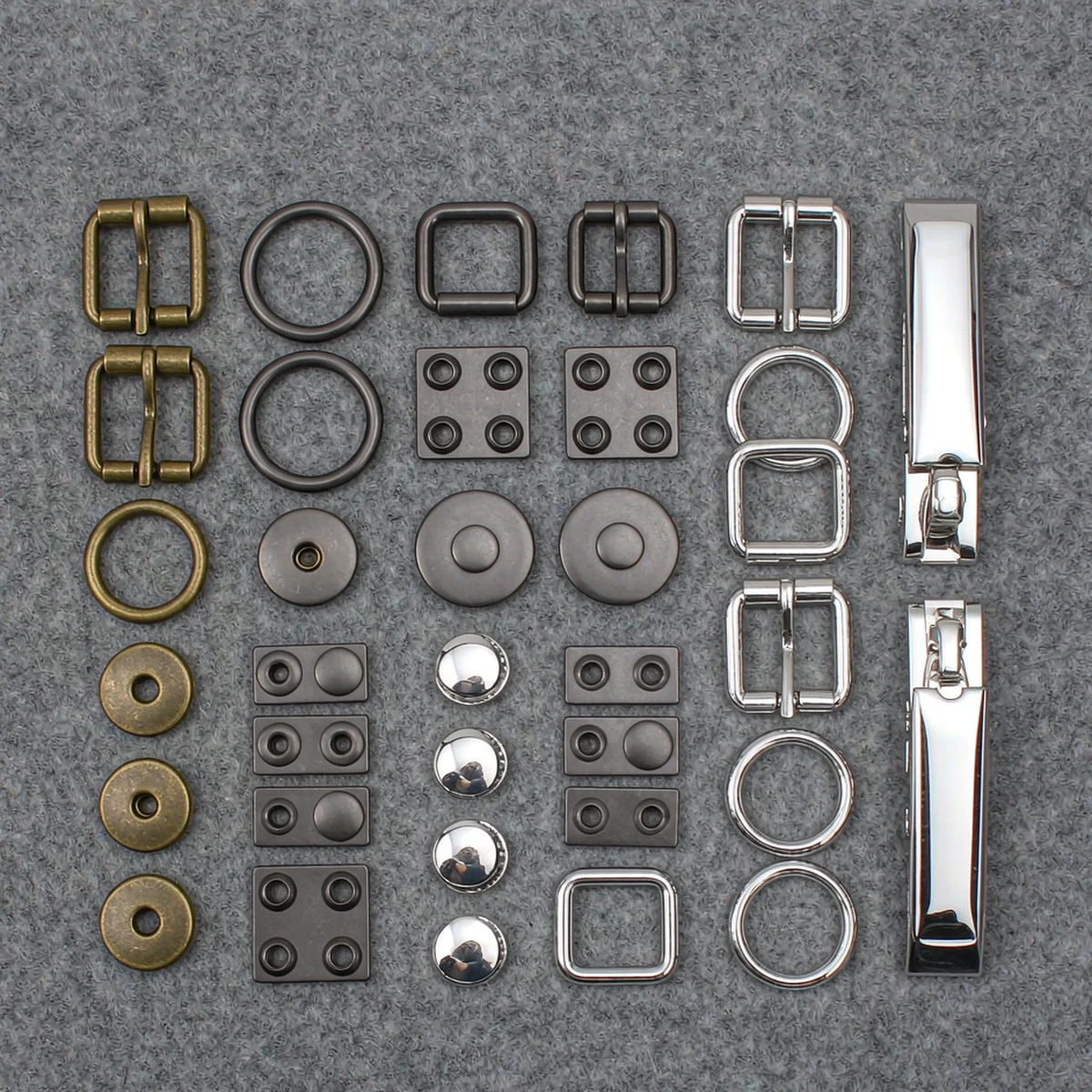
Hardware finish is chosen from a colour card in a meeting, and the decision usually stops there. But the four finish families used in the bag trade behave very differently: they age differently, they cost differently, they tolerate flex differently and they fail in different places. A gunmetal finish that looks right on a sample table can wear to a bright edge in three months.
The specification that matters most is thickness, and it is the one buyers almost never ask about. Colour is a pigment question; durability is a thickness question; and the two are usually discussed as though they were the same.
The Four Finish Families
Each family occupies a different position on the trade-off between colour control, durability and cost.
| Family | How it is applied | Thickness | Strength | Limitation |
|---|---|---|---|---|
| Electroplating | Electrolytic deposition of nickel, brass, copper or chrome | 8–15 µm typical | Cheap, wide colour range, established | Thickness varies on complex shapes; corrosion at thin points |
| PVD | Vacuum deposition of a metal nitride or carbide | 0.3–1.0 µm | Excellent colour consistency, hard surface, no lacquer needed | Very thin; depends entirely on substrate polish |
| Powder coat | Electrostatic powder, oven cured | 60–100 µm | Thick, durable, wide colour range | Chips at edges; matte or textured appearance only |
| Antique / chemical ageing | Chemical oxidation over a plated base, then lacquer | Base plate plus lacquer | Depth and character no flat finish achieves | Residues seed corrosion; lacquer cracks at flex points |
Two of these — PVD and antique — look expensive and are; two are cheap. The reason PVD commands a premium is colour consistency across batches, not just hardness.
Thickness Is the Durable Variable
Almost every corrosion and wear complaint traces back to coating thickness at the point that failed. Electroplating is thinner in recesses, at edges and on sharp radii; the flat area of a sample tests well while the visible edge of the finished buckle is a third of the thickness.
This is why a plating thickness specification, in microns, per surface, is more useful than a salt spray claim. Thickness can be measured non-destructively on incoming goods in seconds, which makes it a practical routine check rather than a laboratory event.
Programme parameters at a glance
| Parameter | Commitment |
|---|---|
| Minimum order quantity | 500 pieces per style / colourway |
| Sampling lead time | 6–10 working days (12–15 days for complex constructions) |
| Bulk production lead time | 35–50 days after sample approval |
| Inspection standard | AQL 2.5 (ISO 2859-1), single sampling, general level II |
| Incoterms | FOB Xiamen — EXW, CIF and DDP available on request |
| Payment terms | T/T 30% deposit / 70% before shipment; L/C at sight for container loads |
| Verified production floor space | 4,950 m² (SGS-verified) |
| Team | 137 staff across 7 production lines |
| Equipment | 149 machines including computerised saddle-stitch and edge-painting units |
| Monthly capacity | 200,000 pieces |
| Entity | Founded 2014; principal has worked in bag development since 2004 |
Colour Consistency and Batch Variation
Colour is where finish decisions cause the most grief in production, and the reason differs by family. Electroplated colours shift with bath chemistry, current density and part geometry, so two batches of the same nominal colour can sit visibly apart. PVD is far more consistent because the process is controlled in a vacuum, which is why it is often specified for hardware that must match across a range.
Antique finishes are the least consistent by design, because the ageing is a chemical process with natural variation. That variation is part of the appeal, but it has to be bounded: a reference sample and an agreed tolerance for how dark and how streaky the finish may be. Without that, a batch that is too dark is a defect and a batch that is too light is a defect, and nobody has defined either.
Keep a physical reference
Colour cards age and photographs lie. Keep a physical reference piece for each finish, in a sealed bag, dated and signed. It is the only artefact that settles a colour dispute two years later.
Antique Finishes: Character Versus Corrosion
Antique brass and gunmetal are the finishes most likely to generate a complaint, because the process that produces the character also produces the conditions for corrosion. The ageing chemical is an oxidiser, and if it is not fully neutralised it continues working inside the joint, under the lacquer, and around the rivet.
The four controls that make an antique finish durable are thorough neutralisation after ageing, complete drying before lacquering, a lacquer that is flexible enough for the part, and a flex test on the finished assembly. The last is the one most often omitted, and it is the one that predicts whether the lacquer will crack at the edge of a buckle within a season.
Matching Finish to Product and Price
The right finish follows the product's position and its use environment rather than its look alone.
| Product position | Sensible finish | Why |
|---|---|---|
| Entry price, fashion | Electroplated nickel, no lacquer | Cheapest; accept visible ageing as part of the product life |
| Mid price, multi-season | Electroplated nickel with lacquer, or PVD | Colour holds across a range; lacquer hides porosity at low cost |
| Premium, colour-critical | PVD over polished substrate | Batch-to-batch consistency, no lacquer to crack |
| Heritage or craft | Antique over plated base, lacquered | Character is the product; needs the neutralisation discipline |
| Outdoor and technical | Powder coat or PVD, matte | Thick, chip-resistant, reads as functional |
| Marine or high-humidity | PVD or powder coat, plus stainless at exposed points | Corrosion resistance is the primary requirement |
Substitution: The Invisible Cost Reduction
The finish is one of the easiest places to reduce cost without changing the drawing. Thickness is reduced, lacquer is thinned, or a cheaper base plate is used, and the part looks identical on the sample table.
The defences are a retained reference piece from the approved lot, an incoming thickness measurement, and a salt spray figure on the assembled hardware rather than on the coupon. Together they cost little and they close the gap that a visual inspection cannot.
Where the Programme Fits
QUANZHOU JUNYUAN BAGS specifies hardware finish by family, colour reference and thickness, with a retained physical reference per finish and a thickness measurement on incoming goods rather than only at approval. On a 6–10 working day sampling cycle, finish approval runs alongside the sample rather than after it, which is the point at which changing a finish is still free.
Pin the finish to a thickness
Send the hardware list and the colour references. The programme team will propose a finish family, a thickness specification and the tests that hold it.
Frequently Asked Questions
What is PVD and why does it cost more?
Physical vapour deposition is a vacuum process that deposits a very thin metal nitride or carbide layer, typically 0.3 to 0.5 microns. It costs more because of equipment and throughput, and it is chosen for colour consistency and hardness rather than for thickness.
Why does my hardware colour vary between batches?
Electroplating colour depends on bath chemistry, current density and part geometry, so batches shift. PVD is far more consistent. Antique finishes vary by design and need a bounded tolerance rather than an exact match.
How thick should plating be?
Ten to fifteen microns on visible surfaces for electroplated nickel, with at least six microns in recesses. Thickness, not colour, is what determines corrosion and wear performance.
How do I measure plating thickness?
X-ray fluorescence on a sample part gives a non-destructive reading in seconds and can be done on incoming goods. It is a far better routine check than a salt spray test on supplier-selected samples.
Why does antique brass corrode?
Because the ageing chemical is an oxidiser. If it is not fully neutralised and dried before lacquering, it continues to attack the metal under the coating, particularly inside joints and around rivets.
Does lacquer make plating more durable?
It hides porosity and improves appearance retention, but it cracks at sharp edges and flex points if it is not flexible enough. Always flex-test a lacquered part before approving it.
What finish is best for a coastal market?
PVD or powder coat, with stainless steel or solid brass at exposed points rather than plated zinc alloy. Pair the choice with a 72 to 96 hour salt spray requirement on the assembled hardware.
Is powder coat suitable for bag hardware?
Yes for technical and outdoor products where a matte, thick, chip-resistant finish suits the design. It chips at sharp edges and reads as functional rather than luxurious, which makes it a poor fit for dress hardware.
How do I prove a substitution has happened?
Compare incoming thickness against the approved specification and against a retained reference piece from the approved lot. A visual comparison will not catch a reduction in plating thickness; a measurement will.
How long does finish approval take?
It runs alongside the sampling cycle rather than after it. On a 6–10 working day sample, finish approval is a parallel task, which matters because changing a finish after bulk is a re-plate of the whole order.