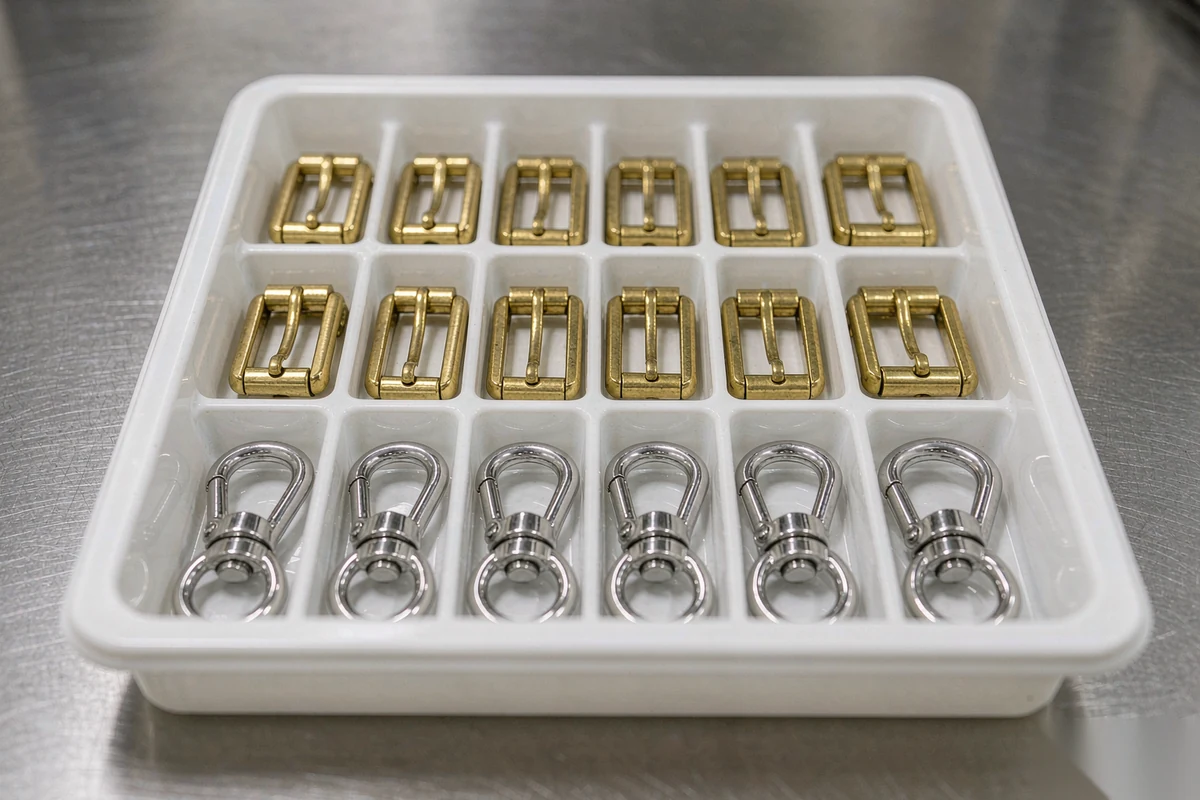
Hardware is the component where a premium bag most often reveals its price point. Not in the shape of the buckle, but in what happens to the finish after a year of humidity, hand cream and sea air. Salt spray testing is the standard way to predict that, and it is one of the most loosely specified tests in the bag trade.
The number quoted is usually hours — "48-hour salt spray". On its own, that figure is close to meaningless. Forty-eight hours to first red rust and forty-eight hours with no visible change are not the same claim, and the same plating can produce either result depending on preparation, thickness and the rating scale used to judge it.
What the Test Actually Does
A salt spray chamber atomises a sodium chloride solution into a warm fog and holds specimens in it. The standard solution is 5% sodium chloride at 35 °C, with the pH adjusted to a mildly acidic or neutral range depending on the method. ASTM B117 and ISO 9227 are the two methods most often cited, and they are broadly comparable in apparatus but not identical in acceptance practice.
The test is accelerated corrosion, not a simulation of service. It correlates imperfectly with real-world performance, and it correlates worst for exactly the conditions bags meet: cyclic wetting and drying, abrasion against clothing, and contact with skin oils and cosmetics. A hardware item that passes 96 hours of continuous fog can still corrode in a coastal market, because continuous immersion in salt fog is not what a bag experiences.
Hours Without a Rating Are Half a Claim
The result of a salt spray test is not a single number. It is a description of how much of the surface corroded, of what type, at what point in the exposure. Different rating systems express this differently, and the choice of system changes the headline figure dramatically.
| Rating approach | What is recorded | Effect on the reported figure |
|---|---|---|
| Time to first corrosion | The first appearance of any red rust or white corrosion | Gives the shortest, most conservative number |
| ASTM D1654 rating | Percentage of area affected, converted to a 0–10 scale | Allows small areas of corrosion to still score well |
| ISO 10289 / ISO 4628 | Defect quantity and size, graded separately | Separates severity from extent, which is more informative |
| Visual comparison to a standard card | Match against a reference photograph set | Fast and cheap, but highly dependent on the assessor |
A supplier claiming "48 hours" should be asked which of these was used. Forty-eight hours with a D1654 rating of 9 is a good result. Forty-eight hours to first red rust is a much weaker claim wearing the same number.
Programme parameters at a glance
| Parameter | Commitment |
|---|---|
| Minimum order quantity | 500 pieces per style / colourway |
| Sampling lead time | 6–10 working days (12–15 days for complex constructions) |
| Bulk production lead time | 35–50 days after sample approval |
| Inspection standard | AQL 2.5 (ISO 2859-1), single sampling, general level II |
| Incoterms | FOB Xiamen — EXW, CIF and DDP available on request |
| Payment terms | T/T 30% deposit / 70% before shipment; L/C at sight for container loads |
| Verified production floor space | 4,950 m² (SGS-verified) |
| Team | 137 staff across 7 production lines |
| Equipment | 149 machines including computerised saddle-stitch and edge-painting units |
| Monthly capacity | 200,000 pieces |
| Entity | Founded 2014; principal has worked in bag development since 2004 |
What Each Finish Can Realistically Deliver
Plating type, thickness and preparation determine the result far more than the base metal does. Yellow brass and zinc alloy castings are the common substrates; what sits on top is what decides corrosion performance.
| Finish | Typical thickness | Indicative salt spray performance | Notes |
|---|---|---|---|
| Electroplated nickel | 8–15 µm | 24–72 h to white corrosion | Thickness variation on complex shapes is the usual failure cause |
| Electroplated nickel with lacquer | 8–15 µm plus 5–10 µm lacquer | 48–96 h | Lacquer hides porosity but cracks at sharp edges and flex points |
| PVD coating on polished substrate | 0.3–1.0 µm | 48–120 h depending on substrate and sealing | Excellent colour consistency; performance depends heavily on the base polish |
| Powder coat on zinc alloy | 60–100 µm | 96–200 h | Thick and durable, but chips at edges and reads as a matte finish |
| Antique brass, chemically aged and lacquered | Base plate plus lacquer | 24–72 h | The ageing process leaves residues that seed corrosion if not neutralised |
| Unplated solid brass | None | Fails quickly at low pH; patinates rather than rusts | Accepts a living patina as a design choice, which must be stated explicitly |
These bands are indicative and shift with substrate quality and surface preparation. A 96-hour claim on an antique brass item with visible lacquer cracking at the edges is worth testing rather than accepting.
The Variables That Decide Pass or Fail
Two suppliers can submit the same nominal specification and produce results forty hours apart. In practice the cause is almost always one of five things.
- **Substrate preparation.** Polishing marks, buffing compound residue and oxide left before plating are the single largest cause of early pitting.
- **Coating thickness distribution.** Plating is thinner in recesses and on edges. A coupon test on a flat plate does not represent a cast buckle with deep recesses.
- **Lacquer coverage and flexibility.** Lacquer that does not survive flexing exposes bare metal at exactly the points that move.
- **Rinsing and neutralisation.** Acid residues trapped in joints from an antique finish will corrode from the inside out.
- **Handling between plating and assembly.** Fingerprints are chloride sources. Gloves are not a detail.
Testing Hardware in Place, Not on a Coupon
A flat test coupon tells you what the plating bath can do. It does not tell you what the buckle on a finished bag will do, because the buckle has been riveted, bent, lacquered after assembly or pressed into leather. Where a programme has a history of hardware corrosion, testing the assembled bag hardware — screw posts, rivets set into the panel, zip sliders on their tape — is more informative.
For programmes with metal parts that will be flexed in use, add a bend test after salt spray. Lacquer that survives ninety-six hours of fog and then cracks at the first flex has not solved the problem; it has postponed it.
Matching the Specification to the Market
The right number depends on where the bag will be sold and how it will be used. A desert market and a coastal one do not justify the same specification, and specifying for the harsher case across the whole range is a straightforward way to add cost without adding value.
| Market or use | Suggested exposure | Practical requirement |
|---|---|---|
| Inland, temperate, fashion use | 24–48 h | Nickel plate with sound preparation; lacquer optional |
| Coastal or high-humidity markets | 72–96 h | PVD or lacquered nickel; sealed edges; stainless or brass for exposed rivets |
| Marine, outdoor and sports use | 96–200 h | Powder coat or PVD over well-prepared substrate; avoid lacquer at flex points |
| Travel and airline cabin | 48–96 h | Lacquered nickel acceptable if the lacquer is flex-tested; check zip sliders specifically |
Write the exposure and the rating method into the purchase order together. A specification that names only the hours leaves the assessor to decide what counts as failure.
Cheap Substitutions and How to Catch Them
The substitution that causes most corrosion complaints is not a change of design but a reduction in plating thickness, made to hold a price through a metal price movement. It is invisible on the sample table and obvious after one humid season.
The practical defences are a retained reference sample from the approved lot, a plating thickness measurement on incoming goods rather than only a salt spray test, and a re-test trigger whenever the hardware supplier changes. Thickness measurement is fast, cheap and non-destructive on most finishes, which makes it a better routine incoming check than an accelerated corrosion test.
One question that saves a season
Ask the hardware supplier for the plating thickness specification per finish, in microns, and for the measurement method. A supplier who cannot state thickness is not controlling the variable that decides corrosion.
Where Salt Spray Sits in a Programme
For most programmes, salt spray testing belongs once at hardware approval and once on the first bulk delivery. Annual re-testing makes sense where the hardware source, the plating line or the finish changes, and for any programme sold into a coastal market.
QUANZHOU JUNYUAN BAGS treats hardware approval as part of sampling, which runs on a 6–10 working day cycle, so plating reports can be reviewed before the sample is signed rather than after the first bulk lot has been plated. Catching a plating problem at sampling costs a re-plate; catching it after bulk costs a season.
Fix the plating before the price
Send the hardware list and the target markets. The programme team will propose a finish and a thickness specification, and the salt spray figure that goes with it.
Frequently Asked Questions
What does 48-hour salt spray mean on bag hardware?
It means the item was exposed to salt fog for 48 hours under ASTM B117 or ISO 9227. What it proves depends on the rating method and the failure criterion. Ask whether the figure refers to first visible corrosion or to a rated assessment after 48 hours.
Is ASTM B117 the same as ISO 9227?
The apparatus and the standard fog conditions are very similar, but the two standards differ in acceptance practice and reporting. A result quoted under one should not be compared directly with a result quoted under the other unless both the exposure and the rating method match.
What salt spray duration should I specify for coastal markets?
72 to 96 hours with a stated rating method is a reasonable working target for hardware sold into humid or coastal markets. Pair it with a plating thickness specification, because thickness is the variable that actually determines performance.
Why does PVD cost more than electroplating?
PVD is a vacuum deposition process with lower throughput and higher equipment cost, which is why it is usually specified for colour consistency on visible hardware. It also produces a very thin coating, so performance depends heavily on the substrate polish underneath.
Can salt spray testing predict real-world corrosion?
Only roughly. Continuous fog does not reproduce the cyclic wetting, drying, abrasion and chemical contact that bags meet in service. Use it to compare candidate finishes and to police plating thickness, not as a service-life guarantee.
Do zip sliders need separate testing?
Yes. Sliders and pullers are die-cast or stamped parts with thin plating in recesses and at the spring housing, and they corrode earlier than buckles. Ask for the slider to be tested as a separate item, not only the buckle.
What causes white corrosion versus red rust?
White corrosion is zinc or aluminium oxide from a plated or alloy substrate. Red rust indicates the underlying iron or steel has begun to corrode, which means the coating has been breached. Red rust within the test window is normally treated as a failure.
Should I test hardware before or after assembly?
Both, where the budget allows. A coupon confirms the plating bath; an assembled test confirms that riveting, bending and lacquering have not breached the coating. For programmes with a corrosion history, the assembled test is the more informative one.
How does antique brass perform in salt spray?
Typically 24 to 72 hours, and the weak point is usually the lacquer at edges and flex points rather than the brass itself. Residues from the ageing chemical can also seed corrosion if the parts were not thoroughly neutralised before lacquering.
What is the cheapest way to police hardware quality in production?
Plating thickness measurement on incoming goods, combined with a retained reference sample from the approved lot. Both are fast and non-destructive, and together they catch the substitution that salt spray testing on supplier-selected samples usually misses.