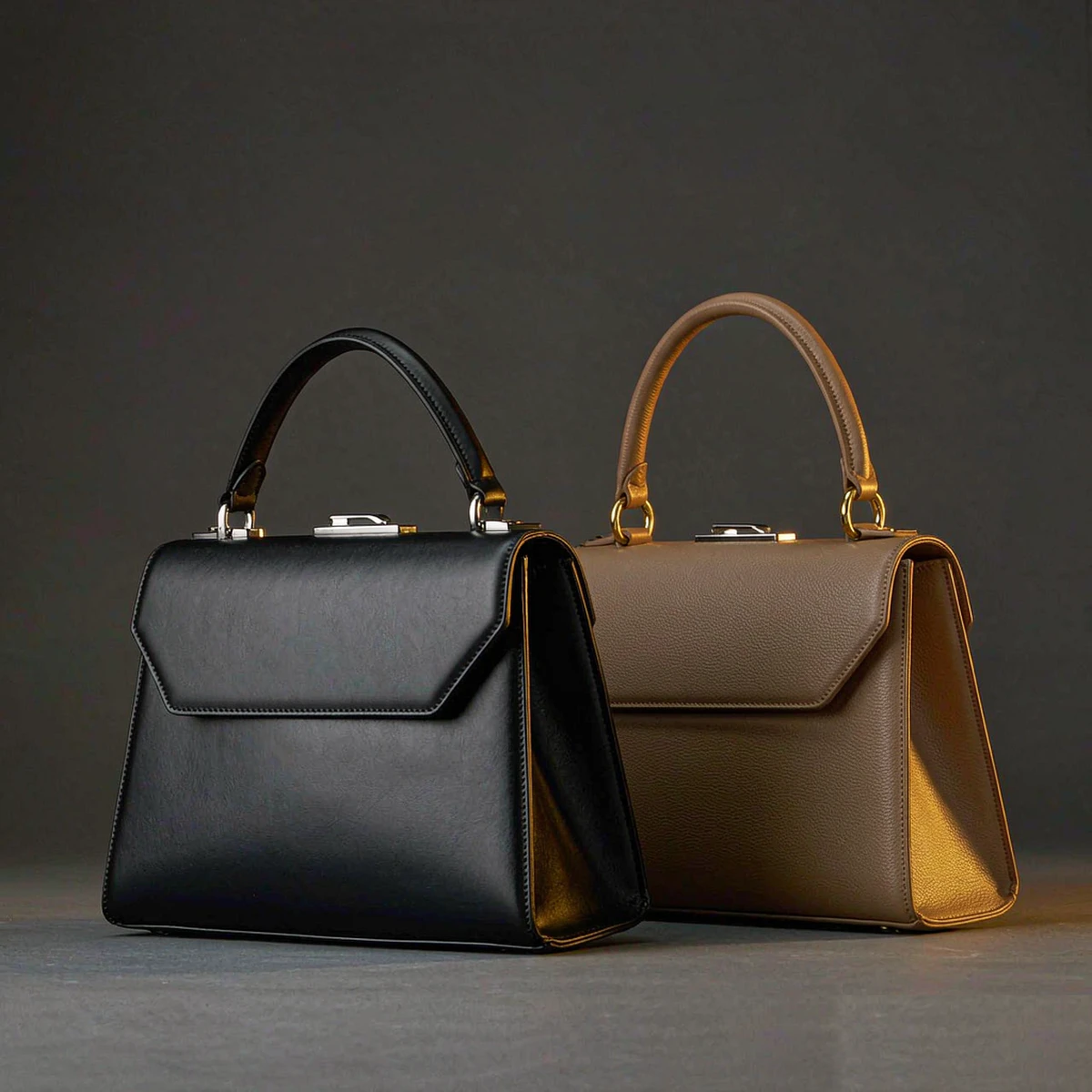
A leather bag that looks crisp in a photograph and soft in a shop two months later has usually failed at the interlining. The leather, the stitching and the hardware may all be correct; the layer behind the leather was too light, too soft, or bonded with an adhesive that gave way in the first warm week.
Interlining is the least discussed and most structural decision in soft bag construction. It controls whether a panel stays flat, whether an edge rolls, whether a gusset stands and whether the bag keeps its silhouette when loaded. It is also, per square metre, one of the cheapest things to get right.
What Interlining Is Doing
Interlining performs four distinct jobs, and a single layer rarely does all four well. Separating them is the first step in specifying the right combination.
- **Body.** Gives a panel stiffness so it does not drape or wrinkle under its own weight.
- **Shape retention.** Prevents a panel from stretching or relaxing over time, particularly on a bias or on soft leather.
- **Edge support.** Holds a folded edge crisp so it does not roll or feather.
- **Surface smoothness.** Prevents the grain from telegraphing the underlying seam allowance or reinforcement.
The Materials and Their Weights
Four families cover almost all bag construction, and each has a characteristic weight range.
| Interlining | Weight range | Effect | Best for |
|---|---|---|---|
| Non-woven, needle-punched | 60–200 g/m² | Soft body, low shape retention | Slouchy panels, linings, pockets |
| Non-woven, fusible coated | 80–250 g/m² | Firm body once bonded | Structured panels and gussets |
| Woven cotton or polyester canvas | 120–300 g/m² | Firm, dimensional stability, no adhesive | Panels that must not stretch |
| Foam, PE or PU | 2–5 mm thickness | Padding and light structure | Straps, back panels, protective sections |
| Board, PP or PE | 0.6–2.0 mm | Rigid planes | Bases, front panels, structured shells |
Weight alone does not predict behaviour. A 150 g/m² fusible non-woven bonded to a soft leather can feel firmer than a 250 g/m² unfused one, because the bond transfers load into the interlining.
Programme parameters at a glance
| Parameter | Commitment |
|---|---|
| Minimum order quantity | 500 pieces per style / colourway |
| Sampling lead time | 6–10 working days (12–15 days for complex constructions) |
| Bulk production lead time | 35–50 days after sample approval |
| Inspection standard | AQL 2.5 (ISO 2859-1), single sampling, general level II |
| Incoterms | FOB Xiamen — EXW, CIF and DDP available on request |
| Payment terms | T/T 30% deposit / 70% before shipment; L/C at sight for container loads |
| Verified production floor space | 4,950 m² (SGS-verified) |
| Team | 137 staff across 7 production lines |
| Equipment | 149 machines including computerised saddle-stitch and edge-painting units |
| Monthly capacity | 200,000 pieces |
| Entity | Founded 2014; principal has worked in bag development since 2004 |
Fusible Versus Sewn-In
A fusible interlining is bonded to the leather with heat and pressure; a sewn-in interlining is stitched into a pocket or sandwiched between layers. The choice affects how the bag ages more than how it looks on day one.
Fusible gives a cleaner surface and better shape retention on a thin leather, but it depends entirely on the bond. A bond that is too weak separates in heat and the panel bubbles; a bond that is too strong stiffens the leather and makes it feel like synthetic. Sewn-in interlining is more forgiving, easier to replace, and does not risk bubbling, but it can shift inside its pocket and it shows at the edges if the panel is unlined.
| Method | Surface quality | Risk | Best for |
|---|---|---|---|
| Fusible, full panel | Cleanest | Bubbling, stiffening, adhesive bleed | Thin leathers, structured panels |
| Fusible, partial | Good | Edge ghosting if the boundary lands on a visible area | Panels that need softness at the edge and firmness in the centre |
| Sewn-in, loose | Good | Migration inside the pocket | Removable or seasonal interlining |
| Sewn-in, quilted | Textured | Adds bulk | Padded panels and straps |
| Laminated at the tannery | Very clean | Little control after the fact; expensive | Premium structured ranges |
Partial fusing is the most underused option. Bonding a shape that stops short of the seam allowance keeps the edge soft and the centre firm, which is what most premium bags actually do.
Adhesive Chemistry Decides How It Ages
The adhesive on a fusible interlining is the part that fails. Three chemistries are common, and they behave very differently in heat and humidity.
- **Polyamide (PA) dot coating.** Low activation temperature, good bond on leather, but softens again in heat. Not suited to tropical markets.
- **Polyethylene (PE) dot coating.** Higher activation temperature, better heat resistance, firmer hand. The usual choice for structured panels.
- **Polyurethane (PUR) or reactive.** Best heat and hydrolysis resistance, higher cost, tighter process window.
- **Solvent-based liquid adhesive.** Requires careful ventilation and carries odour risk; rarely the right answer for a lined bag.
Placement: Where the Reinforcement Goes
Reinforcement is directional. Placing it in the wrong orientation is a common and invisible error.
| Location | Reinforcement | Purpose |
|---|---|---|
| Handle and strap anchors | Woven tape or board patch behind the anchor, oriented along the load | Distributes pull into the panel rather than into the stitch line |
| Base panel | 1.5–2.0 mm PE board or laminated board | Keeps the footprint and protects against ground contact |
| Gusset | Fusible non-woven on the fold, cut on the bias where the gusset curves | Prevents collapse and keeps the bag standing |
| Zip opening | Tape or a narrow strip of fusible along the opening | Stops the opening from stretching and the zip from waving |
| Panel centres | Partial fusible shape | Firmness where visible, softness at the seam |
| Lining pockets | Light fusible, 60–80 g/m² | Prevents card pockets from stretching out of shape |
The orientation point matters most at the handle anchor. Reinforcement placed across the load direction adds almost nothing; the same material placed along it can double the anchor's capacity.
Testing Interlining Before Bulk
Three small tests catch most interlining failures, and all three can be run during sampling.
Where Interlining Goes Wrong in Production
Most interlining defects are process defects rather than material defects, and they appear when the fusing press is set by feel rather than by specification.
- **Temperature too low.** The adhesive does not fully activate and the bond fails weeks later.
- **Pressure too low.** Air remains between the layers and bubbles form in heat.
- **Time too short.** The adhesive skins over before it wets the leather.
- **Cooling under load.** Removing a panel hot and stacking it traps stress and produces waves.
- **Inconsistent leather thickness.** The same press setting bonds well on one area of a hide and poorly on another.
- **No record.** Without a fusing log, a defect cannot be traced to a setting.
Where the Programme Fits
QUANZHOU JUNYUAN BAGS specifies interlining by weight, adhesive chemistry and placement zone on the tech pack, with the fusing parameters recorded per batch and the bond tested after heat and humidity conditioning during sampling. That is the point at which a change of interlining is a decision rather than a surprise in the market.
Specify the layer nobody sees
Send the panel drawings and the leather. The programme team will propose an interlining weight, adhesive chemistry and placement zone, and the conditioning tests that prove the bond.
Frequently Asked Questions
What does interlining do in a bag?
It gives the panel body, holds its shape over time, supports folded edges and prevents the leather grain from telegraphing the seam allowance beneath. Different jobs usually need different materials.
What weight interlining should I use?
Sixty to two hundred grams per square metre for non-wovens, depending on how firm the panel should be. A structured front panel typically uses 150 to 250 g/m² fusible; a soft slouch panel uses 60 to 100 g/m² unfused.
Why does my bag's leather bubble?
The fusible adhesive did not fully bond, or it re-softened in heat. Low activation temperature, insufficient pressure, or too short a dwell time all produce the same result, and it appears weeks after production.
Is fusible better than sewn-in interlining?
Fusible gives a cleaner surface and better shape retention on thin leather; sewn-in is more forgiving and does not risk bubbling. Partial fusing — a bonded shape that stops short of the seam — is often the best of both.
How do I stop a bag edge from rolling?
Support the fold with a narrow strip of fusible along the seam, and keep the main interlining away from the seam allowance. Too much interlining at the edge is a common cause of rolling rather than a cure.
Which adhesive is best for humid markets?
Polyethylene or reactive polyurethane rather than polyamide. Polyamide re-softens in heat, and hydrolysis of the adhesive layer can leave a tacky residue that migrates into the lining.
How should reinforcement be oriented at a handle anchor?
Along the direction of load. Reinforcement placed across the pull adds very little; the same tape or patch placed along it substantially increases the load the anchor can take.
How do I test an interlining?
Peel after 48 hours at 50 °C and after 72 hours at 40 °C / 90% RH, plus a cantilever bend for stiffness and a fold test for edge roll. All three can be run during sampling.
Why does interlining matter on a small pocket?
Because a card pocket without light fusible stretches out of shape within weeks and the bag looks worn. Sixty to eighty grams per square metre is enough and costs almost nothing.
What is a fusing log and why keep one?
A record of temperature, pressure, dwell time, operator and date for each fusing batch. Without it, a bubbling defect cannot be traced to a setting, and the same fault recurs after every investigation.