
Bespoke Carry-On Bags
Cabin bags patterned to a named allowance, then measured loaded — the envelope, the shell and the wheel set settled before a pattern is cut.
A bespoke carry-on bag is a cabin-format piece patterned to a named airline allowance, then dimensioned and weighed packed rather than empty. Orders start at 500 pieces per style and colourway; prototypes take 6–10 working days, 12–15 with custom hardware; bulk leaves 35–50 days after sample sign-off. Every lot is released against AQL 2.5 (ISO 2859-1), single sampling, general level II, FOB Xiamen.
Programme parameters at a glance
| Parameter | Commitment |
|---|---|
| Minimum order quantity | 500 pieces per style / colourway |
| Sampling lead time | 6–10 working days (12–15 days for complex constructions) |
| Bulk production lead time | 35–50 days after sample approval |
| Inspection standard | AQL 2.5 (ISO 2859-1), single sampling, general level II |
| Incoterms | FOB Xiamen — EXW, CIF and DDP available on request |
| Payment terms | T/T 30% deposit / 70% before shipment; L/C at sight for container loads |
| Verified production floor space | 4,950 m² (SGS-verified) |
| Team | 137 staff across 7 production lines |
| Equipment | 149 machines including computerised saddle-stitch and edge-painting units |
| Monthly capacity | 200,000 pieces |
| Entity | Founded 2014; principal has worked in bag development since 2004 |
Cabin Allowances and the Sizer Test
Most carriers publish a cabin figure; very few explain what happens once the bag is full. We work from the published envelope, subtract a working margin for fabric creep and packed bulge, and pattern to the reduced figure instead. The bag is then checked in a rigid gauge with a representative load — a laptop, a wash bag, a folded jacket — because an empty shell that slides into a sizer says almost nothing about the same shell after a fortnight in service.
Reading an allowance as a build envelope
An allowance is three numbers plus a weight cap, and each one governs a different decision. Height sets panel length. Depth decides whether a boarded base can be used at all. Width decides how much internal volume survives once side walls, a device bay and a lining are subtracted. Weight is the constraint that quietly removes options: under a 7 kg cap, a full-grain body with metal feet and a moulded base can leave the traveller barely two kilograms of packing allowance.
Where a packed bag gains millimetres
Bulge rarely comes from the pattern. It comes from a base board bowing under load, from compression straps cut too short to close over a full pack, and from external pockets drafted flat but filled round. We control it with a semi-rigid base, a strap length calculated at maximum fill, and external pockets carrying a gusset allowance rather than a flat facing.
Sizers are not interchangeable. A rigid gauge at a European hub, an open wire frame at a regional airport and the physical bin of a narrowbody aircraft are three different tests, and one bag can pass the first and fail the third. Where a programme serves several carriers, the pattern is built to the most restrictive gauge in the set rather than to an average, because the cost of a single gate-check incident to a travel brand exceeds the cost of giving up two litres of nominal volume.
| Allowance band | Stated envelope (cm) | Weight cap | Empty-weight target | Build note |
|---|---|---|---|---|
| Standard overhead sizer | 55 × 40 × 20 | 7–10 kg | 0.9–1.3 kg | Semi-rigid base board; external pockets gusseted rather than flat-faced |
| North American overhead | 56 × 36 × 23 | No published cap on many fares | 1.1–1.5 kg | Wider body takes a full-width device sleeve without depth creep |
| Underseat and personal item | 45 × 36 × 20 | Frequently folded into the cabin cap | 0.7–1.0 kg | Soft walls throughout; no board, no feet, no framed opening |
| Regional jet and turboprop | 50 × 35 × 20 with gate-check risk | 6–8 kg | 0.8–1.1 kg | Compressible body that tolerates being squeezed into a hold bag |
| Business-class overhead | 55 × 40 × 25 on selected widebodies | 12–18 kg | 1.4–2.1 kg | Leather body viable; the weight budget goes into structure and hardware |
Shell Architecture and Compartment Layout
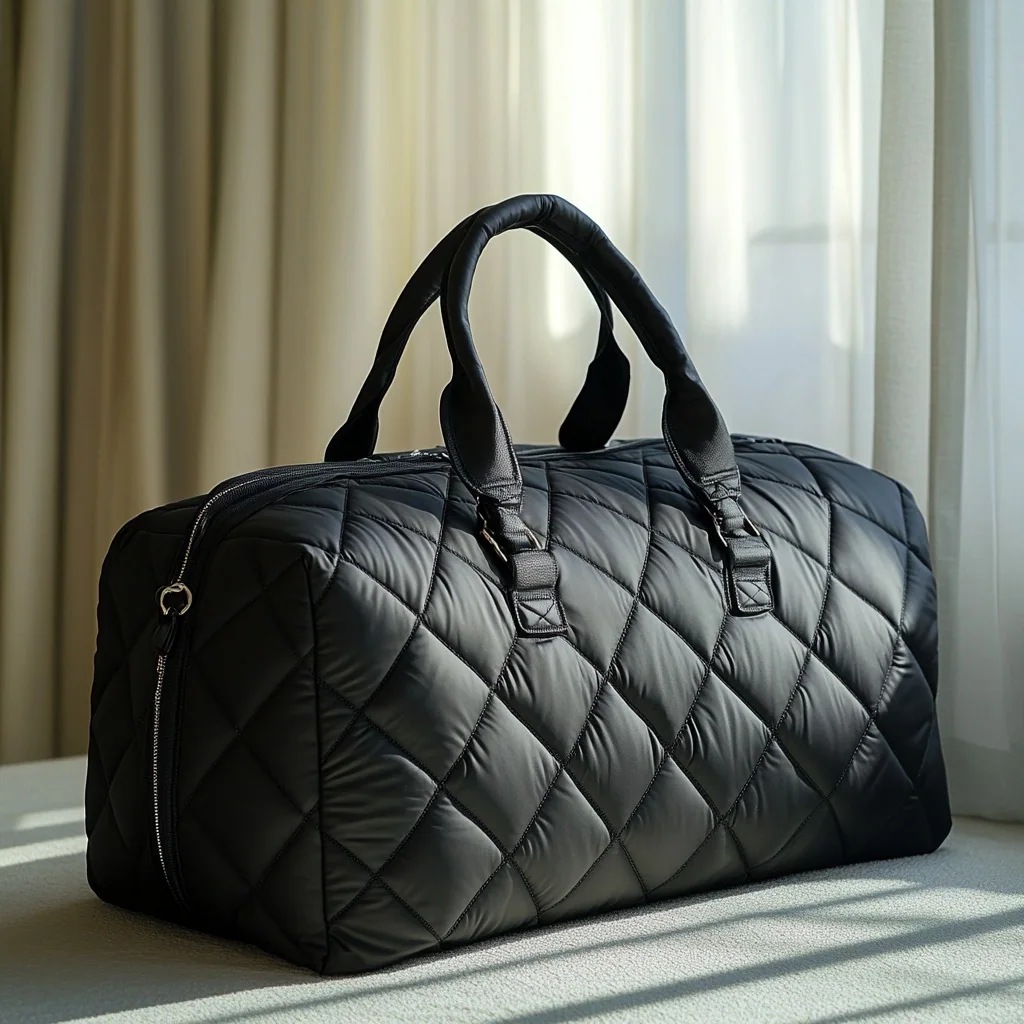
Two architectures divide the category. A soft shell packs forgivingly and tolerates an overfull gauge, but it surrenders protection and lets the silhouette slump on a luggage cart. A semi-structured shell — framed opening, boarded base, lined side walls — holds its section and protects a device bay, at a cost in empty weight and in pattern complexity. The right answer depends on who carries it: passengers who pack to the limit want forgiveness, crews who pack identical kit every rotation want dimension.
Where the mass sits matters as much as how much there is. A bag carrying its weight low — a boarded base, metal feet, a dense lining — stands steady in a bin and swings less against the leg, yet feels heavier to lift overhead. A bag with its weight distributed through the shell feels lighter in the hand and tips over more readily on a cart. Empty weight and centre of mass are both stated on the tech pack so that balance becomes a decision rather than an outcome.
- Framed opening — a 4 mm aluminium hoop or a 3 mm steel wire perimeter sewn into the mouth, so the section holds when the zip is closed and when it is open.
- Boarded base — a 2.5 mm laminated board on four or five riveted feet, sized so the bag stands without the shell fabric touching the floor.
- Device bay — a suspended sleeve wrapped in 6 mm closed-cell foam with a false bottom, so a 15.6-inch machine never lands on the base seam.
- Wet compartment — a welded-seam pocket of 1.5 to 3 litres at one end, lined in TPU-coated polyester and vented through the outer shell.
- Quick-access front — a magnetic or zip pocket dimensioned for a passport wallet and a boarding pass, positioned clear of the handle mount.
- Trolley pass-through — a sleeve cut to the width of the handle uprights it will actually meet, with a snap tab so the bag does not slide down.
Handle Systems, Wheel Sets and Trolley Geometry
Where a cabin piece carries wheels, three geometries decide whether it tracks straight. Wheel diameter sets how it copes with a paving joint. Housing design sets whether a worn wheel can be swapped in the field. Handle travel sets whether a tall traveller walks upright or hunched. Entry builds run two inline wheels with a two-stage handle; long-haul builds run four spinners with a three-stage handle, at roughly 300 to 450 grams of added empty weight.
| Component | Entry build | Long-haul build | What it protects against |
|---|---|---|---|
| Wheel diameter and compound | 50 mm inline skate wheel, 80 Shore A PU | 60 mm double spinner, 78 Shore A PU on a 608ZZ shielded bearing | Vibration, oval wear and the rolling drag that shows up as user fatigue |
| Housing | Riveted axle in a moulded housing | Bolt-through assembly with a replaceable cartridge | One worn wheel condemning an otherwise serviceable bag |
| Handle stages | Two-stage aluminium, three stops, 98 cm extended | Three-stage aluminium, four stops, 108 cm extended, 44 cm collapsed | Lateral play developing after repeated extension cycles |
| Handle tube section | Oval 20 × 30 mm, 1.0 mm wall | Square 22 × 22 mm, 1.2 mm wall with an internal bush | Twist under side load when the bag is pushed rather than pulled |
| Carry handles | 12 mm webbing top handle | Leather-wrapped top and side handles on a 16 mm core | Pull-out at the stress point above the handle mount |
| Base feet | Four moulded feet | Five feet with a replaceable wear pad | Abrasion through the base panel at the point that touches the ground most |
Order Structure and Cost Drivers
Cabin programmes are seldom a single bag. A travel brand will normally specify an overhead piece, an underseat piece and a personal item sharing one hardware family, and that sharing is where most of the unit-cost saving sits. Beyond it, four variables move the price, in descending order of impact: shell material, hardware finish, reinforcement count and print coverage. Changing any of them after the pattern is cut costs more than choosing correctly at brief stage.
Hardware finish is the easiest of the four to underestimate. A plated finish applied to a zip puller, four feet and a handle mount can move the unit price further than a change of shell fabric, and it appears on every piece in the run rather than on one panel.
- Fix the allowance in writing — envelope, weight cap and any carrier-specific sizer rule — before the first pattern is drafted.
- Choose the shell family, whether ballistic nylon, recycled PET, waxed canvas, full-grain leather or a hybrid, and accept its weight consequence.
- Agree the shared hardware set: zip gauge and puller, feet, handle mount, D-rings and any lock housing.
- Specify the compartment stack — device bay, wet pocket, quick-access front, organiser panel, compression.
- Confirm branding method and position against the actual panel geometry rather than against a flat artwork sheet.
- Approve a pre-production sample built in bulk materials and seal it as the reference for both bulk and inspection.
Two Builds Before the Line Runs
A cabin piece is developed in two builds. The first proves the pattern: does the packed bag clear the gauge, does the framed opening close without fighting the zip, does the device bay hold the machine it was drawn around. The second is built in bulk fabric, bulk hardware and bulk lining, and it becomes the sealed reference. Budget for one revision round between the two — dimensional corrections are cheap on a pattern and expensive on a cutting die.
Material intake is the longest single block inside the schedule. A stocked 1680D ballistic nylon can be on the floor inside a week. A solution-dyed recycled PET in a matched colourway, or a leather requiring a lab-dip approval loop, adds two to three weeks before the first bulk panel is cut. A programme with a fixed launch date should be planned backwards from that intake rather than forwards from the sample date.
Verification, Documentation and Dispatch
Release follows measurement, not impression. Pulled units are dimensioned, weighed and cycled; findings are classified critical, major or minor and the lot is accepted or rejected on the count. Where a carrier contract or a corporate travel policy requires it, third-party inspection is arranged before the container is loaded, and the report travels with the shipment documents.
One commercial question is best settled early: whether the bag carries a hangtag stating its cabin compliance. Retail programmes usually want one, because it turns a dimensional claim into something a customer can read on the shelf. Airline and crew programmes usually do not, because the bag is issued rather than sold. Tag artwork, language set and care wording are specified with the packaging rather than added afterwards.
- Dimensional release — every pulled unit measured on three axes against the stated allowance, carrying a representative load.
- Cycle work — zip cycles on the main closure, telescopic handle extension cycles and wheel-run distance reported against ASTM methods.
- Material declarations — REACH (EC) 1907/2006 and CPSIA declarations issued with the programme; OEKO-TEX Standard 100 linings and LWG-sourced leather on request.
- Retained file — sealed sample, approved lab dips, inspection report and carton specification held against the style so re-orders match.
- Dispatch — FOB Xiamen, cartoned to the agreed pack-out, with carton dimensions and gross weight confirmed before freight is booked.
Underseat and Personal-Item Formats
Every cabin programme eventually asks for a second piece, and the second piece obeys a completely different constraint. An overhead bag is judged by a gauge at the gate. An underseat bag is judged by the space beneath the seat in front, which is not published anywhere, varies by aircraft type and seat pitch, and gets smaller the moment the passenger in front reclines. Designing for that means designing for compression rather than for a dimension, and it is why underseat pieces are built softer than the bags sitting above them.
| Format | Typical published figure | Build consequence |
|---|---|---|
| Overhead cabin piece | Around 55 x 40 x 20 cm | Sized by the sizer, so it can carry wheels and a framed opening |
| Underseat bag | Commonly near 40 x 30 x 15 cm, though carriers differ widely | Must compress when pushed forward, so structure stays soft and feet stay minimal |
| Slim personal item | Flat formats around 40 x 25 x 15 cm | Lightly lined, with a trolley sleeve taking the place of wheels |
| Tote or brief format | No published cabin figure to meet | Judged by whether it slides under a seat, which depends on the cabin more than the bag |
Two features earn their place repeatedly on this format. A pass-through sleeve on the back panel lets the underseat bag ride on the handle of a wheeled case through a terminal, which is how it is actually carried, and a shoulder strap that detaches cleanly stops the bag snagging when it is pulled out from under a seat. Both are small specifications and both are noticed immediately when missing.
Pairing matters commercially as much as functionally. A cabin set that shares one hardware family, one lining colorway and one logo placement reads as a range rather than as two unrelated products, and it lets one order of custom components serve both pieces. That is usually the difference between a set that can be costed sensibly and two bags that each carry their own component minimums.
Pack-out is worth planning as well, since an underseat bag usually stays at the passenger's feet for the whole flight. Whatever has to be reached mid-air, whether documents, medication or a device, belongs in an external pocket, because opening the main compartment at a seat means lifting the bag onto a lap. Designing the pocket count around that behaviour is more useful than adding capacity nobody can reach.
Compliance wording deserves restraint here. Overhead compliance can be stated with confidence because the gauge exists, while underseat compliance depends on variables nobody controls from a drawing. Phrasing that says a bag is designed for underseat spaces, rather than promising that it fits every one of them, is both accurate and far easier to defend after a passenger writes in.
Designing a Cabin Bag for the Screening Table
A cabin bag spends only minutes of its life at a security checkpoint, and those minutes shape how the product is remembered. Bags that open awkwardly, hide the device behind a pile of clothing, or require two hands and a flat surface produce a specific kind of frustration that no amount of material quality compensates for. Screening behaviour is therefore worth designing for explicitly, particularly on business and crew ranges where the bag passes through that table several times a week.
- Device access: a bay that unzips fully and lays flat, so a laptop comes out without unpacking anything else.
- Liquids: a clearly marked or transparent pocket placed at the top of the bag, since it is opened at a table rather than on the floor.
- One-handed opening: sliders that can be pulled while the bag is still on a shoulder remove most of the scramble at the tray.
- Metal discipline: unnecessary metalwork invites additional checks, so the count and placement of hardware are decided deliberately.
- Scanner variation: newer computed-tomography units at some airports relax laptop and liquid removal, but rollout is uneven and the bag still has to work at older lanes.
- Opening geometry: a bag that opens like a book presents far more easily to an officer than one opened from a narrow top.
Crew and business ranges deserve one extra consideration, which is that the bag is frequently opened at a tray while the owner is still wearing it or holding something else. That is the moment a stiff slider or a hidden pocket becomes obvious. A puller that can be found without looking, and a pocket that does not require the bag to be laid flat, are small specifications that show up in how a bag is described to colleagues.
None of these features cost much on their own. What they cost is attention during development, which is usually the scarce resource on a cabin programme where the dimensional argument has already consumed most of the available time. Reserving a little of that attention for the screening experience tends to produce the reviews a travel brand actually wants.
Closure Architecture: Zip Paths, Gauges and Failure Modes
Closures are the most frequently replaced component on a cabin bag and the least discussed at specification stage. A zip decision is usually made from a supplier card showing gauge and colour, while what actually determines service life is the path the zip takes, the way it turns a corner, and how the slider behaves on a bag packed past its intended volume. Those are pattern decisions rather than component decisions, and they belong in the first build rather than the third.
Repairability closes the same loop. A closure that a local repair partner can replace keeps a bag in service for years, while one bonded into a seam nobody can open usually ends that bag's life the first time the slider fails. Specifying a standard gauge and a conventional path, rather than a bespoke closure that nobody stocks, is a quiet decision that pays back long after the order is forgotten.
The failure mode worth designing against is overpacking, because it is the one every bag meets eventually. When a zip is forced closed on a full bag, load transfers to the slider, the teeth separate behind it, and the tape tears away from the seam further along the path. A slightly longer path, a larger corner radius and a heavier gauge all push that failure further out, and all three are far cheaper decided on paper than discovered in the field.
Weight Budget: Where the Grams Actually Go
Weight on a cabin bag is not a specification; it is a budget that has to be spent. Carriers publish weight caps as well as dimensions, and while enforcement varies, the consequence of exceeding one falls on the passenger rather than on the brand, which is why empty weight becomes a buying decision. Once a bag ships at a given weight, that figure is effectively a promise about how much a traveller can carry.
| Component group | Share of empty mass | The realistic lever |
|---|---|---|
| Shell and reinforcement | Usually the largest single share | Board specification and how much of each panel it actually needs to cover |
| Frame and opening | Second largest wherever a framed build is specified | Hoop section or wire diameter, set against how much shape retention is genuinely required |
| Hardware | Small in mass and large in cost | Finish choice and the number of separate metal parts rather than their size |
| Wheels and handle | Material only on wheeled cabin pieces | Housing design, which usually saves more than reducing wheel diameter |
| Lining and trim | Underestimated, because it is counted per metre | Lining weight per square metre and the total length of internal zips |
There is a measurement discipline behind that table. A pattern sample is usually the lightest unit a programme will ever hold, because it is made slowly, with carefully trimmed seams and hand-selected panels. Bulk units carry the full seam allowance, standard trimming and whatever adhesive the line actually applies, so the honest figure is the average of several pulled bulk pieces rather than the weight of the approved sample.
Saving weight is then a matter of choosing where to spend. Removing board coverage from a panel that never carries load costs nothing functionally, while reducing it at the base costs the bag its stance when set down. Programmes that treat weight as a budget, allocating grams to the features passengers notice and taking them from the ones nobody sees, end up with a lighter bag and fewer complaints than programmes that simply shave the shell.
Brief a cabin bag programme
Send the allowance you work to, the weight cap and a sketch or reference bag. We will return a costed specification and a build schedule.
Frequently Asked Questions
How much dimensional margin do you leave against the published cabin gauge?
We pattern to the published envelope less a working margin of around 6 mm on each dimension, then verify the finished bag loaded rather than empty. Fabric creep, a bowed base board and filled external pockets account for most of the difference between an empty shell and a packed one, and the margin exists to absorb exactly those three effects.
Can the same carry-on shell be issued in both leather and nylon?
Yes, though the pattern is not identical. A full-grain leather body needs a different seam allowance, a different base board specification and considerably more reinforcement at the handle mount than the same silhouette in 1680D ballistic nylon. Both can share hardware, lining and compartment layout, which keeps them visually one family while the panels are cut to their own material.
What wheel diameter suits cobblestones and older terminal flooring?
A 60 mm double spinner in a 78 Shore A polyurethane compound is the usual answer for rough ground, because the larger diameter bridges paving joints instead of dropping into them and the softer compound absorbs vibration. Smaller 50 mm wheels roll perfectly well on smooth terminal floors and save weight, which is why they remain the entry specification.
Is a framed opening worth the added weight on a soft cabin bag?
It is worth it where the bag must hold its section on a cart or in an overhead bin, and it is a poor trade where empty weight is the binding constraint. A 4 mm aluminium hoop adds roughly 120 to 180 grams depending on perimeter length. On a bag with a 7 kg cap that is a meaningful slice of the budget, so the decision is taken against the allowance rather than on preference.
How is a device bay dimensioned for a laptop that has not been bought yet?
We draw the bay to a stated screen class rather than a specific model, with clearance on three sides and a false bottom so the machine cannot reach the base seam. A 15.6-inch bay is cut with roughly 8 mm of ease across the width and a suspended foam wrap of 6 mm, which tolerates the dimensional spread between machines in the same class.
Can compression straps and an expandable gusset coexist on a cabin bag?
They can, but the two fight each other unless the strap length is calculated at maximum expansion. Where a programme wants both, the gusset is specified with a stated additional depth and the straps are cut to close over the expanded body, so the bag can be compressed back inside the allowance when the gusset is not in use.
What does a wheel-run test actually measure?
It measures wear and drag over a stated distance on a specified surface, recording wheel diameter loss, any development of flat spots and the pull force required to keep the loaded case moving. Results are reported before shipment alongside handle cycle counts. The test is what distinguishes a wheel compound that merely looks correct from one that survives a season of use.
Can the cabin bag carry a lock housing matching our checked case?
Yes, and it is worth specifying at the same time as the checked piece so both share one lock family and one combination logic. The housing is built into the shell or frame, so it is a costing-stage decision rather than a finishing-stage one.
How do you handle a fare-class rule that changes mid-programme?
If a carrier amends its published allowance during development, the pattern is re-checked against the revised figure before the pre-production sample is built. Where the new allowance is the more restrictive one, the pattern is corrected and re-sampled; where it is more generous, the existing build stands and the specification sheet is updated. Nothing ships against an allowance that has been superseded.
What dimensions should an underseat piece be built to?
Published personal-item figures cluster near 40 x 30 x 15 cm, but the real constraint is the space under the seat in front, which varies by aircraft and seat pitch. We build these softer and without wheels so they compress, and phrase any claim as designed for underseat spaces rather than as a fit guarantee.
How can a cabin bag be made easier to get through security screening?
Give the device its own bay that unzips flat, place a marked liquids pocket at the top, and choose sliders that can be pulled one-handed. Keeping unnecessary metal out of the build also reduces additional checks. Some airports now use scanners that relax removal, but rollout is uneven.
Which zip gauge should a cabin bag use?
Number 8 suits a light cabin shell; number 10 is specified where bags are regularly packed beyond their intended volume, because load transfers to the slider and separates the teeth behind it. Path geometry matters as much as gauge, since most failures begin at a tight corner rather than along a straight run.
Where can weight come off a cabin bag without weakening it?
Start with reinforcement coverage on panels that carry no load, then with lining weight and internal zip length. Hardware is usually small in mass but significant in cost. Weight taken from the base board or the handle mount tends to cost more in complaints than it saves in grams, so those stay.