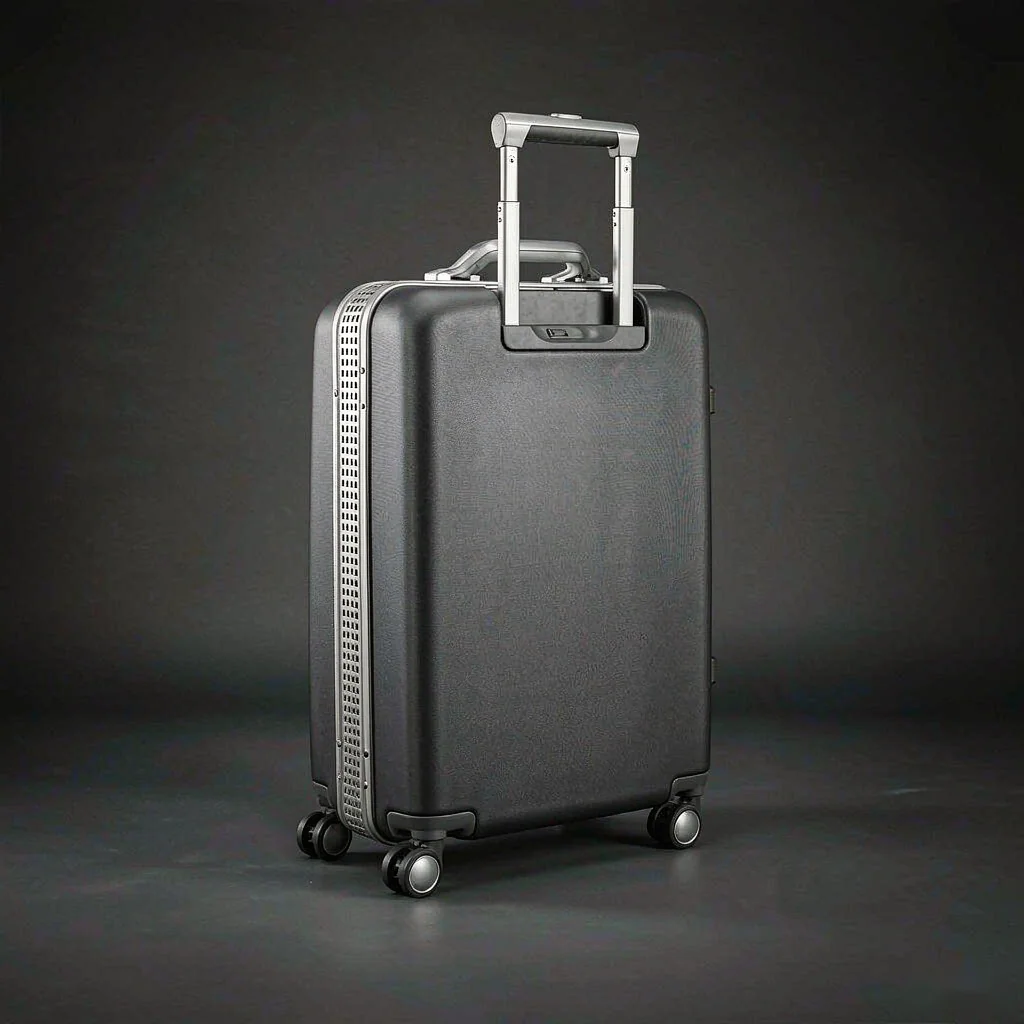
Bespoke Rolling Luggage
Wheeled cases built around handle travel, wheel compound and a written test regime — measured before a bulk line is allowed to run.
Rolling luggage means wheeled cases built around a declared chassis: shell, frame, wheel set, telescopic handle and closure are specified by the buyer and frozen in a sealed pre-production sample. The minimum is 500 pieces per style and colourway. Sampling runs 6–10 working days, stretching to 12–15 where a new shell or bespoke hardware is tooled, and bulk completes 35–50 days after approval. Shipments clear on AQL 2.5, ISO 2859-1, single sampling, general level II, FOB Xiamen.
Programme parameters at a glance
| Parameter | Commitment |
|---|---|
| Minimum order quantity | 500 pieces per style / colourway |
| Sampling lead time | 6–10 working days (12–15 days for complex constructions) |
| Bulk production lead time | 35–50 days after sample approval |
| Inspection standard | AQL 2.5 (ISO 2859-1), single sampling, general level II |
| Incoterms | FOB Xiamen — EXW, CIF and DDP available on request |
| Payment terms | T/T 30% deposit / 70% before shipment; L/C at sight for container loads |
| Verified production floor space | 4,950 m² (SGS-verified) |
| Team | 137 staff across 7 production lines |
| Equipment | 149 machines including computerised saddle-stitch and edge-painting units |
| Monthly capacity | 200,000 pieces |
| Entity | Founded 2014; principal has worked in bag development since 2004 |
Telescopic Handle Travel, Stops and Lateral Play
A telescopic handle is judged at full extension, not collapsed. Three-stage aluminium units extend to roughly 105 cm on a check-in case and collapse to around 43 cm inside the shell; two-stage units on cabins reach about 98 cm. Between those two figures sit the stops, usually spaced at 40 to 50 mm, and the number of stops matters less than how the tube behaves once it is extended and loaded.
Measuring wobble at full extension
Wobble is a tolerance stack, not a single part defect. Tube-to-tube clearance, bush wear, the stiffness of the moulded yoke and the way the assembly is bolted to the chassis all contribute. We specify lateral play at the grip rather than at the tube root, because that is what a traveller feels: a target of no more than 3.5 mm of side-to-side movement measured at the grip with the case loaded to 20 kg and the handle fully extended is a reasonable and achievable figure.
Push-button release and grip geometry
Release mechanisms split into push-button and grip-release. Push-button units give a cleaner silhouette and are cheaper; grip-release units suit gloved or cold-weather use and reduce accidental collapse. Grip section is specified alongside — an oval 22 × 32 mm section sits better in the hand than a round tube of the same weight, and a 1.2 mm wall with an internal bush resists the twist that develops when a case is pushed sideways rather than pulled.
Wheel Compounds, Housings and Rolling Noise
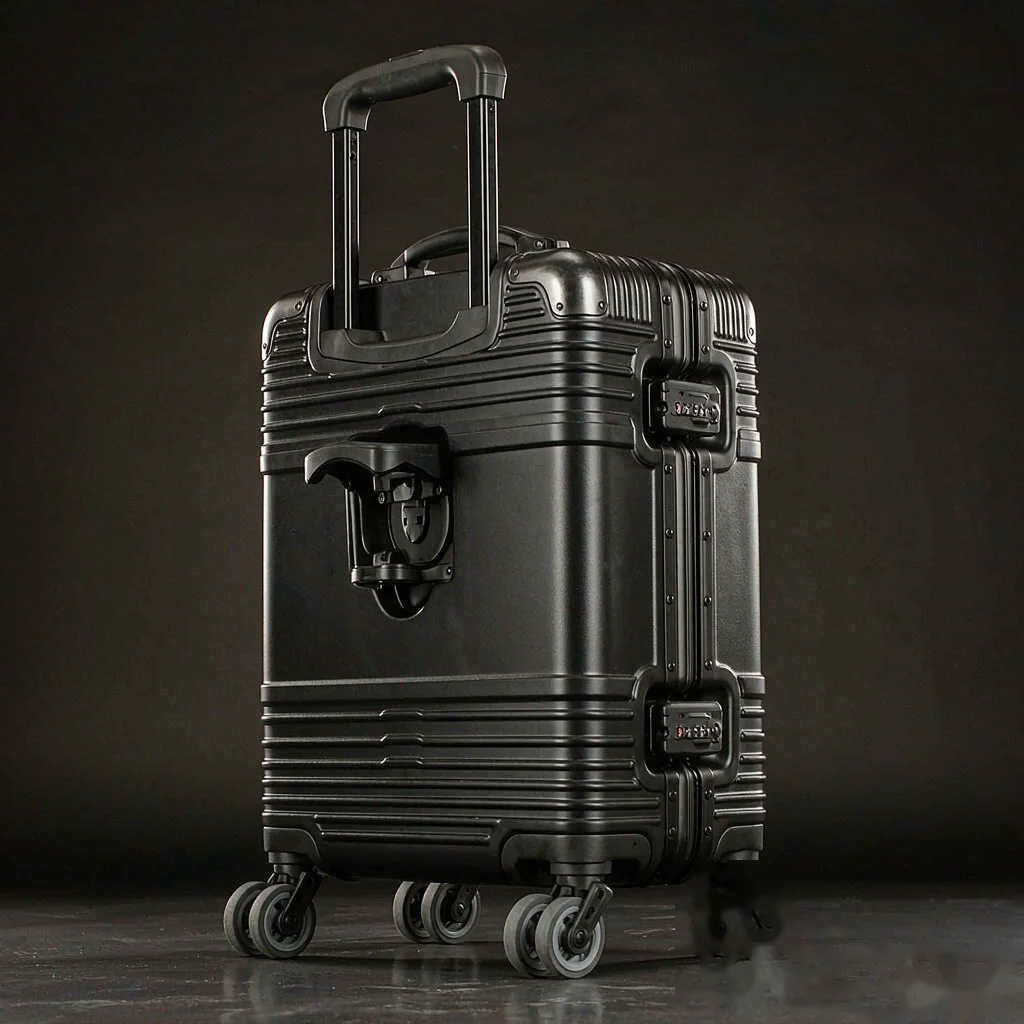
Wheel choice is where hospitality and airline programmes diverge from retail ones. A retail case is bought on how it looks and how it feels on a showroom floor; a hotel corridor case or a crew case is bought on how loud it is at six in the morning. Noise is measurable, and it is specified: sound pressure recorded at one metre with the case loaded and pulled at a constant speed across a stated surface.
| Wheel specification | Compound and diameter | Measured rolling noise | Best suited to |
|---|---|---|---|
| Inline skate wheel | 82 Shore A polyurethane, 52 mm | 62–68 dB(A) at 1 m on polished concrete | Rolling duffels and expedition bodies |
| Double spinner | 78 Shore A polyurethane, 58 mm, 608ZZ bearing | 58–64 dB(A) at 1 m on polished concrete | Hotel corridors, cruise and quiet-floor programmes |
| Soft-tread spinner | 70 Shore A thermoplastic elastomer, 65 mm | 54–60 dB(A) at 1 m on polished concrete | Cruise ships, heritage floors and executive travel |
| Recessed housing unit | 78 Shore A polyurethane, 50 mm, bolt-through | 60–66 dB(A) at 1 m, higher on tile joints | Crew cases where the wheel must be swapped in the field |
Compound and diameter trade against each other. A softer tread dampens noise and vibration but wears faster and picks up grit, which then scores a polished floor; a harder compound lasts longer and transmits more sound. Bearings are the second variable — a shielded 608ZZ unit keeps grit out of the race far better than an open bearing, and grit in the race is what turns a quiet wheel into a squeaking one within a season.
Drop, Tumble and Walking-Test Regimes
Three mechanical tests decide whether a wheeled case survives a season. Drop testing takes a loaded case to a stated height onto concrete and repeats it across faces, corners and edges. Tumble testing rotates a loaded case inside a drum with internal obstacles, which reproduces the random impacts of a baggage belt far better than a drop does. Walking testing runs a loaded case over a measured course with joints, ramps and thresholds, and it is the only one of the three that measures wear rather than breakage.
| Test | Load and distance | Pass criterion | Units pulled |
|---|---|---|---|
| Loaded drop | 20 kg fill, 900 mm onto concrete, six faces | No shell fracture, no wheel detachment, latches stay closed | 3 per style per colourway |
| Rotating-drum tumble | 18 kg fill, 50 revolutions with internal obstacles | Shell intact, handles and wheels retained, zip closure functional | 2 per style |
| Walking course | 22 kg fill, 12 km at 4 km/h across joints and thresholds | Wheel diameter loss under 1.5 mm, no flat-spot development | 2 per style |
| Handle cycle | Extension and retraction, 5,000 cycles at 20 kg | Under 3.5 mm lateral play at the grip after cycling | 2 per style |
| Static load on the handle | 35 kg held for 30 minutes at full extension | No permanent set in the tube or the yoke | 1 per style |
A test result is only useful if the pass criterion was written down before the test ran. We agree the criterion — what counts as a fracture, how much wheel loss is acceptable, whether a scuffed shell is a failure — at the same time as the test is commissioned. Results that fall just outside the criterion are re-tested on a second unit rather than argued about, and any design change made in response triggers the full set again.
Chassis Formats We Engineer Around
The category runs on four chassis types, and the choice sets the floor for both weight and price. A moulded polycarbonate shell gives the best impact-to-weight ratio; an ABS shell trades a little toughness for a lower unit cost; a polypropylene shell is the lightest of the three and the least stiff; an aluminium-framed case is the heaviest and by far the most repairable. Soft-side chassis on a wheeled frame sit alongside hard shells where capacity flexibility matters more than impact resistance.
- Moulded polycarbonate — 2.2 mm nominal wall, the reference choice for check-in sizes, with a painted or textured finish specified against scuff visibility.
- ABS and ABS/PC blends — 1.8 mm wall, lower tooling and unit cost, suited to promotional and entry retail tiers.
- Polypropylene — 2.0 mm wall, the lightest hard option, specified where a weight cap is binding on the programme.
- Aluminium frame — 1.5 mm 6061 section with corner castings and latch closures; repairable, and expensive.
- Soft side on a wheeled frame — ballistic nylon or recycled PET body over a moulded chassis, with expansion gussets and external pockets.
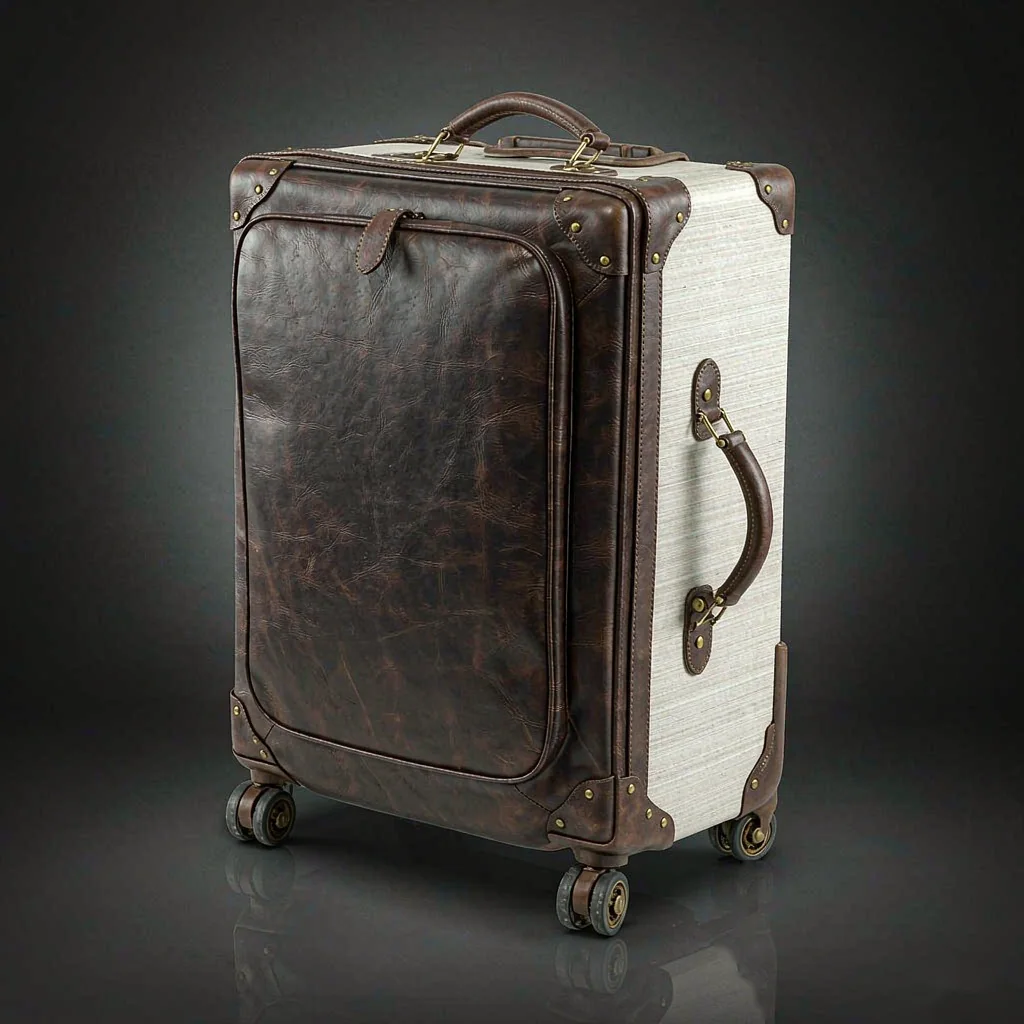
- Hybrid leather-trimmed — a hard or soft chassis with leather handles, trim and lining, for hospitality and executive programmes.
Closure follows chassis. Zip-closed cases take a number 10 coil with lockable sliders and a storm flap, which is lighter and cheaper and tolerates an overfull pack. Framed cases take aluminium latch closures, which resist a forced entry far better and cannot be defeated by a pen pushed into the zip track. The lock housing is built into whichever of the two is chosen, so the decision belongs at costing rather than at finishing.
Tooling, Component Minimums and Unit Cost
A wheeled case carries the deepest component stack in any bag programme, and each component arrives with its own order minimum. Shells need tooling amortised across the run; wheel sets, handle assemblies and lock housings come from component suppliers with their own thresholds. The 500-piece floor exists largely because of those minimums rather than because of assembly capacity.
Shell tooling is the one cost that behaves differently from every other line. It is fixed, it is paid once, and it is recovered across the run, which means the unit price of a case built on a new tool falls noticeably between the first thousand pieces and the fifth. Buyers planning a multi-season platform recover it across seasons; buyers planning one drop should usually use an existing shell instead.
- Declare the size platform — cabin, medium, large — so one shell family and one wheel set can serve the whole range.
- Decide whether an existing shell is being used or a new one is being tooled; that single decision moves both the unit price and the schedule most.
- Lock the wheel specification, including compound, diameter, bearing and whether the housing is replaceable.
- Specify the handle: stage count, extended height, stop spacing, release type and grip section.
- Choose the closure — zip with lockable sliders, or an aluminium frame with latch closures — and the lock housing that goes with it.
- Set the interior: divider configuration, compression, wet compartment, lining and any removable organiser.
- Approve a pre-production case built in bulk components, then seal it as the reference for bulk and for final inspection.
Pre-Shipment Checks and Spares Planning
Release is a two-part decision. The mechanical tests have to pass, and the lot has to clear inspection under AQL 2.5. A case that rolls true, closes under a full pack and holds its handle alignment is the acceptance criterion; a scuffed corner that does neither of those things is a cosmetic finding and is recorded, not rejected. Where a programme intends to service cases in the field, spares are ordered with the first run.
- Component intake checks — shell wall thickness, wheel concentricity, handle play and latch function verified on incoming lots before assembly starts.
- Mechanical reporting — drop, tumble, walking and handle-cycle results issued before shipment, with the surface and load stated on each report.
- Spares specified at order — replacement wheel cartridges, handle assemblies, lock units and feet ordered at 2 to 5 per cent of case volume.
- Compliance file — REACH (EC) 1907/2006 and CPSIA declarations; OEKO-TEX Standard 100 linings and LWG-sourced leather trim on request.
- Retained references — sealed samples, approved finishes and inspection reports held against the style so repeat orders match the original build.
- Production floor — an SGS-verified 4,950 m² site in Quanzhou, Fujian running 7 lines and 149 machines with 137 staff.
Programmes that track individual cases — crew issue, hotel loan fleets, rental operations — usually add serial numbering or a barcode at this stage. The marking is applied during assembly rather than after inspection, so it is specified with the order and not added at the warehouse. Cartons can then be packed by department, deck or fleet block, which removes a sorting step at the receiving end.
Cabin Dimensions: Building to Rules Airlines Rewrite
A cabin case is the only product in a travel range whose size is decided by somebody else. Nobody asks an airline's permission before specifying a duffel, and nobody can specify a cabin wheeled case without it, because the customer's first test happens in a metal sizer at the gate. The complication is that there is no single rule to build against. Airlines publish their own figures, revise them, and enforce them with varying enthusiasm, so the practical task is deciding whose rules matter most and building to the tightest of those.
| Reference point | Commonly published limit | How we specify against it |
|---|---|---|
| IATA Cabin OK guideline | 55 x 35 x 20 cm | Treated as a reference only, since no carrier is obliged to apply it. |
| European low-cost carriers | Around 55 x 40 x 20 cm, frequently with a 10 kg allowance | Built to the tightest figure on the buyer's list and printed on the size plate. |
| US domestic carriers | Approximately 22 x 14 x 9 inches | Converted to millimetres and checked against the same drawing before tooling. |
| Full-service long-haul carriers | Often 55 x 40 x 23 cm, with weight caps nearer 7 kg on some routes | Empty weight becomes a specification line, because weight is checked as often as size. |
Two details decide whether a compliant drawing produces a compliant case. Dimensions are measured including wheels, handles and any external pocket, so a drawing that looks generous before the wheel housing is added can be over the line afterwards. And an expansion zip, which is a genuinely useful feature, pushes a marginally compliant case past the limit once it is opened. Where an expander is required, we suggest building the base case tighter so the expanded figure still fits.
Crew and frequent travellers learn enforcement patterns faster than any specification can reflect. A soft-side case that compresses slightly will pass a sizer that a rigid one cannot, which is why some programmes accept a marginally softer front panel in exchange for tolerance at the gate.
Retail packaging should carry the same figure as the case, expressed in both centimetres and inches, because the question asked most often in a store is simply whether the case will fly. Where a range spans cabin and check-in sizes, printing the cabin figure on the tag and the check-in figure on the carton avoids the returns generated by a buyer who ordered the wrong volume for their route.
Because these numbers change, the route list is worth revisiting at the time of each reorder rather than being carried forward from the last season's file. Programmes serving crew and frequent travellers usually name the three carriers that matter and build to the strictest of them; retail ranges selling across many airlines generally do better with a slightly conservative cabin figure and a clear size plate than with a maximum that fails at some gates.
Interior Architecture: What the Case Does Once It Is Open
Design conversations on wheeled cases gravitate toward the shell, the wheels and the handle, which is fair, because those are the parts that fail. The interior then receives whatever attention is left, which is unfortunate, because it generates the complaints that never reach a test bench: contents arriving creased, a wet item ruining a packed suit, a document that cannot be reached without laying the case flat in an aircraft aisle. Those are specification questions, and they are cheap to answer at the design stage.
Repairability is the consideration usually discovered last. Interiors are the hardest part of a wheeled case to repair in the field, because a lining is captured simultaneously by the shell, the handle tubes and the wheel housings. Specifying a divider that unzips and lifts out, and a lining that releases at least partially rather than being bonded in permanently, turns a repair that would otherwise be uneconomic into one a local partner can actually carry out.
Layout also carries a structural consequence. Heavy contents belong at the wheel end, since packing weight high in the case raises the centre of gravity and makes a loaded case feel unstable when pulled, which is exactly the behaviour a walking test is designed to expose. Interior pockets hung on the shell add local load paths that a shell drawing does not show, so adding them late in development is more disruptive than deciding them at the start.
Power, Locks and Getting Through Security Screening
Two questions now arrive on almost every wheeled programme. The first is whether to build a battery into the case, and the second is what the lock should be. Both have short answers that surprise people: battery integration is usually a bad idea for a check-in case, and the lock matters less for theft than it does for what happens to the case in a screening room.
- Removable cells only: spare lithium cells are required to travel in the cabin rather than in the hold, so a non-removable pack can turn a check-in case into a prohibited item.
- Declare the rating: where a removable pack is supplied with the case, its rating belongs on the product label and in the shipment documentation.
- Recognised lock marks: a lock carrying the accepted travel-security mark can be opened for inspection and relocked, which avoids the far more common outcome of a cut zip.
- Lockable sliders: on zip-closed cases, sliders accepting a small padlock give the same benefit without recessing a lock body into the shell.
- Anti-puncture closure: double-coil construction resists a forced-entry attempt far better than a single coil, and is worth specifying for city ranges.
- Document the contents: chargers and cables travel with paperwork, so whatever ships inside the case should appear in the specification file.
Fleet programmes raise one question retail ranges never meet: key management. Cases issued to crew or loaned to guests can be specified keyed alike, so one key opens every unit in the pool, or keyed uniquely wherever property accountability matters more than convenience. Deciding that at the ordering stage costs nothing, while deciding it after a thousand cases are in service means changing lock bodies.
The cost of getting this wrong is disproportionately high. A case confiscated at a security checkpoint creates a customer service incident that no warranty covers, and it is entirely avoidable with a removable pack and a recognised lock. Programmes issued to crew, where the case is checked repeatedly, feel this most acutely, which is why those specifications tend to be the most conservative in the whole category.
Customs Classification and What It Does to Landed Cost
Wheeled cases are classified under heading 4202, and the subheading turns largely on what the outer surface is made of. That sounds like a technicality until a duty rate is applied to it, because two cases of identical size and function can land at different costs purely because one is moulded and the other is textile-covered. Classification is the importer's declaration to make, but the material information behind it has to come from the specification, and it should be assembled before the first shipment rather than requested afterwards.
Electronics change the paperwork as much as they change the product. Where a removable power pack ships with the case, it tends to bring its own obligations: electrical safety marking, battery transport documentation, and in several markets a waste-electrical registration for whoever places it on that market. Agreeing who holds those obligations before the first shipment avoids the situation where the case itself is compliant and the accessory packed inside it is not.
What we supply in practice is the evidence rather than the declaration: material composition per component, weights, and the construction description a broker needs to classify the case correctly. Assembling that once, at specification stage, means later shipments clear on the same basis. It also prevents the awkward situation where a range quietly changes surface material for cost reasons and the classification nobody revisited stays on the paperwork.
Brief a wheeled-case programme
Send the size platform, chassis preference and annual volume. We will return a component plan, a test regime and a costed schedule.
Frequently Asked Questions
How much lateral play is acceptable in an extended telescopic handle?
We work to no more than 3.5 mm of side-to-side movement measured at the grip, with the case loaded to 20 kg and the handle fully extended. That figure is a tolerance stack rather than a single part tolerance: tube clearance, bush wear, yoke stiffness and how the assembly bolts to the chassis all contribute, so the target is set on the assembled case and verified after cycling.
Can wheel noise be specified as a pass or fail criterion?
Yes. Rolling noise is recorded as sound pressure at one metre with the case loaded and pulled at constant speed across a stated surface, and the figure goes onto the test report. A 78 Shore A spinner on polished concrete typically sits around 58 to 64 dB(A); a softer 70 Shore A tread brings that down by a few decibels at the cost of faster wear.
What is the difference between drop testing and tumble testing on a case?
Drop testing takes a loaded case to a stated height onto concrete and repeats it across faces, corners and edges, which is good for finding structural weak points. Tumble testing rotates a loaded case in a drum fitted with internal obstacles, and it reproduces the random impacts of a baggage belt far more realistically. Programmes with a high checked-baggage exposure should specify both.
How far is a case walked in a walking test, and what is measured?
The usual regime is 12 km at 4 km/h with a 22 kg fill across a course with joints, ramps and thresholds. What is measured is wear rather than breakage: wheel diameter loss, flat-spot development and any increase in pull force across the run. A wheel that looks identical before and after but has lost more than 1.5 mm of diameter will not survive a second season.
Should spares be ordered with the first production run?
Yes, for any programme that services cases in the field. Wheel cartridges, handle assemblies, lock units and feet are cheapest when they are ordered with the original run, because the component supplier is already set up. Ordering them later means re-opening a component minimum. Two to five per cent of case volume is the usual quantity, depending on expected service life.
Which chassis gives the best impact-to-weight ratio?
A moulded polycarbonate shell at roughly 2.2 mm nominal wall gives the best ratio, which is why it remains the reference for check-in sizes. Polypropylene is lighter again but noticeably less stiff, and ABS trades some toughness for a lower tooling and unit cost. Aluminium-framed cases are the heaviest and the most repairable, which suits programmes with long service lives and an in-house workshop.
Can a case be specified with bolt-through replaceable wheels?
Yes. A bolt-through housing with a replaceable cartridge lets a worn wheel be swapped without returning the case, and it is standard on crew and airline programmes. The trade-off is a slightly larger housing and a marginally higher unit cost against a riveted axle, which is why entry retail builds usually keep the riveted assembly.
How is the interior volume of a check-in case actually calculated?
Interior volume is stated as a measured fill rather than a geometric calculation, because lining, divider pads, wheel housings and handle tubes all consume space inside the shell. A case nominally sized at 78 cm will typically deliver between 95 and 118 usable litres depending on how much of the interior is given over to the wheel housings and the handle channel.
Does a soft-side wheeled case need a different test regime?
Partly. Drop and tumble testing still apply, but the pass criteria shift from shell fracture to seam integrity, frame distortion and zip performance under a distorted load. Walking testing matters more on a soft chassis, because the body flexes against the frame and that flex is what eventually works the stitch line at the chassis mounts loose.
Can one cabin case be built to satisfy every airline?
Not reliably, because carriers publish their own figures and change them. The workable approach is naming the routes that matter and building to the strictest limit among them, measured including wheels and handles. A conservative figure with a clear size plate usually performs better in the field than a maximum that fails at some gates.
Why must a powered case use a removable battery pack?
Spare lithium cells are required to travel in the cabin rather than in the hold, so a non-removable pack can make a check-in case unacceptable to a carrier. A removable pack keeps the case usable everywhere, provided its rating is declared on the label and in the shipment documentation.
Which lock should a check-in case carry?
For screened travel, the useful feature is a lock that security staff can open and relock rather than one that resists them, which is why recognised travel-security marks are specified. Lockable zip sliders give the same benefit on soft-side cases without recessing a lock body into the shell.
How is a wheeled case classified on import?
Under heading 4202, with the subheading depending largely on the outer surface material, so moulded and textile-covered cases can be treated differently. Origin follows where the last substantial transformation occurred. We supply the composition and construction evidence the importer's broker needs; the declaration itself is theirs to make.