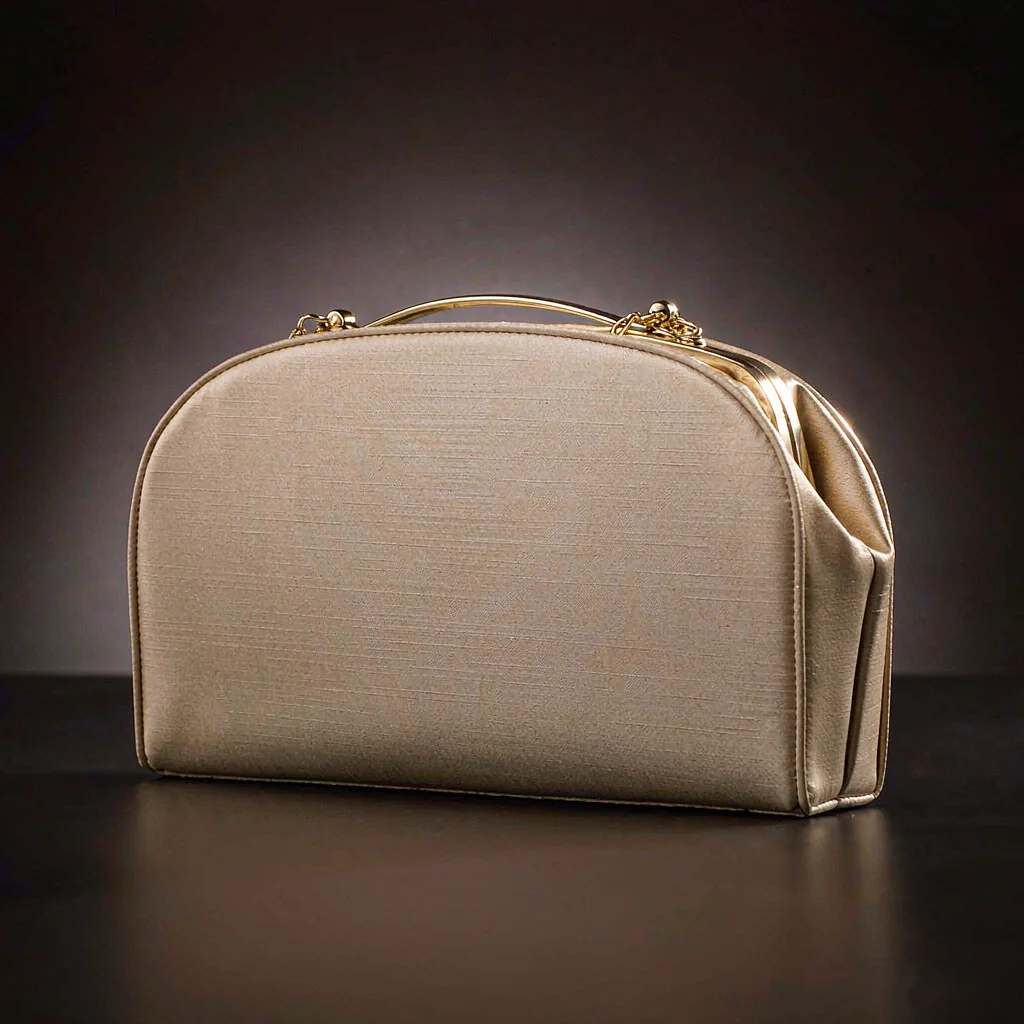
Custom Evening Bags for Occasion Collections
Clutches and framed occasion bags developed around a compact object set, delicate surface control, clasp registration and balanced chain weight.
A custom evening bag is a compact occasion piece—clutch, pouch or framed case—built around a defined object fit and decorative finish. MOQ is 500 pieces per style and colourway; sampling runs 6–10 working days, complex frames 12–15, then bulk requires 35–50 days. Inspection follows AQL 2.5, ISO 2859-1, general level II.
Programme parameters at a glance
| Parameter | Commitment |
|---|---|
| Minimum order quantity | 500 pieces per style / colourway |
| Sampling lead time | 6–10 working days (12–15 days for complex constructions) |
| Bulk production lead time | 35–50 days after sample approval |
| Inspection standard | AQL 2.5 (ISO 2859-1), single sampling, general level II |
| Incoterms | FOB Xiamen — EXW, CIF and DDP available on request |
| Payment terms | T/T 30% deposit / 70% before shipment; L/C at sight for container loads |
| Verified production floor space | 4,950 m² (SGS-verified) |
| Team | 137 staff across 7 production lines |
| Equipment | 149 machines including computerised saddle-stitch and edge-painting units |
| Monthly capacity | 200,000 pieces |
| Entity | Founded 2014; principal has worked in bag development since 2004 |
Design the interior around an occasion carry set
Evening bags have little spare volume, so capacity should be expressed as objects rather than adjectives. A current phone, two cards, a key, lipstick and a compact form a more useful brief than small but roomy. Their combined thickness decides whether an envelope closes, whether a framed case needs a 42 or 55 mm depth and whether an internal pocket is feasible. A bag that fits these objects individually can still fail when they overlap, making a physical fit layout the first development tool.
The carry set also defines structure. A soft pouch can accommodate irregular objects through drape. A rigid minaudière has fixed internal walls and loses usable space to its frame channel, hinge and lining. A slim clutch may need one shaped gusset rather than two flat folds to protect the phone. QUANZHOU JUNYUAN BAGS converts the object list into a closed internal envelope before decorative materials or clasp artwork are committed.
Let the frame dictate the pattern perimeter
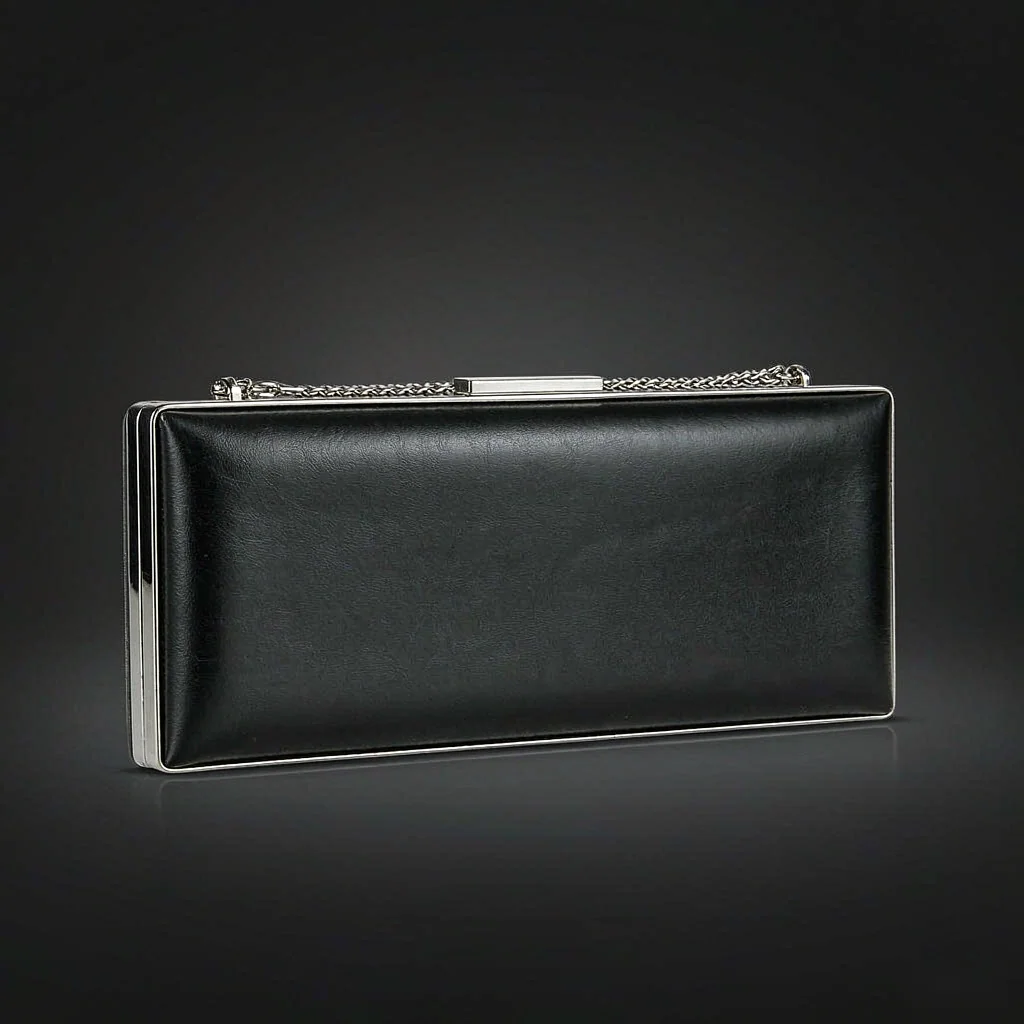
For a rigid or kiss-lock piece, the approved frame is the master dimension. The sewn or wrapped body perimeter is derived from its channel after plating, because finish build can alter fit. If the pattern is approved before the frame first article, operators compensate with adhesive or force, leading to rippled fabric, visible glue and inconsistent closure. The frame sample, hinge action, clasp preload and channel section should be signed before the final body pattern is graded.
| Evening construction | Reference scale | Surface build | Hardware number | Acceptance cue |
|---|---|---|---|---|
| Slim envelope | 25 × 13 × 3 cm | 190 gsm satin over 0.35 mm backing | Two 12 mm concealed magnets | Flap points align within 1 mm |
| Soft draw pouch | 20 × 16 × 5 cm | 0.75 mm suede with sateen lining | Six 5 mm eyelets | Gather count visually even |
| Kiss-lock purse | 21 × 12 × 4 cm | 0.70 mm lambskin wrapped edge | 3.5 mm frame channel | Perimeter gap ≤ 0.8 mm |
| Rigid box clutch | 19 × 11 × 5.5 cm | Metal shell with textile wrap | Two hinges and one top clasp | Clasp centres within 0.6 mm |
| Chain shoulder mini | 22 × 14 × 5 cm | 0.85 mm metallic leather | 110 cm detachable chain | Body hangs level at half load |
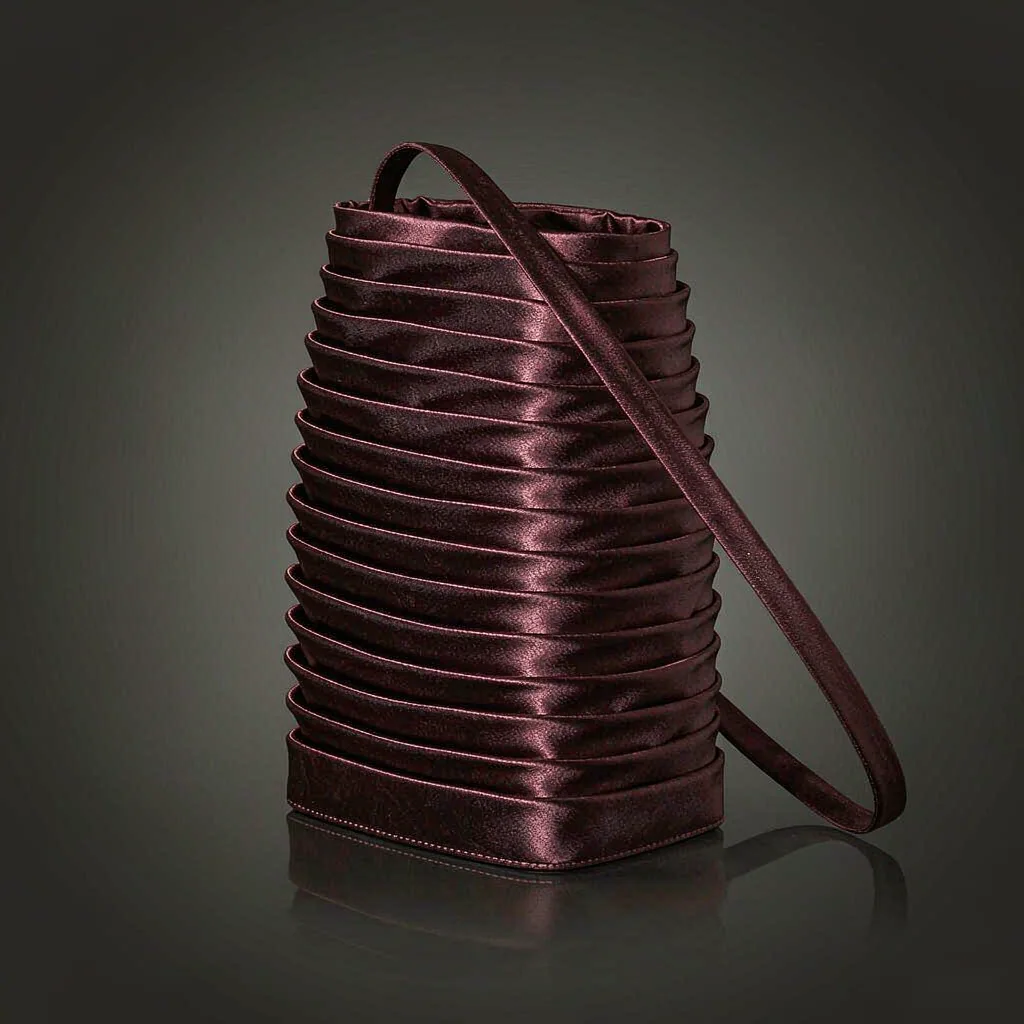
| Pleated satin clutch | 27 × 14 × 4 cm | 210 gsm satin, 8 pleats | One 24 mm bar closure | Pleat pitch within 1.5 mm |
| Beaded panel bag | 24 × 15 × 4.5 cm | Bead layer over 0.50 mm support | Four protected chain anchors | No loose element after rub |
| Wristlet case | 23 × 12 × 3.5 cm | 0.80 mm patent leather | 14 cm wrist loop; No. 3 zip | Loop seam hidden and secure |
Control satin, metallic leather and embellishment at the cut table
Delicate surfaces reveal faults that textured leather hides. Satin must be relaxed and inspected for slubs, pulls and shade direction before markers are placed. Nap or sheen direction is kept consistent across front, back and flap so the bag does not appear two colours under event lighting. Metallic leather is checked for foil fracture at the intended bend radius. Velvet requires a one-way marker. These controls affect yield and should be costed before sampling, not added after a showroom sample looks uneven.
Embellishment changes the substrate. Beading adds weight and creates hard backs that must be isolated from the lining. Crystals need a setting plan that leaves seam allowances clear. Embroidery can shrink satin locally and should be completed before final cutting where registration permits. A 0.45–0.55 mm support layer behind a decorated field spreads the load, while chain anchors receive separate 0.80 mm reinforcement. Adhesive selection is trialled on offcuts because bleed and haloing can appear only after cure.
- Cut all visible satin panels in one sheen direction and mark that direction on the pattern rather than relying on memory.
- Reserve at least 8 mm of clean seam allowance around bead, crystal or embroidery fields to prevent needle and presser-foot damage.
- Use tissue-faced handling trays between operations so metal frames and adjacent pieces do not mark delicate surfaces.
- Test edge folds on metallic leather before bulk cutting; reject constructions that expose foil cracking at the approved radius.
- Shield bead backs and chain washers from the lining with a smooth cover patch that cannot be felt through the interior.
- Record the approved lighting direction for shade review when satin appearance changes materially under warm and cool light.
Match chain mass to the smallest reinforced area
A substantial chain can weigh as much as the empty bag. If its anchors sit on a soft gusset, the body folds upward when lifted and the top frame takes unintended torque. Chain selection therefore includes total mass, link section, finish, length and attachment position. A removable chain should articulate without its hooks scratching the shell, and the storage plan inside the bag should prevent the links marking satin or metallic surfaces when the customer carries it as a clutch.
For a frame case, anchor tabs may connect mechanically to the frame or pass into a reinforced body corner. For a soft clutch, an internal textile or leather bridge can spread force between both side seams. The bridge must not obstruct object fit. A 1.8 kg proof load is applied to the complete carry assembly, followed by a check of frame gap, hinge alignment and surface marking. Testing the chain separately would miss the way its weight changes the whole piece.
- Lay out the exact phone, cards, key, lipstick and compact inside the proposed finished envelope.
- Choose soft, semi-rigid or framed construction according to that object stack and the desired hand feel.
- Approve the frame first article, chain mass and clasp action before freezing the perimeter pattern.
- Trial the decorative substrate with backing, adhesive and embellishment on a full-size panel, not a tiny swatch.
- Build and carry the first prototype by hand, wrist and chain where all three modes are intended.
- Seal a pre-production piece in final materials, with a separate unhandled swatch retained for shade reference.
- Define protective packing before bulk so approved surfaces are not damaged between finishing and delivery.
Inspect under raking light and with white gloves
Evening-bag inspection has a strong appearance component. Raking light reveals adhesive halos, satin ripples, dents and uneven frame wrapping. White gloves reveal snagging edges and protect pale surfaces during handling. The piece is viewed closed from front, side and top, then opened to examine channel coverage, lining tension and hardware backs. Paired metal parts are compared for plating tone because a small difference is obvious on a compact product.
Reject causes on high-visibility occasion surfaces
- Frame grin: a visible light gap appears because the shell perimeter or hinge preload does not match the plated frame.
- Satin roping: diagonal puckers radiate from a seam where feed, backing or thread tension distorts the face.
- Adhesive halo: a darker border develops after cure because glue quantity or substrate compatibility was not trialled.
- Chain bruise: stored links imprint the shell because no pouch, tissue wrap or interior restraint was specified.
- Embellishment drift: the decorative field moves relative to the clasp when embroidery or beadwork is not registered to a fixed datum.
- Clasp rebound: the closure appears shut but releases after light pressure because catch depth and frame spring are mismatched.
Inspection also repeats function. The clasp and hinge are operated through the agreed cycle sample, detachable chain fittings return fully, and the filled piece closes without forcing. The frame perimeter is measured for gaps and the bag is suspended at 1.8 kg. Material requirements can be set with reference to REACH (EC) 1907/2006 and OEKO-TEX Standard 100 where relevant to the sourcing brief, without assuming that every decorative component carries the same documentation. Finished lots use ISO 2859-1 single sampling, general level II, AQL 2.5.
Protect the finish through line work and event delivery
Bulk lead time is 35–50 days after approval. Incoming satin is shade-grouped, frame sets are function-matched and decorated panels are counted before assembly. Clean handling zones separate surface work from abrasive operations. Top-of-line units establish wrap tension and clasp registration; in-line pulls check hidden backing, anchor placement and lining coverage before the frame is permanently closed. Final pieces receive individual chain wrapping, shaped tissue and dust protection suited to the approved pack-out.
The programme is coordinated in Quanzhou, Fujian through an SGS-verified production floor of 4,950 m², with 137 staff, seven lines, 149 machines and stated monthly capacity of 200,000 pieces across categories. Payment terms are T/T 30% deposit and 70% before shipment. Standard delivery is FOB Xiamen, with CIF or DDP available on request. For launch tests, a small-batch pilot may be possible; regular orders remain 500 pieces per style and colourway.
Keep an occasion colour story inside one dye and plating lot
Occasion palettes are unforgiving. Black satin against black satin reads identically only when the two pieces come from one dye lot, and the same is true of champagne leather beside champagne thread. Because the standard minimum of 500 pieces applies per style and colourway, colour planning is also a costing decision: three colourways of one clutch are three commitments, while three colourways sharing one frame set, one plating buy and one lining colour behave like a coherent capsule.
Metallic surfaces multiply the difficulty. Foil-fracture behaviour changes with lot, so a metallic approved in one batch may crack at a bend radius the previous batch tolerated without any visible difference in the swatch. Retaining a physical master from the approved lot — viewed under the same lighting recorded at approval — removes most disputes that otherwise surface halfway through a season, frequently when the remaining volume is urgently needed.
Thread deserves a note of its own. Because it usually sits closest to the leather colour rather than matching it exactly, two lots of nominally identical thread can read differently against the same satin, particularly under warm lighting. Approving thread against the actual dye lot rather than against a shade card avoids a difference nobody has words for.
Sample quantities also deserve early thought. Occasion pieces are frequently required for look-books, press gifting and store displays weeks before bulk, and requesting those units during development rather than afterwards protects both the schedule and the units themselves, since nothing then has to be removed from the bulk allocation.
A folded reference card listing each lot — leather, thread, metal and lining — should travel with the samples. It becomes the shared vocabulary for every later conversation about what the approved combination actually was, which is otherwise the question most difficult to answer.
Decide lining visibility before the interior is closed
A compact opening is dark by nature. Whatever the exterior finish achieves, the customer first sees the interior when the clasp is released under low light, and a lining selected for cost rather than legibility will read as a shadow. Because interior choices are also the hardest to change after bulk, they belong in the pack at the same time the carry set is fixed, not at the last possible stage.
- Contrast first: a lining three to four steps lighter than the exterior lets dark objects be seen without a search.
- Reflectance over colour: sateen and taffeta return light where suede and brushed microfibre absorb it, raising usable visibility at no cost.
- Bulk discipline: every millimetre of lining thickness is stolen from an already tight object envelope, so thinner reads larger.
- Pocket restraint: one slim card slot is usually all a 3 cm depth can accept before the phone rubs against the seam.
- Seam concealment: pocket binding should face the lining side, since a raw turn line will be the brightest thing in view.
Where the concept requires an unlined interior — a raw suede pouch, for example — that decision should be explicit, because its consequences reach further than appearance. Unlined constructions expose adhesive lines and lining-free embellishment backs, both of which then need a higher level of finishing control than a lined version of the same silhouette would demand.
Decorated linings are best avoided here. Beaded or embroidered interiors look superb under showroom light, yet their backs carry hard edges that both mark objects and consume usable space. The practical route is a smooth lining, with decoration reserved for the exterior where the customer can actually see it.
Adhesive choice follows the same reasoning. Some formulas darken pale linings or migrate slowly through them, appearing months later as a faint stain nobody can account for. Trialling on offcuts, then checking again after cure rather than immediately, catches behaviour that a same-day inspection never reveals.
Patterned linings can work well, though scale governs the result. A large repeat reads as two different colours depending on where it lands in the piece, whereas smaller repeats behave predictably inside an interior this compact.
Give every closure a cycle life, not just a look
An evening clasp is opened and closed more times per hour of use than most bag hardware, generally in poor light and often one-handed. A closure that passes an appearance review can still fail there, either through losing preload or through the plating wearing at the contact point. Specifying an operating cycle turns a subjective judgement into something both sides can repeat on the next production run.
| Closure type | Representative trial | Checked afterwards | Typical reason for rejection |
|---|---|---|---|
| Kiss-lock frame | 500 open and close cycles | Frame gap, hinge alignment, plating at contact points | Preload lost, or grin appeared at one corner |
| Concealed magnet pair | 300 cycles plus pull separation test | Flap alignment, whether the bag self-opens under load | Magnet lost strength or pulled through the interlining |
| Turn clasp on rigid shell | 400 cycles with lid restraint released | Screw torque, centre registration, lid rise | Centre drifted, so the lid caught when closing |
| Detachable chain hooks | 200 attach and release cycles | Hook deformation, scratching on adjacent surfaces | Hook opened enough to release unintentionally |
| No. 3 zip closure | 300 traverses with the bag loaded | Slider wear, tape separation at the stop | Slider split the tape at the reinforced end |
Trials are run on the complete assembly rather than on the component alone, because a closure is loaded by the body it sits on. Around a rigid shell the clasp sees very different forces from those around a soft clutch, and a frame that performs beautifully in the hand can behave differently once the interior is filled with the agreed object set.
Cycle trials also protect against a subtler problem: plating wear at contact points. Two finishes that look identical may wear at very different rates, so specifying the coating alongside its thickness — and testing to the agreed count — prevents the disappointment of a clasp that looks tired after a single season of evening use.
Failure evidence should be kept rather than described. A photograph taken at the point of failure, with the cycle count recorded beside it, teaches more than any paragraph of explanation and prevents the same discussion returning every season.
Reuse an approved frame set for the next occasion season
Frames, clasps and channels represent the longest lead items in an occasion programme and the least negotiable part of its cost. Reusing them across seasons is therefore the single most useful economy available to a brand, provided the surrounding decisions were recorded the first time. Where they were not, the second season quietly becomes a fresh development cycle that happens to look like a repeat.
- Retain one fully assembled pre-production unit plus the unhandled swatch set, both filed against the lot numbers they were built from.
- Record channel depth and closed perimeter gap after plating, since those are the figures the next pattern is graded against.
- Keep the tooling identified and held, noting whether it belongs to the programme or to the buyer, with that agreed in writing.
- Note the adhesive and curing conditions used, because delicate surfaces forgive very little substitution at this stage.
- Re-approve only what genuinely changes: usually lining colour, chain finish and any refreshed decorative element.
Handled this way a repeat needs little more than a date and a quantity. Where a new dimension or a new closure is introduced, sampling returns to 12–15 working days against 6–10 for an unchanged body, and bulk runs 35–50 days after approval. Enquiries for the next season can start early through specification development, where the lot records already exist.
Send the object set before selecting the frame
Share the phone dimensions, required contents, construction reference, surface material, chain preference and event date. We will build an evening-bag specification around fit, frame registration and protected finishing.
Storage decides whether reuse succeeds. Frames and clasps stored loosely in a drawer acquire scratches and slight bends long before anybody notices, while sets kept bagged by programme and dated arrive two seasons later in exactly the condition their record assumes. It is unglamorous administrative work with a measurable return.
Where reuse is intended, order spare frames with the original tooling run. Components bought alongside the first season cost less and match better than replacements sourced later, when minimum quantities return for what should have been a small addition.
Frequently Asked Questions
How much capacity should an evening clutch provide?
Capacity should be agreed against a named phone, cards, key, lipstick and compact rather than a litre figure. Arrange those objects at their real thickness inside the proposed internal envelope and retain the layout. This exposes overlap conflicts and confirms whether a card pocket or mirror sleeve can be added without preventing closure.
What causes puckering on a satin evening bag?
Typical causes are mismatched feed, excessive thread tension, unstable backing, a blunt needle or local shrinkage from embroidery. Satin sheen makes small distortions visible. A full-size trial panel using intended thread, backing and seam direction is more reliable than a small material swatch, and it should be approved before the bulk marker is released.
When is a custom frame worth the longer sample window?
A custom frame is justified when the silhouette, clasp or branded perimeter is central to the product identity and expected volume supports tooling. It moves sampling from the usual 6–10 working days to 12–15 because the first article, plating, hinge and body fit require joint approval. Stock frames are better for schedule-led capsules.
How is a detachable evening chain prevented from marking the bag?
Hooks are oriented away from the shell, contact edges are polished, and the chain receives a sleeve or small pouch for storage inside. The packed product uses tissue or separate wrapping so links cannot imprint satin or metallic leather. Chain mass is also checked against the anchors because movement under load creates marking even when plating is smooth.
Does beading change the minimum order calculation?
The standard MOQ remains 500 pieces for each style and colourway. Bead, crystal and embroidery vendors may impose their own component or artwork minimums, which affect costing and pilot feasibility. A small-batch option may be considered with available embellishment, but handwork time, replacement allowance and inspection intensity must be included in the programme.
What packaging prevents clasp and frame marks?
Protective film or tissue isolates metal from the shell, chain is wrapped separately, and shaped acid-free tissue prevents the body moving in its dust bag or box. The frame must not bear carton pressure. A pack-out trial is approved with the product because a visually perfect piece can be damaged during vibration if its metal parts are left free.
How are event-date evening bag orders staged?
Work backward from the required arrival, allowing 6–10 working days for a normal sample or 12–15 for a complex frame, then 35–50 days after approval for bulk. Add inspection, booking and transport to the chosen market. Terms are 30% T/T deposit and 70% before shipment; FOB Xiamen is standard.
What does the AQL review focus on for occasion bags?
ISO 2859-1 general level II single sampling at AQL 2.5 governs the finished lot, while the agreed defect library directs attention to frame gaps, clasp security, satin ripples, adhesive marks, embellishment loss, chain anchors and plating consistency. Functional and cosmetic classifications are fixed beforehand so a high-visibility flaw is not debated during release.
How many colourways can one occasion capsule carry comfortably?
The standard minimum of 500 pieces applies per style and colourway, so three shades of one clutch are three commitments. Keeping the frame set, plating buy and lining shared across those shades costs far less than giving each its own hardware development, and makes the group read as one deliberate capsule rather than separate purchases.
How is plating tone kept consistent across a matching frame set?
Approve every metal part together on a single signed board rather than separately, because tone differences invisible alone are obvious when parts sit a few centimetres apart on a compact bag. Retain that master away from light and file it against the lot record so reorders compare against the approved object, not memory.
Which lining performs best inside a small dark opening?
Choose contrast and reflectance over decoration. A lining three to four steps lighter than the exterior, in sateen or taffeta rather than suede, returns light so contents can be found quickly. Thickness matters too: every millimetre consumed by lining comes out of an already tight object envelope.
Can an unlined interior still look finished?
Yes, but it costs more attention rather than less. Unlined constructions expose adhesive lines and embellishment backs, so application control must be tighter and bond testing more careful. Make the choice explicit at brief stage so the finishing requirement is built into both the costing and the acceptance criteria.
How many open and close cycles should an evening clasp survive?
A kiss-lock frame is typically trialled through about 500 cycles, concealed magnets through 300 plus a pull separation test, and detachable chain hooks through 200 attach and release cycles. Trials run on the complete loaded assembly, since the body changes how the closure is stressed.
Can an approved frame be reused on a resized occasion body?
Usually yes, so long as channel depth and the closed perimeter gap after plating are recorded and the new pattern is graded from those figures. Introducing a new dimension or closure instead returns sampling to 12–15 working days, against 6–10 working days for an otherwise unchanged body.