
Niche sports programmes succeed when the specification is written around load, weather and repetition rather than around appearance. A golf or team bag carries a defined weight in a defined way, is exposed to water and abrasion, and is expected to survive seasons of handling that no fashion piece encounters. That shifts the specification towards base reinforcement, strap engineering, weather performance and tested hardware, and it makes durability testing a specification item rather than an optional check.
The commercial logic for sports brands is also distinct. These programmes are frequently tied to sponsorship, membership or team kit cycles, which means reorder timing is predictable and brand placement requirements are non-negotiable. A bag that performs well but carries the sponsor's mark badly has failed its primary purpose, and one that looks right in a showroom but fails in the second season damages the brand more than a fashion equivalent would.
This article covers the construction, material, branding and testing requirements of golf and sports carry, and how a niche programme is planned. It reflects the work the programme team undertakes on our SGS-verified production floor in Quanzhou, Fujian.
Programme parameters at a glance
| Parameter | Commitment |
|---|---|
| Minimum order quantity | 500 pieces per style / colourway |
| Sampling lead time | 6–10 working days (12–15 days for complex constructions) |
| Bulk production lead time | 35–50 days after sample approval |
| Inspection standard | AQL 2.5 (ISO 2859-1), single sampling, general level II |
| Incoterms | FOB Xiamen — EXW, CIF and DDP available on request |
| Payment terms | T/T 30% deposit / 70% before shipment; L/C at sight for container loads |
| Verified production floor space | 4,950 m² (SGS-verified) |
| Team | 137 staff across 7 production lines |
| Equipment | 149 machines including computerised saddle-stitch and edge-painting units |
| Monthly capacity | 200,000 pieces |
| Entity | Founded 2014; principal has worked in bag development since 2004 |
Why Sports Carry Differs From Fashion Carry
Three variables separate the categories. Load is defined and often heavy, and it is carried in a specific orientation. Environment includes water, mud, grass, sunlight and temperature extremes. Handling is rough and repetitive, and frequently involves being set down on or dragged across abrasive surfaces. Fashion carry is optimised for appearance under good conditions; sports carry is optimised for function under bad ones.
| Variable | Fashion carry | Sports carry | Specification consequence |
|---|---|---|---|
| Load | Light, variable | Defined, often 8–20 kg | Reinforced base and load path |
| Orientation | Hand or shoulder | Back, shoulder or trolley-mounted | Strap geometry and attachment strength |
| Environment | Indoor, dry | Outdoor, wet, abrasive | Coated materials and drainage |
| Handling | Careful | Rough and repetitive | Abrasion-resistant base and corners |
| Appearance priority | Primary | Secondary to function and branding | Finish chosen for durability |
| Lifecycle | Seasonal | Multi-season | Repairability and spare parts |
The lifecycle point shapes everything downstream. A multi-season product needs spare parts, a repair path and materials that do not become unavailable after eighteen months. Specifying a component that has no replacement source is a decision to make the whole product obsolete, and it is worth checking component availability at specification rather than at the first warranty claim.
Golf Programmes: Structure and Requirements
Golf carry is the most technically demanding category in this group because the load is long, rigid and heavy, and because the bag has to work both when carried and when mounted on a trolley or cart. That dual use creates conflicting requirements: a comfortable carry system and a stable mounting geometry, which have to be resolved in the same structure.
Full-length dividers are the element most often specified loosely and most noticeable in use. A divider that stops short of the base allows club grips to tangle, which is the single most common functional complaint in the category. Stating that dividers run the full length, and protecting the top collar where shafts enter and exit, resolves it at negligible cost.
Trolley compatibility deserves early attention because it constrains the structure. Mounting points and any strap pass-through must be positioned to suit standard trolley geometry, and a bag designed purely for carrying frequently sits badly on a trolley. Confirming the mounting requirement in the brief prevents a sample that is right for one use and wrong for the other.
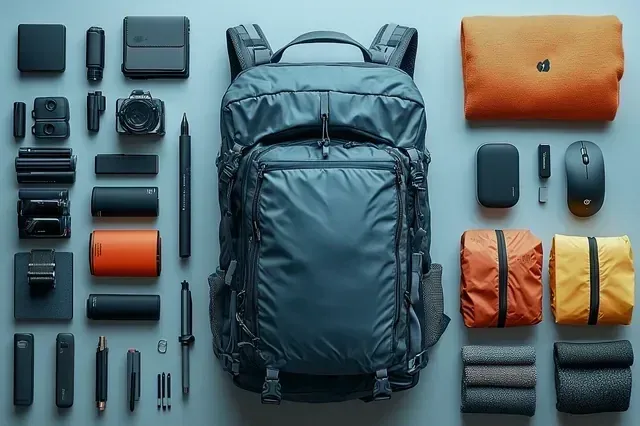
Team, Club and Kit Bags
Team and club bags are volume programmes with a different priority: consistency across a large order, clear identification, and a construction that survives being thrown into a bus or a changing room. Individual personalisation is common, which adds a process requirement alongside the product one.
- One construction standard applied across the entire order, with no variation between units.
- Identification system: name, number or initials applied by a method that survives washing and abrasion.
- Compartments sized to the actual kit rather than to a generic volume figure.
- Ventilation or drainage in compartments intended for wet or used items.
- Reinforced grab handles at both ends, since these bags are lifted from wherever they land.
- A repair path, because team bags are expected to last several seasons.
Personalisation is the operational risk in this category. Applying a name or number to a finished bag introduces a step where errors are visible and individual, and a misspelled name on a team order is not returnable in the ordinary way. The control is a proofing step: a confirmed roster, a digital proof per individual, and approval before application begins.
Materials for Outdoor and Sports Use
Material selection in sports carry is governed by performance rather than by hand. Abrasion resistance, water behaviour, weight and colour fastness under sunlight outrank the tactile qualities that dominate fashion specification. Leather still has a place, particularly in premium golf and heritage team pieces, but it is usually combined with technical textiles rather than used alone.
| Material | Strength | Limitation | Typical use |
|---|---|---|---|
| Coated polyester or nylon | Light, water-resistant, abrasion-tolerant | Less premium in hand | Team and kit bags |
| Waxed cotton | Heritage appearance, durable | Heavier, requires care | Premium golf and country sports |
| Full-grain leather | Premium, patinas, repairable | Weight and water sensitivity | Premium golf, trim and reinforcement |
| TPU-coated fabrics | Highly water-resistant, weldable | Hand is technical, not soft | Wet-weather and waterproof sections |
| Reinforced base fabrics | Abrasion-resistant, structural | Stiffer, heavier | Base panels and wear points |
Water behaviour should be specified precisely, because water-resistant and waterproof are different claims with different constructions. Water-resistance is achieved by coating and construction; waterproofness requires sealed seams, welded construction or a liner, and it should be stated with a test method rather than asserted. A brand claiming waterproof performance needs the test behind the claim.
Colour fastness under sunlight is under-specified in this category and produces visible failures. A team colour that fades unevenly across a season looks worse than a colour that was never bright, and the specification should state a fastness requirement rather than rely on a supplier's general assurance.

Branding and Sponsorship Requirements
In sports programmes, branding is frequently the point. A sponsor's mark has to appear at a stated size, in a stated position, with a stated colour match, and it has to survive the same conditions the bag does. That makes branding a tested specification rather than a decorative one, and it makes proofing a formal step.
| Method | Durability in sports use | Colour accuracy | Best for |
|---|---|---|---|
| Embroidery | Very high | Good, limited by thread palette | Team crests, primary marks |
| Woven or printed patch | High | Good | Sponsor marks and event branding |
| Heat transfer | Moderate | Very good | Detail and photographic marks |
| Silicone or rubber badge | Very high | Good | Modern sports branding |
| Debossed leather patch | High | Limited | Premium golf and heritage pieces |
Colour accuracy is the recurring issue with sponsor marks, because a sponsor's brand guidelines usually specify an exact colour and the application method may not reproduce it precisely. Agreeing an acceptable match against a physical proof, signed off by the rights holder, prevents a rejection at delivery that no amount of argument will resolve.
Placement should be confirmed against the bag in use rather than on a flat drawing. A mark positioned correctly on a pattern can sit under a strap, across a seam or beneath a carry handle once the piece is assembled, and only a physical check on a sample reveals that.
Durability Testing and Warranty
Sports carry should be tested to defined conditions rather than assessed by inspection. Load testing, abrasion testing, cycle testing on closures and colour fastness testing are all standard, inexpensive relative to a programme's value, and decisive in preventing the failures that generate warranty claims and reputational damage.
- Load testing: carry the stated weight for a defined duration and check strap attachment and seam integrity.
- Abrasion testing on base and corner materials, since these fail first in real use.
- Cycle testing on zips, buckles and closures against a stated count.
- Water performance testing by a defined method, not by visual assessment.
- Colour fastness to light and to rubbing, with a stated minimum rating.
- Hardware corrosion testing where the product will be used outdoors or near salt water.
Test reports serve a second purpose beyond quality. They define what the warranty actually covers, because a warranty promising durability without a test behind it is a commercial liability rather than an assurance. Stating the test method and the pass threshold gives both the brand and the production team a shared definition of what acceptable means.
Planning a Niche Sports Programme
Niche programmes are planned around the season or the kit cycle rather than around a fashion calendar. That is an advantage, because the timing is predictable and production can be booked accordingly. It also means the consequences of a delay are fixed: a team bag arriving after the season has started has missed its purpose entirely.
| Phase | Working time | Critical output |
|---|---|---|
| Requirement capture | 2–3 weeks | Load, environment, branding and volume defined |
| Specification and materials | 1–2 weeks | Approved material list with test requirements |
| Sampling | 6–10 (12–15 complex) working days | Physical prototype |
| Testing | 1–3 weeks depending on scope | Test reports against stated thresholds |
| Revision and approval | 6–10 working days | Sealed reference sample |
| Bulk production | 35–50 days | Finished goods |
| Inspection and delivery | 2–5 days plus freight | AQL 2.5 report and shipment |
Testing is the phase most often squeezed, and it should not be, because a failed test discovered after bulk is the most expensive outcome available. Booking laboratory time during sampling rather than after it keeps the critical path intact and means a failure produces a revised sample rather than a rejected container.
Reorder planning matters more here than in fashion, because kit cycles repeat. A programme that retains the pattern and the approved material list can repeat a team order in the following season with minimal development, and personalisation can be updated from a new roster against the same specification.
Cost Drivers Specific to Sports Carry
Sports carry costs more per unit than an equivalently sized fashion bag, and buyers new to the category are sometimes surprised by where the money goes. Reinforcement, hardware rating, testing and personalisation processing are the four items that account for most of the difference, and all four are avoidable only at real functional cost.
| Cost driver | Why it adds cost | Can it be reduced |
|---|---|---|
| Base and corner reinforcement | Extra material and labour | Only by reducing durability |
| Rated hardware | Higher-specification components | Not without lowering load rating |
| Waterproof construction | Sealed or welded seams | By limiting to specific sections |
| Testing programme | Laboratory fees | By limiting scope, with risk |
| Personalisation processing | Per-unit handling and proofing | By simplifying the identifier system |
| Spare parts holding | Inventory carried for repairs | By designing for replaceability |
Waterproof construction is the most reducible of these without real loss, because full waterproofing is rarely needed across an entire bag. Limiting sealed construction to the compartments that genuinely require it, and using water-resistant construction elsewhere, keeps most of the perceived benefit at a lower cost.
Spare parts deserve a decision of their own at the planning stage. A programme running across several seasons will generate repair requests for exactly the components that fail first: zip sliders, strap hardware and base feet. Confirming that those components are held in stock, or are standard items available from more than one source, costs nothing at specification and prevents the situation where an otherwise sound bag cannot be repaired because one fitting is no longer obtainable.
One further consideration belongs in the planning of any golf or team programme: the weight of the empty bag. Buyers focus on what a bag must carry and rarely state what it may weigh, yet the two together determine whether the piece is usable. A golf bag that is structurally excellent at four kilograms may lose to a competitor at three, and stating an empty-weight ceiling in the brief gives the development team a constraint to engineer against rather than a target to discover.
Develop a sports or golf carry programme
Send the load requirement, the use environment and the branding specification, and the programme team will return a construction proposal, a material list with test thresholds and a production schedule. Development runs on our production floor in Quanzhou, Fujian. Contact service@junyuanbags.com or WhatsApp +86 177 5002 0688.
Frequently Asked Questions
How do golf and sports bag programmes differ from fashion bag programmes?
They are specified for load, weather and repetition rather than for appearance. Sports carry holds a defined weight in a defined orientation, is exposed to water, mud and sunlight, and is handled roughly. That shifts the specification towards base reinforcement, strap engineering, weather performance and tested hardware.
What should a golf bag specification include?
Full-length dividers with top-collar protection, a stable reinforced base, dual-strap carry geometry, trolley mounting compatibility, a pocket layout with drainage where required, and weather protection. Confirming trolley compatibility in the brief prevents a sample that carries well but mounts badly.
Why do full-length dividers matter in a golf bag?
Because a divider that stops short of the base lets club grips tangle, which is the most common functional complaint in the category. Running dividers the full length costs very little and removes the problem entirely. Protecting the top collar where shafts enter and exit prevents wear at the same point.
Which materials suit sports and outdoor bag programmes?
Coated polyester or nylon for team and kit bags, waxed cotton for premium golf and country sports, full-grain leather for premium trim and reinforcement, TPU-coated fabrics for wet-weather sections, and reinforced base fabrics at wear points. Selection is governed by abrasion, water behaviour, weight and colour fastness.
What is the difference between water-resistant and waterproof bags?
Water-resistance comes from coating and construction; waterproofness requires sealed or welded seams or a liner, and should be stated with a test method rather than asserted. A brand claiming waterproof performance needs the supporting test. Limiting sealed construction to compartments that require it controls cost.
How is sponsor branding applied to sports bags?
By embroidery, woven or printed patches, heat transfer, silicone badges or debossed leather patches, depending on the durability and colour-accuracy requirement. Sponsor colours usually need an agreed match against a physical proof signed off by the rights holder before production begins.
Why is placement of a logo checked on a physical sample?
Because a mark positioned correctly on a flat pattern can sit under a strap, across a seam or beneath a carry handle once the bag is assembled. Only a physical check on a sample reveals that, and correcting it after bulk has been cut is expensive.
What testing should a sports bag programme include?
Load testing at the stated weight, abrasion testing on base and corner materials, cycle testing on zips and closures, water performance by a defined method, colour fastness to light and rubbing, and hardware corrosion testing where the product is used outdoors or near salt water.
When should durability testing happen?
During sampling rather than after it. A failed test discovered after bulk is the most expensive outcome available, since it produces a rejected shipment rather than a revised sample. Booking laboratory time early keeps the critical path intact and usually shortens the overall programme.
How is personalisation managed on team orders?
Through a proofing step: a confirmed roster, a digital proof per individual, and approval before application begins. Errors in personalised team orders are visible, individual and difficult to return, so the proof is the control rather than an inspection at the end.
What is the minimum order for a sports or golf programme?
Five hundred pieces per style and colourway is the standard starting point. Team and club orders frequently exceed this because the roster determines quantity. Small-batch pilots are available for brands testing a construction before committing to a full season order.
How long does a niche sports programme take?
Roughly three to four months from requirement capture to delivery. Requirement capture takes two to three weeks, sampling six to ten working days, testing one to three weeks depending on scope, and bulk production thirty-five to fifty days after approval. Testing is the phase most often squeezed and least safely.
Why does sports carry cost more than an equivalent fashion bag?
Because of base and corner reinforcement, rated hardware, waterproof construction where specified, the testing programme, personalisation processing and spare parts holding. Of these, waterproof construction is the most reducible without real loss, by limiting sealed seams to the compartments that need them.
How should a warranty be defined for a sports bag?
By reference to tests rather than to adjectives. A warranty promising durability without a test behind it is a commercial liability. Stating the test method and the pass threshold gives both parties a shared definition of acceptable performance and makes claims resolvable.
Can a sports programme be reordered in later seasons?
Yes, and that is one of the advantages of the category. Kit cycles repeat, so a retained pattern and an approved material list allow a following-season order with minimal development. Personalisation is updated from a new roster against the same specification, and production can be booked in advance.
What inspection standard applies to sports bag bulk orders?
Release is made against AQL 2.5 under ISO 2859-1, single sampling at general level II, with a written report. For sports programmes the defect classification should give particular weight to functional defects, since a closure or strap failure matters more here than a cosmetic variation.