
A bespoke bag is built from a small number of parts — panels, gussets, a base, handles or straps, a closure, hardware, structure and lining — and its performance is determined less by any single part than by how they interact. Understanding that anatomy lets a buyer specify a bag precisely, evaluate a sample intelligently, and diagnose a failure after the fact. It is the vocabulary of the trade, and it is not difficult to learn.
The most useful mental model is structural rather than decorative. Every bag carries load from the point where the user holds it, through an attachment, into the body, and down to the base. The silhouette is what that structure looks like from outside. Buyers who think this way ask better questions: not whether a bag looks sturdy, but where the load goes and what happens at the weakest junction.
What follows works through the bag from the outside in. Each section covers what the part does, the choices available, and what to specify so that the production run matches the prototype.
Programme parameters at a glance
| Parameter | Commitment |
|---|---|
| Minimum order quantity | 500 pieces per style / colourway |
| Sampling lead time | 6–10 working days (12–15 days for complex constructions) |
| Bulk production lead time | 35–50 days after sample approval |
| Inspection standard | AQL 2.5 (ISO 2859-1), single sampling, general level II |
| Incoterms | FOB Xiamen — EXW, CIF and DDP available on request |
| Payment terms | T/T 30% deposit / 70% before shipment; L/C at sight for container loads |
| Verified production floor space | 4,950 m² (SGS-verified) |
| Team | 137 staff across 7 production lines |
| Equipment | 149 machines including computerised saddle-stitch and edge-painting units |
| Monthly capacity | 200,000 pieces |
| Entity | Founded 2014; principal has worked in bag development since 2004 |
Anatomy also determines what can reasonably be changed later. A silhouette drawn from a small number of large panels is expensive to alter, because changing one panel changes the geometry of everything joined to it. A design built from more, smaller components can often be revised locally. Understanding where the rigidity in your design comes from tells you which future changes will be cheap and which will require a new pattern.
Panels: Front, Back and Base
Panels are the primary surfaces of the bag and they carry more responsibility than appearance. The front and back panels resist distortion, hold the internal structure and provide the substrate for hardware and branding. The base carries the entire weight of the contents and takes the abrasion of every surface the bag is set down on. Specifying panel substance and interlining together is what determines whether a bag holds its shape.
| Panel | Primary job | Specification to state |
|---|---|---|
| Front panel | Presentation, hardware substrate | Material, substance, interlining, reinforcement behind fittings |
| Back panel | Structure, strap or handle anchorage | Material, substance, reinforcement at load points |
| Base panel | Weight bearing, abrasion resistance | Material, stiffener specification, feet type and position |
| Side panels | Volume definition where no gusset | Material, substance, fold allowance at junctions |
| Facing or flap | Closure surface, brand placement | Material, edge finish, closure alignment tolerance |
Panel count is a cost decision disguised as a design decision. Every additional panel adds a seam, and every seam adds cutting, skiving, stitching and finishing time, plus a potential failure point. This is not an argument for minimalism; complex panelling can be beautiful and functional. It is an argument for knowing that the pattern is where the unit cost is largely determined.

Grain direction is the other panel decision that separates competent work from the rest. Leather has a direction of stretch, and panels cut without regard to it will distort differently under load, producing a bag that twists or sags on one side. A specification that states grain direction per panel, or a cutting template that enforces it, prevents a failure that is difficult to diagnose after the fact.
Gussets: The Hidden Volume
A gusset is the strip of material that gives a bag depth. It is the least visible major component and one of the most consequential, because gusset geometry governs usable volume, how the bag opens, and how it behaves when empty. A gusset that runs the full perimeter creates a different bag from one that stops at the base, and a gusset folded at the corners behaves differently from one that is cut and joined.
| Gusset type | Behaviour | Typical application |
|---|---|---|
| Full perimeter gusset | Maximum structure and consistent depth | Structured business bags, briefcases |
| Base gusset only | Softer, collapsible upper body | Totes, shoppers |
| Bellows gusset | Expands when filled, folds flat when empty | Holdalls, weekend bags |
| Cut-and-join corners | Crisp square corners, more labour | Premium structured silhouettes |
| Turned corners | Softer profile, fewer seams | Relaxed and slouchy styles |
The gusset is also where a frequently specified number misleads. Stated external dimensions tell you the bag's footprint, not its usable volume; seam allowances, interlining thickness and gusset geometry all consume internal space. Where capacity matters — a device, a garment, a specific packing list — specify the internal clearance you need rather than the external dimension you like.
A gusset also governs how a bag ages. A narrow gusset on a heavily loaded bag concentrates stress at the fold line, and repeated flexing eventually cracks the finish there. A gusset with adequate allowance distributes that movement across a wider radius. This is one of the few places where a small specification change produces a large difference in service life, which makes it worth stating explicitly in the brief.
Handles: Drop, Core and Attachment
Handles are the most heavily loaded component in any hand-carried bag and the most common site of catastrophic failure. Three variables determine their performance: the drop, meaning the height from the top of the bag to the underside of the handle; the core, meaning what sits inside the leather; and the attachment, meaning how the load transfers into the body.
Attachment deserves particular attention because it is where the load path either distributes or concentrates. A handle stitched directly to an outer panel puts the entire weight on a stitch line through a single thickness of leather. A handle anchored into an internal reinforcement spreads that load across the panel. The second method costs more and fails far less often, which is why it separates a bag that lasts from one that does not.
Attachment hardware is where many otherwise well-made bags quietly lose their service life. A rivet set through a single thickness of leather will elongate the hole under repeated load, and once the hole is elongated the rivet no longer holds. The fix is cheap at specification stage — a backing plate, a washer, a reinforcement layer — and expensive afterwards, because by then the panel is damaged.
Straps: Length, Width and Load
Shoulder and crossbody straps are governed by the same logic as handles, with the added complication of adjustability and of friction against clothing. Width matters more than most buyers expect: a narrow strap concentrates load and cuts into the shoulder, while a wider strap distributes it. Where a strap is detachable, the hardware becomes part of the load path and needs to be specified accordingly.
- Length range: state minimum and maximum, measured including hardware, not just webbing or leather.
- Width: selected against expected load; wider for heavier contents.
- Adjustment mechanism: slider, buckle or ladder lock, with the finish code stated.
- Attachment hardware: swivel hooks or rings rated for the load, not merely sized to the strap.
- Detachability: if detachable, specify whether attachment points remain visible when removed.
- Edge and finishing: consistent with the bag's other leather components.
One more consequence of gusset choice is worth stating, because it surprises buyers. The gusset largely determines how a bag sits when placed on a surface. A base gusset with a stiffened panel sits flat and upright. A full bellows gusset with a soft base slumps. Neither is wrong, but they read very differently in a product photograph and on a shop floor, so the choice should be made deliberately rather than inherited from the pattern.
Closures: Zips, Frames and Flaps
The closure governs security, access and, more than most buyers realise, the bag's structural behaviour. A zip running the length of an opening allows wide access but carries load differently from a framed closure, which adds rigidity to the mouth. A flap with a turn-lock distributes closure force to a single point. Each has consequences for how the bag opens, how it wears, and how it fails.
| Closure type | Structural effect | Durability consideration |
|---|---|---|
| Full-length zip | Minimal added rigidity; wide access | Slider and tape quality; end stop security |
| Framed closure | Adds rigidity to the mouth; holds shape | Frame alignment; hinge and lock wear |
| Flap with turn-lock | Load concentrated at the lock point | Lock seating; leather wear at the fastening |
| Magnetic closure | No structural contribution | Magnet strength over time; placement |
| Drawstring or toggle | Shapes the mouth; flexible volume | Cord abrasion at eyelets or channels |
Zips in particular repay careful specification. Tape width, coil or tooth type, slider quality, end stops and pull design each affect how the closure performs under load and how it fails. A zip that is too light for the panel substance will bow; a slider that is not matched to the tape will derail. These are inexpensive components and disproportionately common causes of return, which is why specifying them by reference rather than by description pays dividends.
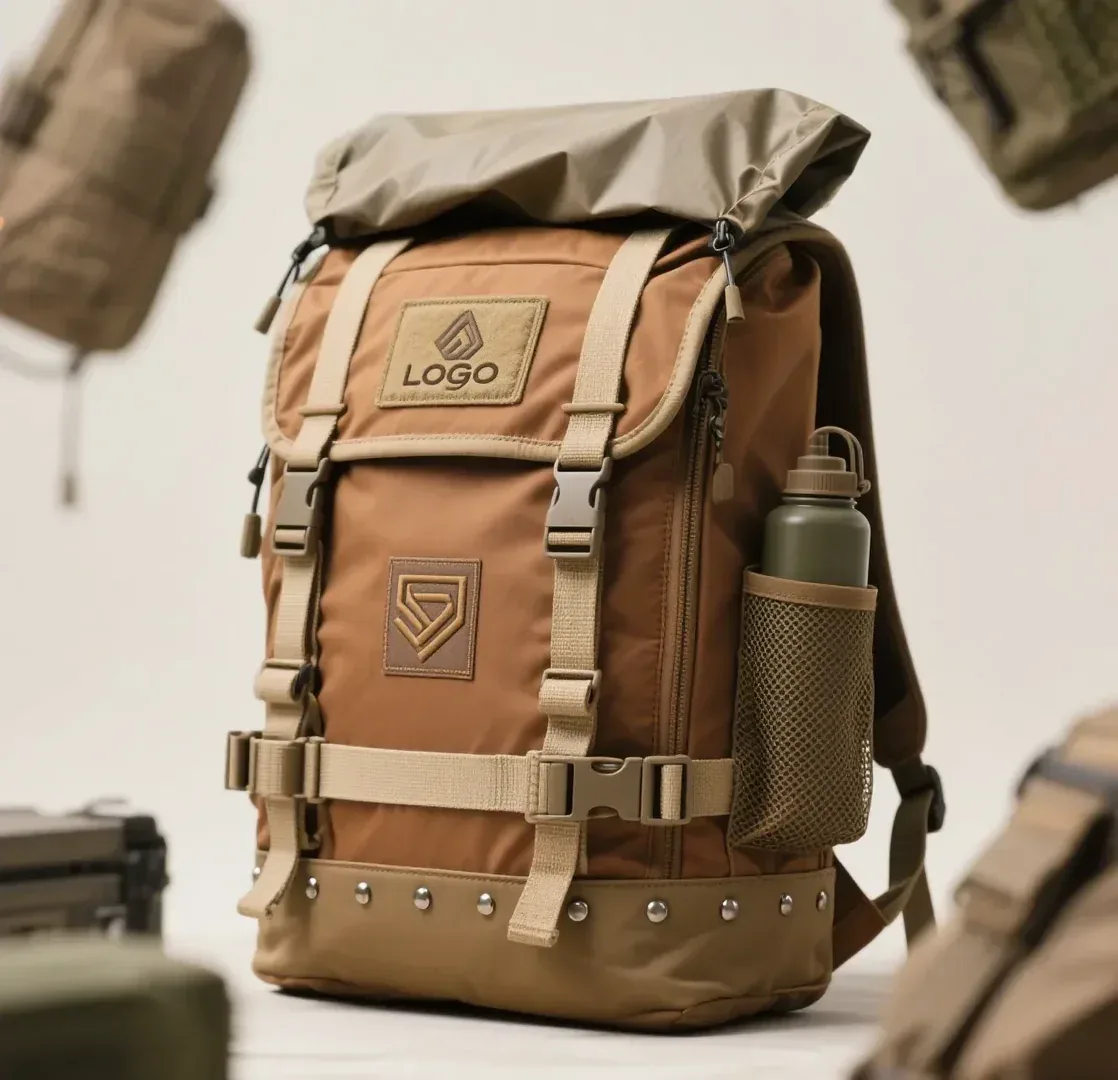
Structure: Interlining, Stiffeners and Feet
Between the outer material and the lining sits the structure: interlinings that give body, stiffeners that hold specific panels, and reinforcement that spreads load. This layer is invisible in the finished bag and entirely responsible for how it behaves. Two bags using identical outer leather can feel and perform very differently purely because of what sits behind it.
- Interlining: gives panels body and prevents collapse; weight selected by intended drape.
- Stiffener: holds specific panels — typically the base and sometimes the back — to a defined shape.
- Reinforcement: spreads concentrated load from handles, straps and hardware into the structure.
- Padding: protects contents, particularly device sleeves; thickness affects internal dimensions.
- Feet: lift the base off surfaces and absorb abrasion; position affected by load distribution.
- Seam allowance and skiving: determine bulk at junctions and the flatness of folded edges.
Specification here should be stated in terms of performance rather than brand names where possible: what the panel should resist, how much it should flex, and what it needs to protect. That gives the production partner room to source sensibly while keeping the outcome defined, which generally produces better results than naming a single proprietary material.
There is a temptation to over-specify structure, and it is worth resisting. A bag stiffened in every panel loses the suppleness that makes leather pleasant to use, and can feel inert rather than luxurious. The better approach is selective: reinforce where load concentrates and where shape must hold, and allow the material to behave naturally everywhere else. That judgement is easier to make on a physical sample than on paper, which is precisely why sampling exists.
Interiors: Linings, Pockets and Organisation
The interior is where the bag is actually used, and it is where specification is most often left vague. A good brief states pocket count, dimensions and closure types; device sleeve dimensions matched to a specific device; key attachments; and the lining material with its own performance requirements. Vague interiors are not cheaper — they are simply decided by someone else.
- Lining material: stated with weight, finish and abrasion expectation, not just colour.
- Pocket inventory: count, dimensions, closure type and position, listed explicitly.
- Device protection: sleeve sized to a named device, with padding thickness specified.
- Key and accessory attachment: type and position, reinforced where load is repeated.
- Internal branding: method, position and size, consistent with external branding.
- Cleanability: relevant for wash bags, amenity pieces and items likely to see spills.
Interiors should also be specified with their end use in mind rather than in the abstract. A corporate briefcase needs organisation that survives daily commuting. A wash bag needs a lining that can be wiped clean and seams that resist moisture. A travel holdall needs access that works in a confined space. Naming the use case in the brief gives the pattern cutter something concrete to design against.
How the Parts Work Together
Anatomy only becomes useful when the parts are understood as a system. Handle substance affects attachment design. Gusset geometry affects what the base has to carry. Closure type affects mouth rigidity, which in turn affects whether an internal stiffener is needed. Changing one element shifts the load path, and the knock-on effect is what determines whether a revision is trivial or expensive.
| Change | Knock-on effect | Review before approving |
|---|---|---|
| Increase handle drop | Greater torque at the attachment | Attachment reinforcement and panel substance |
| Deepen the gusset | Higher volume, higher base load | Base stiffener and feet specification |
| Lighter outer material | Less inherent structure | Interlining weight and reinforcement |
| Add an external pocket | New seam and stress line | Panel substance, waterproofing, edge finish |
| Switch closure type | Changed mouth rigidity | Internal stiffener and opening geometry |
| Reduce panel count | Simpler construction, different drape | Silhouette and shape retention |
The corollary is that the cheapest place to resolve a design problem is on paper, and the most expensive is in bulk. A specification that has been reviewed for constructability — panel by panel, junction by junction — will still encounter surprises, but they will be small ones. That is the whole argument for investing in development rather than rushing to production, and it is why the most experienced buyers in this trade are also the most patient at the briefing stage.
This is why experienced developers resist late changes to a settled specification, not out of conservatism but because they can see the knock-on effects. It is also why the specification sheet matters so much: it makes the interactions visible before they are built, when changing them is still a matter of editing a document.
Specify your bag properly
Share your design intent and intended load. The programme team will help convert it into a dimensioned specification covering panels, gussets, handles, structure and interiors.
Frequently Asked Questions
What are the main parts of a bespoke bag?
The principal components are the front and back panels, the base, the gussets, the handles or straps, the closure, the hardware, the internal structure including interlining and stiffeners, and the lining with its pocket layout.
What does a gusset do in a bag?
The gusset is the strip that creates depth. Its geometry governs usable volume, how far the bag opens, and how it behaves when empty. Full perimeter, base-only and bellows gussets each produce a distinctly different bag.
Why do handles fail more often than other parts?
Handles carry the entire weight of the bag and contents, and the load concentrates where they meet the body. Without internal reinforcement spreading that load into the panel, the stitch line becomes the failure point.
What is handle drop and why does it matter?
Handle drop is the distance from the top edge of the bag to the underside of the handle. It determines whether the bag works as a hand carry, over the elbow, or on the shoulder, and it is a frequent source of samples that feel wrong.
How many panels should a bag have?
As few as the design allows. Each additional panel adds cutting, skiving, stitching and finishing operations plus a further potential failure point, so panel count is largely a cost decision expressed as a design decision.
How do I specify internal structure to a supplier?
State the performance requirement rather than only a brand name: what the panel should resist, how much it should flex, and what it must protect. This keeps the outcome defined while leaving sensible sourcing freedom.
Does leather thickness change how a bag should be constructed?
Yes. Substance affects seam allowance, turning bulk, fold behaviour and hardware setting. A construction that works at one thickness can fail at another, which is why substance belongs in the specification from the start.
What is the difference between a framed and an unframed bag?
A framed bag has a rigid structure at the mouth that holds its shape and adds rigidity. An unframed bag relies on the material and interlining, giving a softer, more relaxed profile and typically lower construction cost.
How do I judge whether a sample will survive repeated use?
Inspect the load points: handle attachments, strap junctions, base corners, zip ends and repeated flex areas. Then apply a simple loaded carry or cycle test and re-inspect. Most structural weaknesses appear quickly under that protocol.
What lining materials are available for bespoke bags?
Common options include suede and microsuede, cotton and canvas, performance microfibre, and branded jacquard. Selection should follow abrasion resistance, weight, cleanability and how the lining colour reads against the outer material.
How much does hardware choice affect unit cost?
Materially. Custom-tooled fittings carry tooling charges and higher unit prices, while catalogue fittings in standard finishes cost far less. The trade-off is exclusivity, since catalogue hardware can be ordered by any competitor.
What should be included in a bag specification sheet?
External dimensions with tolerances, material and substance, hardware schedule with finish codes, gusset and base construction, internal layout and pocket dimensions, branding method and position, packing specification and inspection standard.
How long does it take to develop a new bag pattern?
A first prototype typically takes six to ten working days, extending to twelve to fifteen for complex constructions. Most programmes need two rounds before the specification is settled and bulk is authorised.
What is the minimum order for a bespoke bag programme?
The standard minimum is 500 pieces per style per colourway. A small-batch pilot route is available for brands testing demand, at a higher unit cost because tooling and set-up are spread across fewer pieces.
How is quality verified on a bulk run?
Inspection runs to AQL 2.5 under ISO 2859-1, single sampling, general level II. Buyers should also define a defect classification matrix for their product so cosmetic and functional issues are graded consistently.
Can a bespoke bag be designed for repair?
Yes, and it is worth specifying. Replaceable handles, standard zip sliders, accessible linings and documented component specifications all extend service life and keep repair economical years after purchase.
How does panel layout affect material cost?
Directly. Leather is irregular and sold by area, so panel size, shape and placement determine cutting yield. Two designs using identical material can differ in cost substantially purely because of pattern geometry.
What is skiving and why is it used?
Skiving thins leather at seams, folds and joints. It reduces bulk where panels overlap, allows straps and straps ends to wrap cleanly, and helps folded edges lie flat rather than ridge.
Why is the base of a bag so important structurally?
The base carries the full weight of the contents and absorbs the abrasion of every surface the bag rests on. Without adequate stiffening and feet, distortion and wear appear at the base before anywhere else.
Should a buyer specify tolerance on internal dimensions?
Yes, particularly where a device or garment must fit. External dimensions do not guarantee internal clearance, because seam allowances, interlining and padding all reduce usable space inside the bag.