
Vegan leather is not one material but a family of constructions, and the useful comparison is between specific constructions rather than between animal and non-animal categories. Most commercial vegan leathers are coated composites: a face layer of polyurethane, plant feedstock or recycled fibre bonded to a textile backing, and that backing determines most of the performance. The practical buying conclusion is that a well-specified PU composite will outperform a poorly specified plant-based one, and that the questions worth asking concern abrasion cycles, coating adhesion, hydrolysis resistance and documented chemistry rather than whether a material contains animal content.
What “vegan leather” actually covers
The term describes what a material does not contain, which is why it tells a buyer almost nothing about how the material will behave. Two products sold as vegan leather can share nothing but the absence of hide: one may be a solvent-free polyurethane on a recycled knit, another a mycelium sheet on a polyester scrim with an acrylic topcoat. Their abrasion results, their hydrolysis behaviour in humid climates and their end-of-life options differ substantially. Treating them as one category is the most common error in non-animal material specification.
Each of these carries a different balance of consistency, cost and story. Polyurethane and microfibre constructions win on repeatability, which matters enormously at volume, because a material that varies between rolls produces visible shade and hand differences across a production run. Plant-based and mycelium materials win on narrative and on reducing fossil-derived content, at the cost of greater lot-to-lot variation and, in most cases, a shorter track record under real wear conditions.
The families compared, construction by construction
A comparison table is only useful if it compares the attributes that change a specification decision. Hand feel and marketing story are easy to judge from a swatch; what cannot be judged by touch is how the face layer behaves after several thousand abrasion cycles, how the coating responds to heat and humidity in transit, and whether the material can be re-finished or repaired. The table below sets the families side by side on those decision attributes.
| Family | Face / backing | Abrasion behaviour | Hydrolysis risk | Repairability | Relative cost |
|---|---|---|---|---|---|
| PU on knitted base | PU face, polyester or cotton knit | Good; surface scuffs rather than cracks at moderate cycles | Moderate in hot humid storage | Spot repair possible, full refinish limited | Low to moderate |
| Microfibre non-woven | Resin-impregnated micro fibre structure | Very good; high tear strength, consistent across lots | Low to moderate | Limited; usually panel replacement | Moderate to high |
| Cactus composite | Cactus biomass in binder, textile backing | Moderate; improves with quality of topcoat | Depends on binder system | Limited | High |
| Apple or pineapple composite | Fruit-waste biomass in binder, backing varies | Moderate; variable between suppliers | Depends on binder system | Limited | High |
| Mycelium sheet | Grown biomass with coating on carrier | Variable; early track record, improving | Depends on finish | Very limited | High |
| Recycled fibre sheet | Reclaimed fibre with resin or latex binder | Moderate; lower tensile strength | Low | Very limited | Low to moderate |
| Full-grain leather (reference) | Hide, aniline or semi-aniline | Excellent; wear reads as patina | Low with correct storage | High; refinishable and repairable | Moderate to high |
The reference row matters. Full-grain leather remains the benchmark for repairability, and any non-animal material that cannot be refinished will, all else being equal, have a shorter service life. That does not disqualify vegan options, but it does mean a brand specifying them should invest the savings or the story in a construction that makes panel replacement feasible, because that is the realistic repair route for a coated composite.
Programme parameters at a glance
| Parameter | Commitment |
|---|---|
| Minimum order quantity | 500 pieces per style / colourway |
| Sampling lead time | 6–10 working days (12–15 days for complex constructions) |
| Bulk production lead time | 35–50 days after sample approval |
| Inspection standard | AQL 2.5 (ISO 2859-1), single sampling, general level II |
| Incoterms | FOB Xiamen — EXW, CIF and DDP available on request |
| Payment terms | T/T 30% deposit / 70% before shipment; L/C at sight for container loads |
| Verified production floor space | 4,950 m² (SGS-verified) |
| Team | 137 staff across 7 production lines |
| Equipment | 149 machines including computerised saddle-stitch and edge-painting units |
| Monthly capacity | 200,000 pieces |
| Entity | Founded 2014; principal has worked in bag development since 2004 |
Programme parameters shape which of these families is viable. Non-animal materials are sold by the metre rather than by the hide, which makes cutting yield more predictable, but minimum purchase quantities are frequently set by the mill and can exceed what a first run needs. Our standard MOQ is 500 pieces per style or colourway, and where a brand wants to validate a vegan material before committing, small-batch pilots let the construction be proven on the line first.

Performance testing: what to measure before committing
Swatch approval is the point where most vegan specifications go wrong, because a swatch cannot reveal behaviour under stitch tension, at a folded corner, or after a few weeks in a humid warehouse. The tests below are inexpensive relative to the cost of a failed bulk run, and each one maps to a failure mode that shows up in the field. We run the applicable set during sampling for any alternative-material programme, and record results in the tech pack.
| Test | Standard family | Failure it predicts | When to run |
|---|---|---|---|
| Abrasion resistance | Martindale or Taber methods | Face layer break-through and shine at contact points | At material selection, before tooling |
| Coating adhesion | Peel or cross-cut adhesion methods | Delamination at folds and turned edges | At material selection |
| Hydrolysis / humidity ageing | Accelerated humidity ageing | Flaking and tackiness in hot humid transit or storage | Before first shipment to a humid market |
| Tear and tensile strength | Tensile testing to ASTM methods | Strap failure and handle pull-out under load | At material selection |
| Colour fastness to rubbing | Crocking methods | Dye transfer onto light clothing and linings | At material selection and per colourway |
| Seam strength | Seam slippage and strength methods | Stitch tear-through at load-bearing joins | At prototype stage, on the real construction |
Two of these are routinely skipped and should not be. Humidity ageing predicts the flaking complaints that arrive six months after delivery to a tropical market, and seam strength on the real construction catches the failure mode where a material passes every sheet test but tears along the stitch line because the backing is too weak for the specified stitch density. Both are far cheaper to discover in sampling than in a returned shipment.
Chemistry and compliance: OEKO-TEX, REACH and CPSIA
A material can be entirely free of animal content and still fail chemical compliance. Solvent-based coatings, plasticisers, flame retardants, azo dyes and surface treatments used to improve abrasion all appear on restricted-substance lists, and the vegan label carries no regulatory meaning in either the EU or the US. The documents to request are the same ones requested for any coated material, and they should name the specific product rather than a product family.
- Request an OEKO-TEX certificate matched to the article class and to the specific material reference, not to a supplier's generic range
- Obtain a REACH statement naming the restricted substances tested where goods will be placed on the EU market
- For the US market, confirm CPSIA limits on lead and phthalates and keep the third-party test report on file
- Ask for the safety data sheet for coatings and adhesives used on the material, including edge paint and topcoats
- Confirm whether the binder is solvent-based or water-based, since this drives both VOC load and worker exposure
- Verify the certificate date: material formulations change, and a certificate issued two years ago may not describe current production
One practical caution about solvent-free claims. A material marketed as solvent-free may still use a solvent-based adhesive at the assembly stage, which shifts the exposure rather than removing it. Brands that want the claim to hold through to the finished bag should specify the adhesive system in the tech pack and verify it at the assembly site, which is a straightforward check for any partner operating under ISO 14001.
Where vegan materials work best in a bag
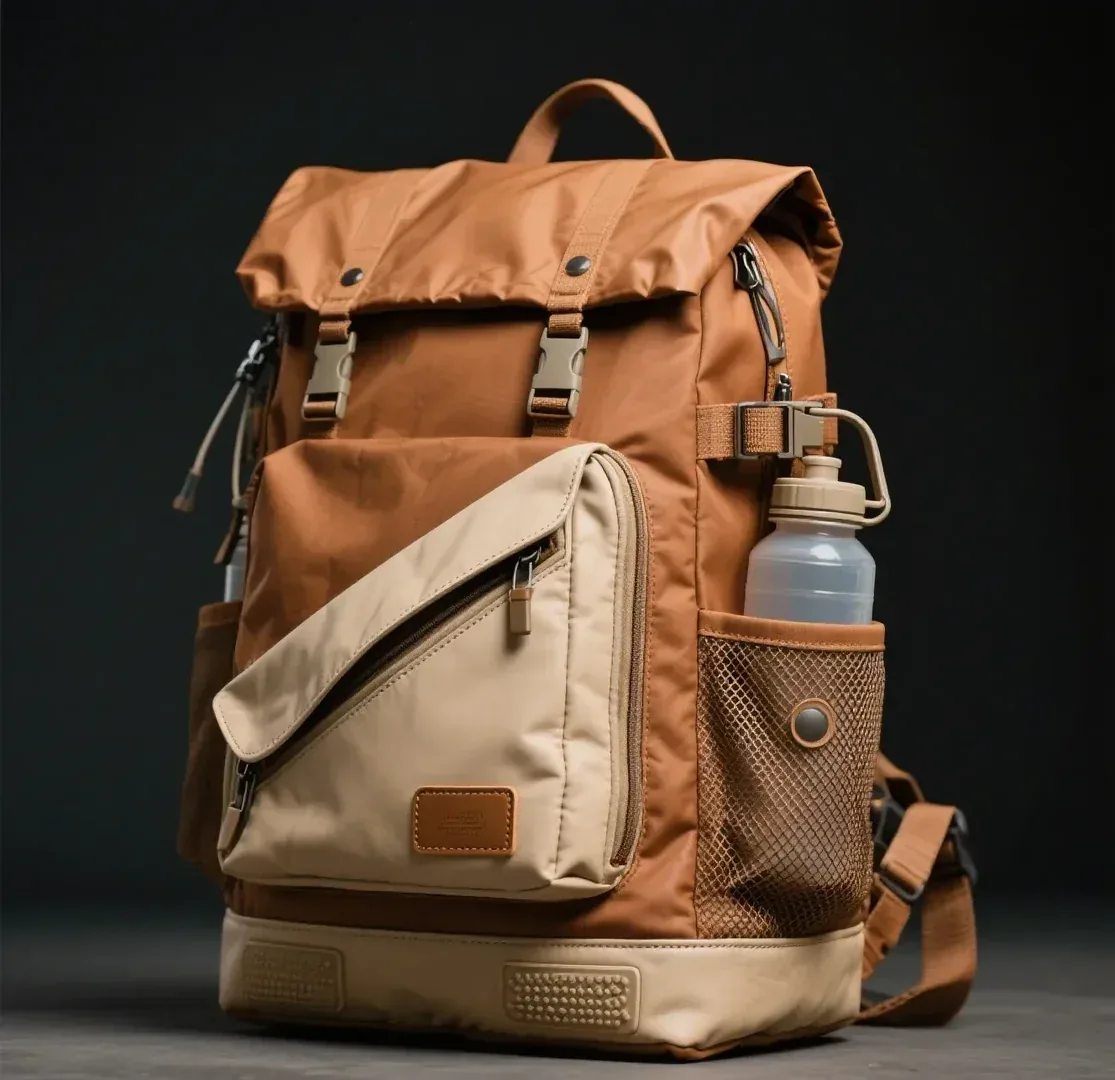
Placement is the most under-used lever available to a designer working with non-animal materials. Using a vegan material across an entire structured bag exposes it to every stress the design contains; using it selectively puts it where it performs well and keeps a stronger material at the load paths. This is not a compromise so much as good engineering, and it is how most durable alternative-material programmes are actually built.
- Body panels on unstructured or semi-structured silhouettes, where the material is not carrying primary load
- Front and gusset panels on totes, with reinforced bases and load-bearing handles in a stronger material
- Linings, where abrasion is lower and consistency of appearance matters more than tensile strength
- Trims, welts and binding, where a consistent coated surface reads well and is not structural
- Small leather goods: card holders, pouches, wash bags and tech sleeves
- Luggage shells with a reinforced frame, where the skin is cosmetic and the frame carries the load
The reverse list matters just as much. Coated composites are poorly suited to thin turned edges, to strap constructions that rely on high stitch density, and to unlined bags where the reverse face is visible and cannot be finished. Where a design depends on those features, the programme team will usually propose either a construction change or a hybrid specification, and that conversation belongs in sampling rather than after bulk approval.
Cost, availability and supply reality
Non-animal materials are priced per metre and quoted by the mill, so the cost structure differs from hide purchasing in ways that affect planning. Mill minimums can be substantial, lead times for plant-based and mycelium materials are longer than for commodity polyurethane, and shade consistency between production lots is a recurring risk that is best managed by over-ordering against a single lot for a full colourway.
| Factor | What typically happens | How to plan around it |
|---|---|---|
| Mill minimum order | Set by the mill per colour, often above first-run needs | Consolidate colourways, or run a pilot through small-batch |
| Lot-to-lot shade variation | Visible across a production run if lots are mixed | Buy the full colourway requirement against one lot |
| Lead time for novel materials | Longer than commodity PU, sometimes several weeks more | Order material before sample approval, not after |
| Testing cost | Fixed per material per test cycle | Test at family level, repeat only on formulation change |
| Price movement with volume | Limited for novel materials, better for established PU | Do not model aggressive cost-down on novel inputs |
| Storage and shelf life | Coated materials have finite shelf life | Rotate stock and avoid holding material across seasons |
Trade estimates suggest plant-based material prices continue to ease as capacity comes online, but the trajectory is uneven and dependent on individual suppliers, so brands should model flat pricing rather than assume cost-down. The more reliable saving comes from yield: material sold by the metre produces less unusable waste than hide, and on simple panel layouts that difference can offset part of the per-metre premium.
Storage deserves a brief note as well. Coated materials have a finite shelf life, and stock held across seasons can degrade before it is ever cut, particularly in a humid warehouse. We rotate material stock by delivery date on our production floor in Quanzhou and flag any material approaching the end of its stated shelf life before it enters a cutting plan, which is a low-cost control that prevents a category of defect that is very difficult to diagnose after assembly.

How to specify a vegan material programme
The specification that works names the construction, not the category. “Vegan leather” invites a substitution; “polyurethane face on recycled knit backing, minimum 30,000 abrasion cycles, hydrolysis-tested, OEKO-TEX certified at article class II, water-based adhesive at assembly” does not. Once the specification is written at that level, a development partner can source against it, test against it and hold the bulk material to it.
- Name the material family and, where possible, the approved commercial reference
- Set minimum performance thresholds: abrasion cycles, tear strength, coating adhesion, colour fastness
- State the compliance documents required, and the market they apply to: REACH for the EU, CPSIA for the US
- Specify the adhesive and edge-finish system, since these are part of the finished article's chemistry
- Decide placement: which panels use the alternative material and which carry load
- Define the repair route, normally panel replacement, and whether the brand will offer it
- Record the approved material lot at sample approval so bulk cannot silently substitute
Sampling runs 6–10 working days for standard constructions and 12–15 for complex ones, and alternative materials benefit from the longer window because seam trials and edge-finish trials need to be run on the actual material. Bulk production is 35–50 days after sample approval, with inspection at AQL 2.5 under ISO 2859-1. Where a brand is comparing two candidate materials, we develop both constructions in parallel so the decision rests on tested results rather than on swatch impressions.
Test a vegan material before you commit to it
Send us the material families you are considering and the market you sell into. We develop both constructions in parallel, run the applicable performance tests and document the compliance file before bulk. Contact the programme team at service@junyuanbags.com or WhatsApp +86 177 5002 0688.
Frequently Asked Questions
What is vegan leather made of?
Most commercial vegan leather is a coated composite: a face layer of polyurethane or plant biomass applied to a woven or non-woven textile backing. The backing and binder determine most of the performance. A small number of products are grown sheets, such as mycelium, which are still finished with a coating and carried on a textile substrate.
Is vegan leather more sustainable than real leather?
It depends entirely on which two products are being compared and over what service life. A vegan composite that delaminates after three years will generally carry a higher annual footprint than a full-grain hide that lasts fifteen. The comparison favours vegan materials when durability, coating chemistry and end-of-life options are genuinely comparable.
How long does a vegan leather bag last?
Service life varies with construction quality and with climate. Well-specified polyurethane and microfibre materials routinely give several years of regular use, while some plant-based composites show earlier surface wear in humid conditions. Hydrolysis and humidity ageing tests during sampling give the most reliable indication for a specific market.
Why does vegan leather peel or flake?
Flaking usually indicates failure at the interface between the coating and its backing, often accelerated by heat and humidity during storage or transit. It is a construction issue rather than an inherent property of non-animal materials. Specifying a hydrolysis-tested material and controlling warehouse conditions prevents most instances.
Does vegan leather pass REACH compliance in the EU?
There is no automatic answer, since the vegan label carries no regulatory meaning. Compliance depends on the coating, binder and dye chemistry, and is demonstrated through a REACH statement plus test evidence for the specific material. Brands should request both and check that the certificate matches the commercial reference being purchased.
What is OEKO-TEX certification for vegan bag materials?
OEKO-TEX screens materials and articles against a list of harmful substances and issues a certificate by article class. For a bag material, the certificate should match the specific product reference and the correct article class, since higher skin-contact classes carry stricter limits. Always check the issue date as formulations change.
Can a vegan leather bag be repaired?
Rarely in the way leather can. Coated composites cannot be refinished or re-dyed, so the realistic repair route is panel replacement or component replacement. Designing for that from the outset, with removable linings and standard hardware, is what makes a repair programme feasible for non-animal materials.
Is PVC leather still used in bags?
It is largely avoided in premium work because of plasticiser and chlorine concerns and because it performs poorly against modern restricted-substance lists. Polyurethane and microfibre constructions have largely displaced it. If a supplier offers a very low-cost PVC option for the EU or US market, treat the compliance file with particular care.
Which vegan material performs best for a structured bag?
Microfibre non-woven constructions generally perform best for structured work, offering consistent lots, high tear strength and good abrasion results. Polyurethane on a knitted base is the value alternative. Plant-based composites suit panels and lower-stress areas rather than a load-bearing shell.
Should a brand use vegan material across the whole bag?
Usually not, and placement is a design lever rather than a compromise. Using a strong material at handle attachment, base and strap load paths while using the alternative material on panels gives a longer service life. Hybrid specifications are common in durable alternative-material programmes.
How much more do vegan materials cost?
Established polyurethane is comparable to mid-grade hide on a per-unit basis, while plant-based and mycelium materials carry a clear premium and limited cost-down with volume. Testing is a fixed cost per material per cycle. Better nesting yield from metre-based material offsets part of the premium on simple panel layouts.
Do vegan materials change the minimum order quantity?
They can, because mill minimums are set per colour by the material supplier rather than by the assembly partner. Our standard MOQ is 500 pieces per style or colourway, and trimming the number of shades in a first drop is the simplest way to clear a mill minimum. Small-batch pilots are available to validate a material first.
How should a brand test a vegan material before bulk?
Run abrasion, coating adhesion, hydrolysis ageing, tear strength, colour fastness and seam strength on the real construction. Swatch-level results miss stitch tear-through and fold delamination, which are the two failure modes most often reported after delivery. All six are inexpensive relative to a failed bulk run.
Can vegan leather be recycled at end of life?
Rarely in practice, because the bonded face and backing layers are difficult to separate. Mechanical recycling produces a low-grade filler rather than a usable sheet. This is why design for disassembly and a repair or resale pathway currently deliver more environmental benefit than relying on recycling for coated composites.
Does CPSIA apply to vegan leather bags in the US?
Yes. CPSIA limits apply to consumer products placed on the US market, including lead and certain phthalates, and they apply regardless of whether a material contains animal content. Brands should hold a third-party test report for the finished article and keep it available for retail partners and enforcement requests.
How do I avoid greenwashing when marketing a vegan bag?
Make only claims you can document, and state the boundary of each claim. Saying a bag uses a plant-based face is accurate; implying the whole product is biodegradable usually is not. Name the certification, avoid vague terms such as eco-friendly, and be prepared to publish the service-life and repair information too.