
Leather takes colour by two mechanisms: transparent dye absorbed into the fibre, or opaque pigment held in a binder on the surface. Aniline dyeing gives depth and patina with wide variation between hides; semi-aniline adds a light pigment for uniformity; full pigment coating gives near-total consistency and the widest colour range at the cost of natural character. For a bespoke programme the decision is between character and repeatability, and it should be made before the colour is chosen rather than after the first production lot arrives mismatched.
How Colour Enters Leather
Dyeing happens in the drum after tanning, where soluble dyestuffs penetrate the full substance of the hide. Because the dye is transparent, what the eye finally sees is colour plus the grain structure underneath, which is why aniline leather looks deep rather than painted. Pigment finishes work differently: insoluble colour particles are suspended in a resin binder and applied to the surface in thin coats, building opacity layer by layer.
- Drum dyeing: colour penetrates throughout the substance, so a scratch reveals the same colour beneath.
- Spray or roller finishing: pigment sits on the surface, so damage reveals a different layer underneath.
- Fatliquor interaction: the oils used to soften the hide shift the final shade slightly and are part of the recipe.
- Finish sheen: gloss, satin or matte topcoats change perceived colour without changing the dye at all.
- Curing: heat and time after application move the shade, which is why a wet sample rarely matches a dry one.
That last point causes more approved-sample disputes than any other. A colour read on a freshly finished swatch will shift as the finish cures and as residual moisture leaves the hide. Our practice is to approve colour on a fully cured sample, held under standardised lighting, and to record the tolerance in both directions rather than accepting a single target.
Penetration depth is the other variable worth understanding, because it governs what a scratch looks like. Drum-dyed leather is coloured through most of its substance, so a scuff reveals a similar shade and can often be rubbed away. Surface-pigmented leather is coloured only at the top, so the same scuff reveals a paler layer beneath and reads as damage. Two bags of identical colour can therefore behave completely differently in service, and that difference is invisible at approval.
The Three Dye Families
Most commercial leather falls into one of three families defined by how much pigment sits on the surface. The differences are consequential: they determine uniformity, hand feel, patina potential, and whether a reorder will match the original.
| Family | Pigment level | Uniformity | Patina | Best for |
|---|---|---|---|---|
| Aniline | None or negligible | Low; varies by hide | Strong and rapid | Heritage pieces sold on character |
| Semi-aniline | Light pigment plus dye | Moderate to good | Moderate | Premium bags needing some consistency |
| Pigmented | Heavy pigment coating | Excellent | None | Programmes needing precise repeats |
| Pull-up or waxy | Dye plus heavy oil and wax | Low by design | Very strong; lightens when flexed | Casual and heritage designs |
| Metallic or pearlised | Pigment with effect particles | Good | None | Occasion and fashion-forward pieces |
Pull-up deserves particular mention because it confuses buyers. The leather contains so much oil and wax that flexing it displaces the finish and lightens the colour temporarily, producing the characteristic two-tone effect at folds and corners. Some customers read those lightened areas as damage. They are the intended behaviour of the material, and the product copy should say so.
Programme parameters at a glance
| Parameter | Commitment |
|---|---|
| Minimum order quantity | 500 pieces per style / colourway |
| Sampling lead time | 6–10 working days (12–15 days for complex constructions) |
| Bulk production lead time | 35–50 days after sample approval |
| Inspection standard | AQL 2.5 (ISO 2859-1), single sampling, general level II |
| Incoterms | FOB Xiamen — EXW, CIF and DDP available on request |
| Payment terms | T/T 30% deposit / 70% before shipment; L/C at sight for container loads |
| Verified production floor space | 4,950 m² (SGS-verified) |
| Team | 137 staff across 7 production lines |
| Equipment | 149 machines including computerised saddle-stitch and edge-painting units |
| Monthly capacity | 200,000 pieces |
| Entity | Founded 2014; principal has worked in bag development since 2004 |
Special Effects and Decorative Colour
Beyond the three families sits a long list of applied effects, each of which changes cost, lead time and repeatability. They are best used deliberately, on a component or a limited run, rather than as the default for a whole programme, because most of them introduce variation that is difficult to control at volume.
| Effect | Method | Repeatability | Cost impact |
|---|---|---|---|
| Hand antiquing | Darker pigment worked into recesses by hand | Low; each piece differs | High labour minutes |
| Ombré or gradient | Controlled spray fade across a panel | Moderate with a mask | Moderate to high |
| Dip-dyed | Panel or whole bag immersed in dye | Low; depth varies with dwell time | Moderate |
| Two-tone panel | Contrasting panels or binding | High | Low to moderate |
| Foil or metallic transfer | Heat-applied metallic film | High | Moderate |
| Printed pattern | Digital or screen print onto finished leather | High | Moderate, with setup costs |
Hand effects in particular should be sampled twice. Because the variation is the selling point, a single approved sample tells you almost nothing about the range the production run will span. Two or three samples establish the band, and the specification should then state that band as accept and reject limits rather than referring back to one piece. Where the effect is applied by named individuals rather than by a documented method, that dependency should also be recorded, because it becomes a capacity constraint as the programme grows.
Colour Matching and Tolerance
Every colour conversation eventually reaches the same question: can you match this? The honest answer depends on what this is. A Pantone reference is a printed ink standard on paper; leather is a dyed, textured, semi-translucent substrate. A close match is usually achievable, an exact one is not, and the gap between the two should be agreed in writing before production.
| Reference type | Reliability | Recommended use |
|---|---|---|
| Physical leather swatch | Highest; same substrate and texture | Always preferred as the primary reference |
| Pantone or RAL code | Moderate; printed on paper | Useful as a starting point, not as the acceptance standard |
| Fabric or textile swatch | Low; different reflectance | Acceptable only with a tolerance agreed in advance |
| Screen or photograph | Very low; device dependent | Never used as an acceptance standard |
| Previous season sample | Good, if retained properly | Reliable provided it has been stored away from light |
Lighting is the other half of the problem, and it is where metameric failures come from. Two samples can match under one light source and differ under another, because the dye formulations reflect light differently across the spectrum. Viewing under at least two standardised sources, typically a daylight simulator and a retail warm-white source, catches most of these before they reach a shop floor.
Fastness: What Testing Actually Covers
Colour that looks right and stays right are different propositions. Fastness testing measures how a finish resists the four things that actually damage it: rubbing, light, perspiration and water. Published ISO and ASTM methods exist for each, and a specification that names the required rating is enforceable in a way that a subjective assessment never is.
| Test | Scale | Practical target for a bag | Typical failure |
|---|---|---|---|
| Rubbing fastness, dry | 1–5 grey scale | 4 or better | Colour transfer onto clothing |
| Rubbing fastness, wet | 1–5 grey scale | 3–4 or better | Marks from damp hands or rain |
| Light fastness | 1–8 blue wool scale | 4 or better | Fading on a display shelf |
| Perspiration fastness | 1–5 grey scale | 4 or better | Discolouration at handles |
| Finish adhesion | Pass or fail after flexing | Pass at the specified cycles | Cracking at folds |
Pale and saturated colourways deserve extra scrutiny, because both sit at the edge of what dyes do reliably. Very pale shades show handling and denim transfer most readily, while highly saturated reds, bright blues and vivid greens are the most prone to light fading and to rub transfer. Testing them costs very little relative to the cost of a returned production run, and the results should be recorded on the specification so that a future season is not surprised by the same failure twice.
Colour in Construction: Edges, Thread and Lining
A shell colour is only one element of the colour story. Edge paint, stitching thread, lining, hardware finish and zip tape all sit against it, and each is specified separately with its own tolerance. Mismatches between them are the most visible quality signal in a finished bag, because the eye reads an inconsistent edge line as a fault regardless of how good the panel is.
- Edge paint: matched to the shell or deliberately contrasted; a slight shade difference is more visible than a large one.
- Thread: tonal thread hides stitching irregularities; contrast thread makes every deviation visible and demands tighter work.
- Lining: coordinate in tone depth rather than in hue, since linings and shells rarely match exactly across materials.
- Zip tape: a standard component with a limited colour range; choose it early so the shell can be matched to it.
- Hardware: warm metals flatter warm leathers, cool metals flatter cool ones; mixing registers across a collection looks accidental.
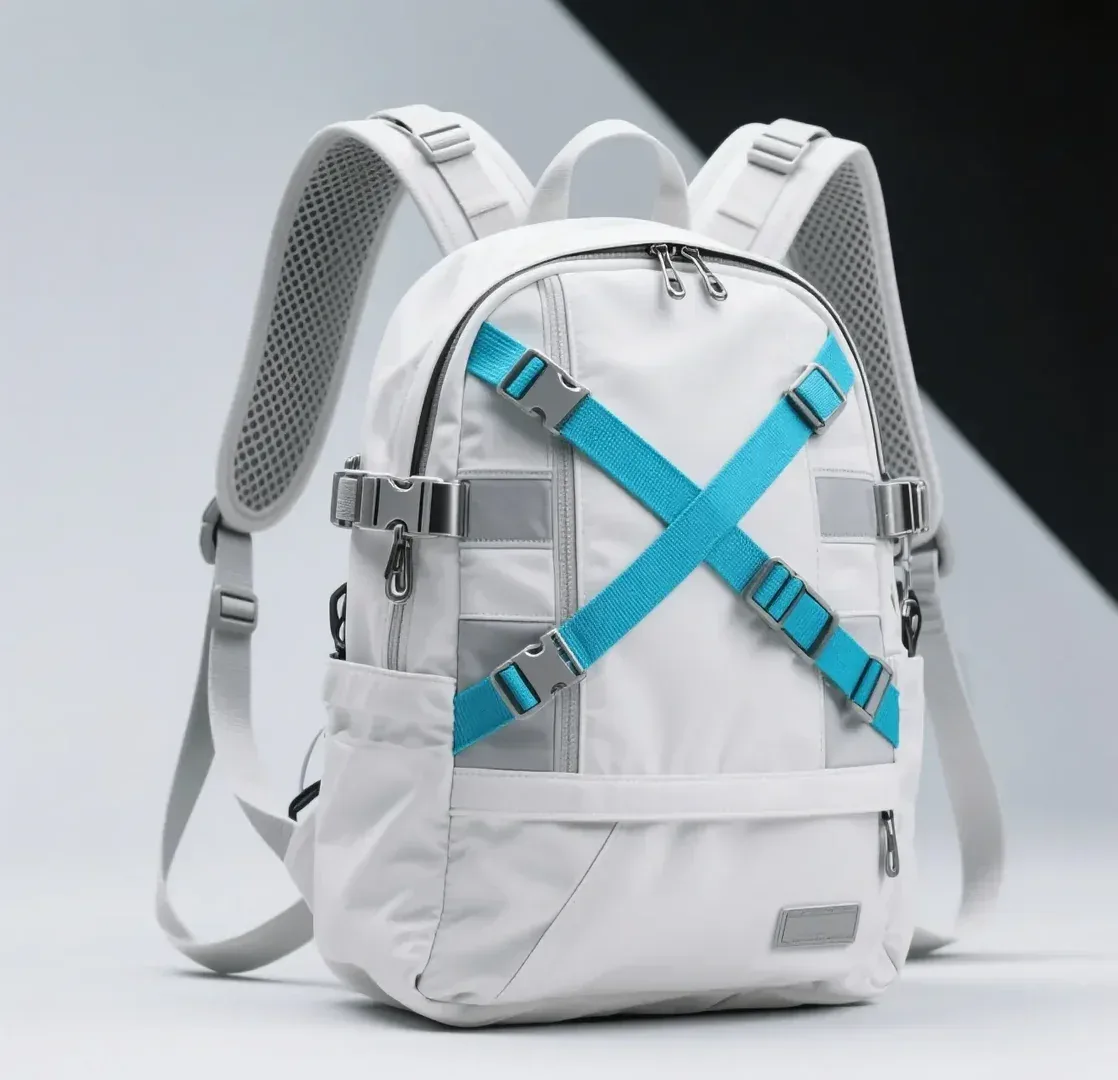
Sequencing is practical rather than aesthetic. Zip tape and hardware finishes come from supplier ranges with a finite number of options, while leather can be dyed to a very wide range. It is therefore far easier to match the leather to an available zip tape than to source a zip in the exact shade of an already approved hide. Deciding the hardware and tape colours first removes an entire category of compromise from the development process.
Custom Colour at Volume
A bespoke colourway is a development project with a minimum quantity attached. Tanneries mix dye recipes in batches, and a batch has a minimum size, so a custom shade usually requires a commitment well above a single bag. The standard programme minimum of 500 pieces per style and colourway generally covers the development comfortably; smaller pilots are possible but carry a surcharge that reflects the fixed cost of the dye lot.
| Approach | Quantity implication | Lead time implication |
|---|---|---|
| Stock tannery colourway | No minimum beyond the style MOQ | Fastest; material is held |
| Custom match to a swatch | Usually requires a full dye lot | Adds development days before sampling |
| Custom hand effect | Any quantity, but labour-intensive | Adds production time per piece |
| Printed or digital colour | Setup cost independent of volume | Moderate; setup once, then fast |
| Small-batch pilot | Below standard MOQ with a surcharge | Standard sampling window |
Repeatability is the hidden risk in custom colour. A dye lot mixed today will not be reproduced exactly next year, even by the same tannery with the same recipe, because hide uptake varies with season and with the raw material supply. Retaining a reference swatch and allowing a documented tolerance for reorders is the only workable answer.
Brands running multiple colourways in one collection should also consider how many distinct dye lots they are asking the tannery to manage. Each colourway is a separate recipe, a separate approval and a separate inventory risk, and three colourways of a single style consume considerably more development attention than three styles in one colourway. Launch collections are usually stronger when the colour story is disciplined and the style range carries the variety.
Specifying Colour in a Programme
Our production partners in Quanzhou work from a written colour specification supported by a signed retained swatch, and the programme team will confirm the dye family, the fastness targets and the tolerance before a colourway enters sampling. The fields below are the ones that make the difference between a controlled programme and a contested one.
One operational detail closes the loop. Retained swatches fade, and a swatch that has sat in a sunny office for two seasons is no longer a valid reference. Store references in the dark, in a sealed envelope, and refresh them from each approved production lot so the reference chain stays intact across the life of the programme.
Colour decisions made carefully at specification stage are the cheapest quality insurance available to a bag programme, and they cost nothing but attention. Our team develops the colourway with the brand, documents the tolerance and holds the reference; coordinated examples across categories appear in the custom collections catalogue.
Develop a colourway that repeats
Send the target shade, the reference you are matching and the intended market. The programme team will recommend a dye family, run fastness testing and build a sample with coordinated edge, thread and lining within 6–10 working days.
Frequently Asked Questions
What are the main ways leather is coloured?
Leather is coloured either by transparent dye absorbed into the fibre in a drum, or by opaque pigment held in a resin binder on the surface. Aniline dyeing gives depth and patina with variation between hides; pigment finishes give uniformity and a wider colour range but no patina. Semi-aniline sits between the two.
Can leather be matched to a Pantone colour?
A close match is usually achievable, an exact one is not, because Pantone references are printed ink on paper while leather is a dyed, textured and semi-translucent substrate. The reliable method is to use the Pantone code as a direction and then approve a physical leather swatch as the acceptance standard, with a stated tolerance.
What is the difference between aniline and semi-aniline leather?
Aniline leather is dyed with transparent dye and carries no pigment, so natural markings stay visible and patina develops strongly. Semi-aniline adds a light pigment layer that evens out colour and gives some stain resistance while retaining much of the natural character. Pigmented leather carries a heavier coating and shows no patina at all.
Why do two leather samples match under one light but not another?
This is metamerism: two dye formulations can reflect light identically under one source and differently under another, because their reflectance curves differ across the spectrum. Approving colour under at least two standardised sources, typically a daylight simulator and a warm retail white, catches most of these failures before production.
How much colour variation is normal between leather bags?
On aniline and pull-up leathers, visible variation between panels and between pieces is normal and expected; on pigmented finishes it should be minimal. The specification should state the acceptable band rather than imply a single target. For hand-antiqued or ombré effects, variation is the product, and several samples are needed to define the range.
What is rubbing fastness and why does it matter?
Rubbing fastness measures how much colour transfers from the leather onto a cloth under controlled abrasion, rated on a grey scale from one to five. A bag scoring poorly transfers colour onto light clothing, which is one of the most damaging complaints a brand can receive. A rating of four or better is a reasonable target for dry rubbing.
Which leather colours are hardest to produce?
Very pale shades and highly saturated colours are both difficult. Pales show handling marks and denim transfer most readily, while vivid reds, bright blues and intense greens are most prone to light fading and rub transfer. Both should be fastness tested before a programme commits, and both benefit from a pigmented rather than an aniline finish.
How many pieces are needed for a custom colour?
A custom colourway requires a dye lot, and a dye lot has a minimum size. The standard programme minimum of 500 pieces per style and colourway generally covers development comfortably. Small-batch pilots below that figure are possible, but they carry a surcharge reflecting the fixed cost of mixing and running a small lot.
Will a colour match exactly on a reorder?
Not exactly. Hide uptake varies with season and raw material supply, so the same recipe will not reproduce an identical shade a year later. The workable approach is to retain a signed reference swatch from the approved lot and agree a documented tolerance for reorders, rather than expecting an exact repeat.
What is pull-up leather?
Pull-up leather is dyed and then heavily stuffed with oils and waxes, so flexing the material displaces the finish and temporarily lightens the colour at folds and corners. That two-tone behaviour is intended and is the reason the material is chosen. Customers sometimes read it as damage, so product copy should explain it.
Should edge paint match the leather exactly?
A close match is usually better than an exact one. A slight mismatch reads as a deliberate contrast, while a near-miss reads as an error. Many houses deliberately contrast the edge as a design signature. Either way the edge colour should be specified alongside the shell rather than chosen after production begins.
Does leather colour change over time?
It depends on the dye family. Aniline and vegetable-tanned leathers darken and deepen with light, handling and absorbed oils. Pigmented leathers hold their colour closely and instead fail by coating wear. Semi-aniline sits between. Stating the expected direction in the specification prevents customers reading intended patina as a fault.
How should thread colour be chosen?
Tonal thread, close to the shell shade, conceals minor stitching irregularities and suits production at volume. Contrast thread makes every deviation in stitch line visible and demands tighter workmanship, which raises cost. Where contrast stitching is a design signature, the stitch tolerance should be tightened on the specification to match.
What causes leather colour to fade?
Ultraviolet exposure is the principal cause, which is why bags displayed in direct sunlight fade fastest, usually on the panel facing the light. Heat accelerates the process, and certain saturated dyes are more susceptible than earth tones. Light fastness testing on a blue wool scale predicts the behaviour before a programme commits to a colourway.
Can a colour effect be applied by hand?
Yes. Antiquing, hand-rubbed patinas and brush-applied highlights are all done by hand and produce genuine variation between pieces. That variation is the appeal and also the risk: approve two or three samples to establish the acceptable band, and record the limits, because a single sample cannot define a range.
How should colour references be stored?
Retained swatches fade, so a reference left on a sunny desk for two seasons is no longer valid. Store signed swatches in the dark inside a sealed envelope, and refresh the reference from each approved production lot. That keeps the reference chain intact and makes reorders and disputes far easier to resolve.
What is the cost impact of a custom colourway?
Development is the main cost, not the dye itself. Recipe formulation, lab dips, approval swatches and a minimum dye lot all carry fixed expense, which is why small runs attract a surcharge. Once a colourway is established and recorded, subsequent seasons usually run at little or no premium over a stock colour.
Can a bag use two different leather colours?
Yes, and two-tone construction is an efficient way to add visual interest without a custom dye lot. Contrasting panels, bindings, handles or welts use stock colourways together, keeping minimums and lead times unchanged. The caution is dye consistency: two colours from different lots may age at different rates, which should be checked on a sample.